Showing posts with label .Burma/Myanmar. Show all posts

Wednesday, 11 September 2019

Martial Art of the Month: Lethwei

Lethwei, aka Burmese boxing, or Burmese bare-knuckle boxing, popped up on my radar while watching some Asian MMA fights. Seems this particular promotion is breaking the Myanmar market, and so is hyping its Burmese fighters - many of whom have Lethwei in their arsenal. I had not heard of the art before. And it's brutal!

From what I can make out, Lethwei shares many aspects with neighbouring striking arts such as Muay Thai and Khmer boxing. The big differences are, however:
  1. Rather than being a foul, head-butting is an integral part of the art
  2. No gloves or mitts are worn - only gauze wraps. (This should also make for some pretty lethal/painful strikes) 
  3. In local and traditional bouts, at least, there are no points, only knockouts. And you could knock your opponent out more than once before the game is ended.
Lethwei is an old art. I can't find dates which agree online, but it seems there are carvings depicting it in Burma's ancient Pyu cities. (Which apparently date from 200 BC to around 1100 AD - which is fairly broad!) But perhaps uniquely, when fights were held for entertainment, it seems that anyone from a king to a farmer could get into the sandpit-ring and call for an opponent.

How it works: While muay thai is known as an art of eight limbs (strikes using punches, kicks, elbows, knees) the use of the head makes Lethwei nine limbed. Just as there are multiple techniques to learn for say kicking, or elbows, there are also multiple kinds of head-butt in Lethwei, which can be used in different ways. More clinching is allowed in Lethwei, as well as some familiar throws and sweeps.

Traditionally - and in modern local matches - the only way to win is to knock out or  incapacitate your opponent. If both fighters are standing, the bout is declared a draw. Even more unusually, if one participant is knocked out, his or her corner has two minutes to revive their fighter, and send them BACK to continue in the ring! This is not an art for the faint-hearted. 

A bout will usually consist of five, three-minute rounds. With a two minutes between each round. This is double the usual rest-time for sports like Western boxing or MMA - and perhaps it's needed?? In the modern day, groin and gum shields are compulsory.

Lethwei has also enjoyed some popularity worldwide. In the mid-20th century, a process of modernising the rules was undertaken, with the aim of making the sport more transferable overseas. In international fights, a points-system is used, rather than only KO or incapacitation options. The art has had some success in Japan. And this year the World Lethwei Championships were even screened to a global audience via UFC Fight Pass. 

Here's a vid showing a basic head-butt training technique. The reel features Lethwei star Phoe Thaw, and well-known international Lethwei fighter, Dave Leduc. The 'arm slapping' action at the beginning and end is called lekkha moun. It is the way of challenging a Lethwei opponent to fight. 


And some clips from contemporary Lethwei training + bouts in Myanmar. I watch a lot of fights, but these do seem pretty brutal even to me! Balls of steel required for this art, and I guess is shows a little how lethal traditional martial arts would have been in the field centuries ago - a matter of life and death after all. (You have been warned.) 


Also on this blog:
Martial Art of the Month: Cambodia - Pradal Serey (Khmer Boxing)
Burmese Nosh: First Contact 


Thursday, 22 June 2017

Burmese Nosh: First Contact

OK, actually, first contacts.

But anyway.

I met a couple of young Burmese people (and yes they call it Burma, not Myanmar) socially recently, who inspired me to try Burmese food. I've yet to visit Burma/Myanmar, which only recently opened up to tourism and commerce. And the cuisine was not even on my radar previously. But turns out there are a couple of decent Burmese food outlets in Singapore, so I gave it a go.

Twice. It's GOOD!

This experience of Burmese food offered unique, fairly fragrant flavours and tasty balances of mild spice, sour, nutty etc. The cooking doesn't use coconut like nearby countries do, and it is not frighteningly chilli-full either. (OK, this restaurant would be catering to a local Singaporean audience, but most SE Asians are unafraid of chilli!) So my guess is that overall Burmese cuisine is milder than others, such as Indian or Thai, from which it apparently draws historical influence (alongside Chinese). My personal view is that Burmese cuisine is not unlike Peranakan (Straits Chinese) food in terms of delicate flavours and combos. But obviously, I've only had a limited experience of it so far. And as one Burmese friend said, this restaurant was only about 60% as good as the real deal back home. 

Either way, here is a selection of the dishes I tried :)

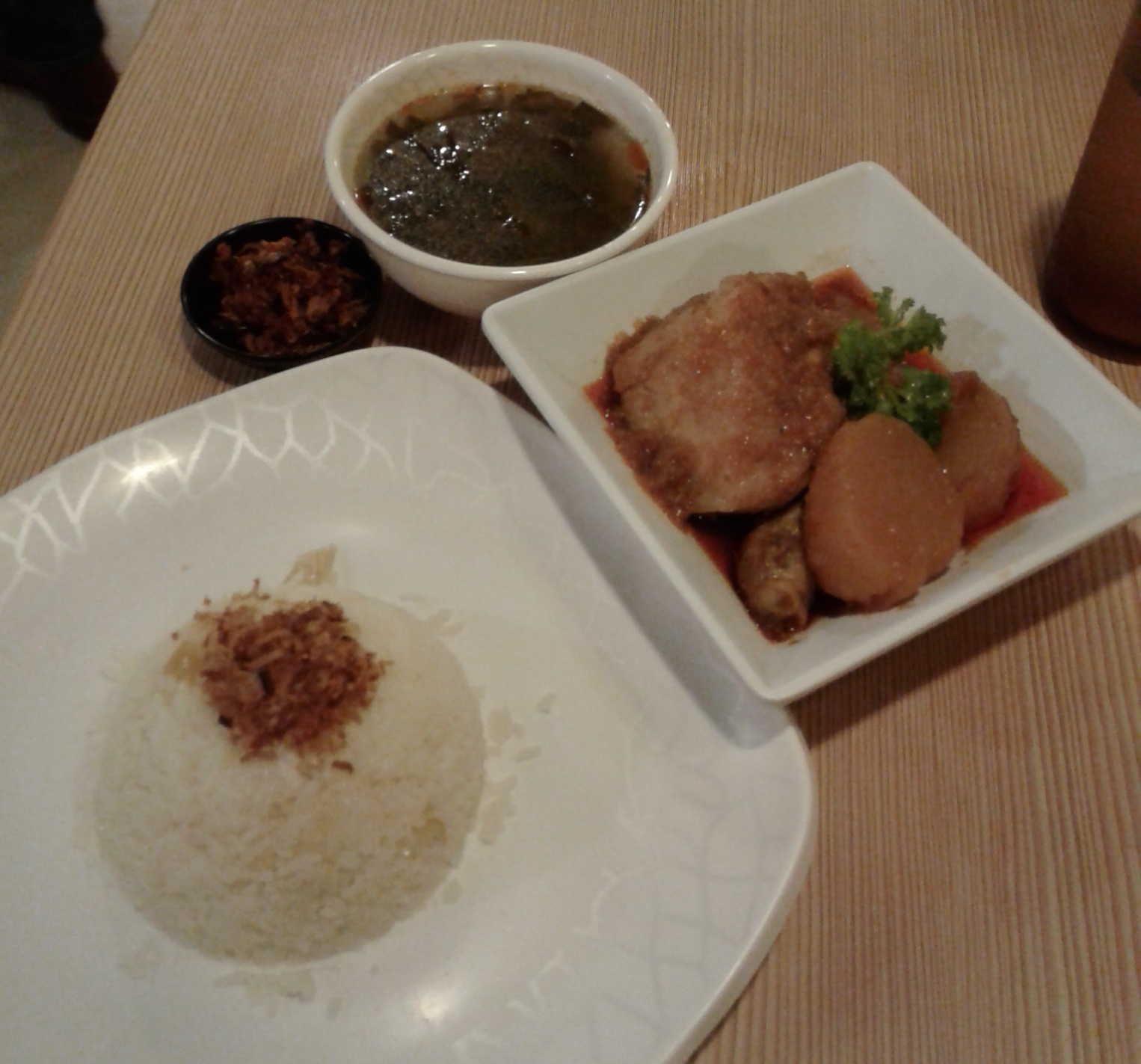
Black Bean Pork
Tender pork stewed with black bean sauce. I don't know what's in the recipe (apart from, one would guess, black beans!) but the gravy was rich, nutty, black-beanish with a touch of 'sour' to it ...I might even say 'lemonish' but apparently there's no citrus in there. It came with rice and a watery sour/spicy soup. 


Tea Leaf Salad
This is more a 'mix', not a Western-style leafy salad. Ours was served pre-mixing, so that we could try the components individually. But it was good as a mixture too. The ingredients included: stewed tea leaves, dried shrimp, garlic cloves (require peeling!), a potpourri of various (roasted?) nuts, raw tomato and green chillis. A tasty, crunchy combo, though I avoided the chillis!


Chicken Curry with Butter Rice
Tender chicken in a sort of fragrant, flavoursome curry sauce. It was not a creamy, heavy curry, but quite a light one, with mild chilli spice, and includes potatoes - yum. And maybe that slight hint of (not) citrus again?? (Is it tamarind?) Rice was indeed buttery, and the meal came with a sour/chilli side soup with greens again, which was quite a good flavour complement. 


Shwe Yin Aye (a rampant rainbow-coloured cendol dessert!)
Cendol (chendol) is actually a green noodley thing used in a lot of SE Asian desserts (a fave of mine being the Malay pudding called... erm, Cendol!) The Burmese version is a different recipe, and offers a selection of cendol, jellies, coconut jelly, sticky rice, sago, white bread, beans and nuts, all in a creamy coconut soup. It wasn't bad, not too sweet, the rice and sago were particularly nice. The bread was a bit strange to me, but perfectly edible in the mix!  


Where?
We went to: Inle Restaurant in Peninsula Plaza, Singapore. http://www.inlemyanmar.com.sg/

If you're feeling braver re 'guessing the menu' the next door, more casual, YaNant Thit was also recommended for curry. (I think some of the menu is in Burmese, hence the 'guessing' aspect!) https://foursquare.com/v/yanant-thit-burmese-food/4bf510176a31d13ae667962e

Happy eating!