Showing posts with label Nature. Show all posts

Sunday, 7 May 2023

Foraging in the UK (& wild garlic pesto)

Foraging has a trendy edge to it in the UK, where I am currently. It is the act of picking leaves, fruits and fungi from the wild to eat. These are often also ingredients you wouldn't normally find in supermarkets.

Tbh I have a friend in Hokkaido, Japan, who forages while hiking and cooks her finds. And during my rural UK childhood, it was very normal to collect things like wild blackberries from local hedgerows to make jam or a pie at home. It's an old practice worldwide.

In fact there is legislation around UK foraging, and you need permission from the landlowner to do it. Some of this is to do with tresspassing laws, plus there is a long list of wild plants and fungi which have been protected by law since 1981. So get an OK from the farmer, wildlife trust, or whoever else owns the land before you start! (This also applies to digging up wild plants to use in a garden etc.) Most sites do not allow commercial foraging, for obvious reasons of scale and unfair profit.

In the past couple of decades (one of which I was overseas for) organic and natural foods have become much more desirable to Brits. This is due to concerns over pesticides harming both humans and our ecosystems, and the environmental impacts of large-scale agriculture in general. I've mentioned before the complex class systems of the UK. And the popularity of organic foods is seen as a fairly middle-class thing. Not least because they are so much more expensive to buy.

What could (in theory) be more organic than foraged things growing wild? AND (in theory) they're also free! UK celebrity chefs like Hugh Fearnley Whittingstall have also popularised unusual, local, responsibly foraged ingredients at home. So you can see how the trend has grown from just something country people did occasionally to make pie. 

The number of foraging Brits also spiked further over the pandemic - as people spent more time outdoors, and in their kitchens.

There are of course, other concerns for foraging besides the law - not least that you need to be a real expert on plants and fungi! Many items look very similar to the untrained eye - but some can be highly  poisonous to eat. There are also some ingredients which must be prepared properly for safe eating (even our common potato is incredibly toxic, unless cooked and used in the right way - not that potatoes grow wild here!) 

Wild garlic growing

The Pesto

ANYWAY. I got gifted a bunch of wild garlic from our local woodland. They have strict rules on foraging, which is allowed to a certain weight per home individual after permission. There's a £5000 fine if you forage without a permit! One experienced forager had overpicked, and so handed the surplus back to the park. And since I volunteer there sometimes, I was offered some. 

I had never clapped eyes on wild garlic before, tbch, but was advised that pesto was an easy and tasty recipe for it. (I had not made pesto before, either).

Foraged

I improvised, due to affordable ingredients I could find in our local supermarket, and looked up a few pesto recipes to get a vague idea of what to do - the rest was a 'taste as you go' experiment!  Here is what I did:

Very carefully washed each garlic leaf separately! I might have been being paranoid here, but was thinking dogs and foxes, and the fact garlic grows on the ground! Laid the leaves out to dry (I have reused the paper towels, of course). 

I separated out the buds with stalks for salads.

Ingredients: wild garlic leaves/stalks, crushed walnuts, grated parmesan, olive oil, lemon juice. 

Wanged amounts in a blender until I got the texture and taste I wanted. (FYI the leaves break down to a much smaller volume).

The flavour: a cross between garlic and watercress, I think. The pesto is quite subtle, but with a garlic undertone. And ideally would be best married with homemade or fresh pasta to showcase this. Freezes well in individual portions, though try to defrost overnight in the fridge (microwaving will totally wilt the leaf content). 

The raw buds in salad are really delicious - slightly creamy flavoured even, but with a mild garlic kick. 

Here's the final dish made with cheapo pasta - will try to source a more upmarket carb for the next portion!


Sunday, 18 July 2021

Kolhrabi!

So, we went to Hampton Court Palace recently (a revisit for me - but after a long time!) And they have carts in the grounds where you can purchase fruit, veg and plants from the gardens. There is no charge, and no attendant - you just donate what you can, if you want to. It's a bit like the concept of a hotel Honesty Bar. But with produce. 

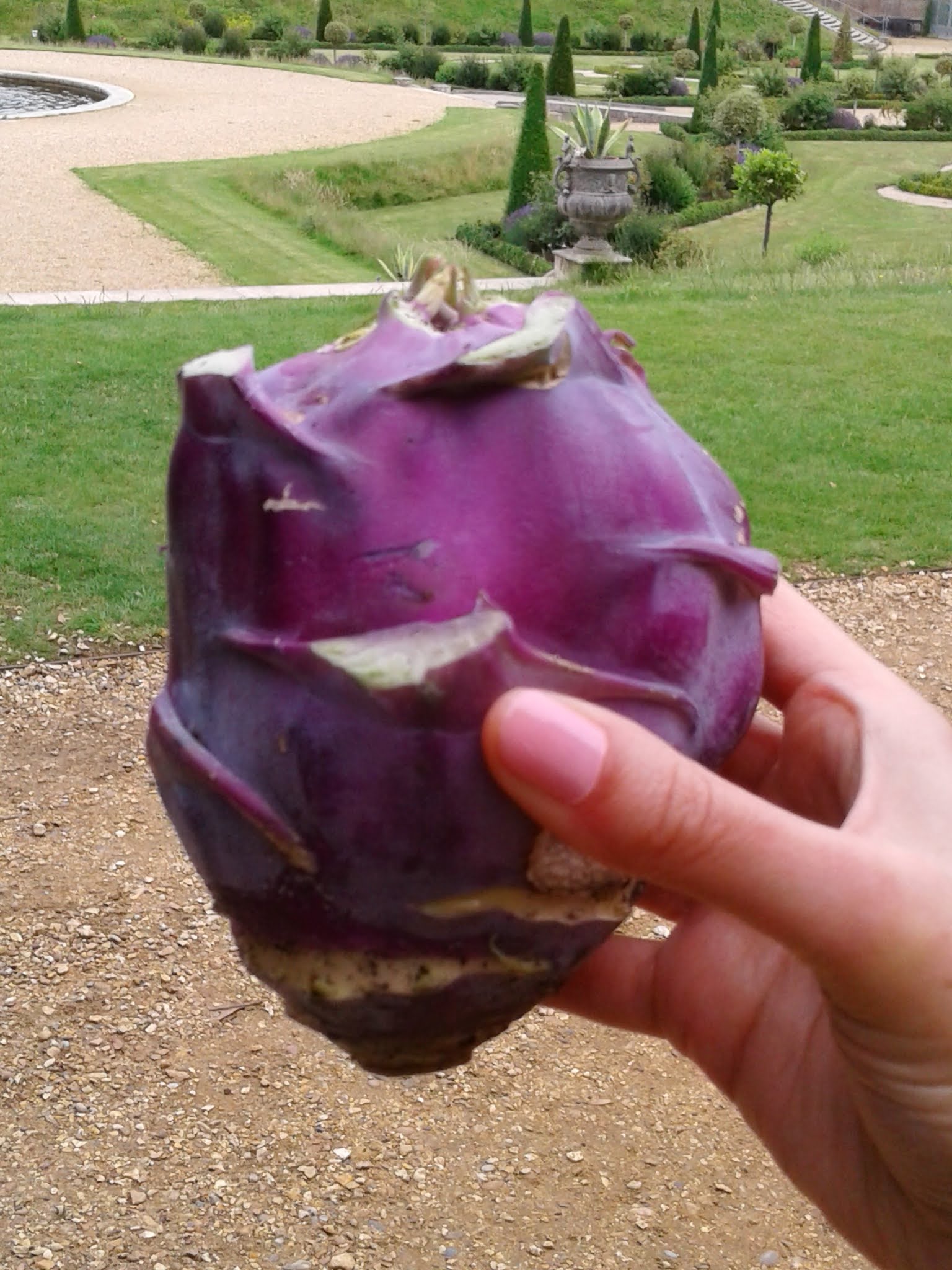
And amongst the vegetables was this weird thing: a kohlrabi. OK, I've been outside Europe for a while, but I'd never seen it before. So I bought one to experiment with. 

This guy is a brassica - related to cabbages and cauliflowers. The bit I got - the 'bulb' - actually grows above ground as a fat stem, as this is not a root vegetable. The leaves can also be eaten, apparently. The bulbs come in white or purple varieties, and the name is German meaning 'cabbage turnip' - which I guess describes its looks! (It does also somewhat resemble a dragon fruit imho... )

I roasted the first half (it requires peeling and chopping, plus steaming first, to soften it up) and the outcome and general review was 'so so'. It's not sweet or flavoursome like a parsnip when roasted, or crispy like a potato. Fairly bland tbch!

Then a Greek friend suggested trying slices raw, dipped in lemon juice. And this was absolutely delicious! Raw, this vegetable is sort of like a cross between a radish and a carrot in texture - crunchy, mild and very refreshing. It would definiately work nicely in salads I think. And I will try it again if I can find one! 


Wednesday, 18 September 2019

British Birdsong

As some of you know, I love birdsong, and have all my life! There is something very evocative about it - of country, of temperature, setting - for me. 

And the UK - possibly because most of my childhood was spent there - has some of the most evocative. These aren't the big, projected chirrups of tropical birds, but when you get used to them, they're very distinct. Most of these birds have many different calls (for mating, alarm, general chat!) but I've picked the ones I know best for these four faves.

You will hear less bird-life in London than in rural parts of Britain. A spring or summer woodland in the UK can be a cacophony of really quite lovely singing, and worth visiting!

Chaffinch
This is such a springtime + sunshine (morning) song for me! Though as this video shows, these guys sing at all times of year :)


Blackbird
One of the most common and unremarkable-seeming of British birds. But they have a very clear and pretty song. This video also features their agitated alarm calls (which we did hear when the cats were outside!) Blackbird calls are very reminiscent of long English summer evenings to me!


Woodpigeon
Another song very evocative of long, warm, relaxed summer evenings in rural areas. These plushie guys are different from London's famous, scrawnier, city pigeons (which are descended from lost racing pigeons). I have seen Woodpigeons in the city's leafier parks, but not heard them - perhaps due to urban noise pollution?


European Robin
These guys' clear little tones can be heard year-round in the UK. And they always makes me smile. Robins are much-loved in Britain. Partly because they're quite social with humans (they will often sit near gardeners for example - I expect hoping to get worms and bugs exposed by the work!) They also have a place in old Christian folklore, and their winter presence and cheerful plumage has made them emblematic of Christmas :) 


Also on this blog:
Favourite bird calls of Singapore


Thursday, 19 April 2018

#RefuseTheStraw update

I can't remember which week this is. But I've been failing massively with this initiative in Malaysia, not to mention a general daily encrustation with other plastics (bags, water bottles, takeaway packaging.. ). (I'm on the hoof at the moment, so in temporary accommodation, without kitchen etc!)

It's not good. 

But what's a bit better is the acquisition of a reusable steel straw. FINALLY! In fact I was hoping to receive a set in a birthday package - but it turned out that six out of eight parcels sent from the UK were 'lost' (apparently most likely stolen) in the Malaysian postal system. And the straws went too. 

So how delighted was I to find that some friends have set up a scuba travel company, and they're also supporting #RefuseTheStraw as part of its conservation efforts. And for merch, I managed to purchase a very jolly box with a steel straw, cleaner, and clips for keeping my own - reusable - chopsticks. (The box is also made of old shells, apparently, and is biodegradable..) 

How to proceed with hawker drinks, and a few other traditional things here, remains to be seen. But everything else requiring a straw can now be plastic-free for me. A small step in the right direction. Huzzah! 


(More images from my ample hand modelling portfolio..)

If anyone is interested in scuba holidays, btw, you can check out my friends' site here:
https://www.scuba-concierge.com/


Also on this blog:
Operating #RefuseTheStraw in Asia: Week 1 
Bags of Fun! Eco Practices East and West


Wednesday, 12 July 2017

Operating #RefuseTheStraw in Asia: Week 1

Yep, I'm giving this a go. Even though the main campaign is aimed at Europe and N America. 

Plastic bottles and bags are a worry, ecologically. But had you ever thought of the humble straw... and the damage it can do en masse?

Straws are such insignificant things, and tbh we often don't think about or (more importantly) need them when we use them. But they also play an unpleasant role in polluting our oceans and food-chains. As the placard says, a plastic straw takes 200 years to break down. And before it does, the plastic clogs up our oceans, can get ingested (often fatally) by sea creatures. When it finally disintegrates - even worse - it becomes tiny toxic particles, which permeate our oceans and their residents. (That's alongside all the bags and bottles which are doing the same things.)

Perhaps not so insignificant, after all?

So I'm going to try to stop using them. Or at least drastically cut down. SE Asia (where I am living now) is really not very good on care for the environment. Compared to Europe, anyway. I know the affluent EU traditionally has some of the world's best scores for being eco-friendly, and kids have grown up being educated about it for some decades. But it's sometimes shocking to see the use and misuse (and mis-disposal, and complete lack of care) regarding plastic over here in Asia. The situations for a lot of developing, or nearly-developed countries is quite different. I know that there are potentially more pressing things economically for a lot of SE Asian countries. Plus a whole raft of other hurdles such as education, corruption etc to jump before even embarking on this slow journey of change. But actually, I have a sneaky feeling that eco care has become important for everyone now, regardless. If the planet gets screwed, then frankly we're all stuffed!

I'm not an eco warrior, and I have no intention of preaching to anyone. This is just my own effort whilst living in the tropics. Let's see how it goes!

#RefuseTheStraw Week 1 
Obstacle 1. This guy! 


This is the traditional way of serving takeaway drinks in SE Asia. It has been for as long as I can remember (a few decades!) And it's fast, simple and cost-effective. And it's a double-whammy on plastic! OK, for RM$15 (£2.70) you can go to Starbucks for a pristine paper cup of latte. But most locals (and me) will still opt for the RM$1.80 (32p) hawker version! How does one drink this on the hoof without a straw???

Obstacle 2. Nobody knows what I'm on about. 
It's standard practice in SE Asia (including at several Western-style cafe chains) to give you a straw with any cold drink. That's how its served. And we tend to drink a fair amount of cold stuff in the tropics. You can ask for no straw, but it confuses staff and can slow down a long queue. In my case, I requested no straw, but the drink arrived at our table as usual - with a straw! I can not use it, but that rather defeats the object. Also, for the more basic roadside outlets, I have a suspicion that straws (rather than drinking from the lip of the cup) are used for hygiene. More investigation and work required on these aspects!


Success 1! Pacific Coffee Company in Kuala Lumpur
If you are able to pay the prices of a Western-style coffee chain, it's a bit easier to #RefuseTheStraw. Your iced drink comes in a clean throwaway cup (perfectly hygienic to drink from) and you pick up your own straw if you want it. So there's one score on the straw! The hitch here is that the cup itself was plastic. So I'm not sure how much good my efforts did..

***

Why I'm doing it - plus two cases
As I've mentioned before, my (still relatively light!) direct concern for the environment was catalysed when I started to SCUBA dive the outstanding reefs and seas of SE Asia. It is such a privilege to be able to witness (responsibly) the incredible life - a throbbing metropolis even! - underneath our seas. Not to mention the idyllic palm-fringed beaches which are natural throughout the region.

But you'll also see some of the most disgusting ruination of these places by plastic pollution. And when you go underwater - reefs, and animals, choked by it. It's careless, large-scale pollution which I've never seen the likes of on British beaches.

A Business Case
On the most practical level, if you happen to be a developing nation, the beaches and reefs are all huge draws for tourism. They're the free-gift that SE Asia has received!

What happens when the wildlife starts to die off, or migrate elsewhere? Or the beaches become polluted and unappealing? The tourism will also migrate elsewhere. Taking care helps to protect long term local economies, as well as the long term health of our seas.

An Emotive Case 
Here are the waters of a) The pristine natural beach and waves of uninhabited island, and protected dive site, Sipadan in East Malaysia, which I visited last year. And b) nearby inhabited, and not protected Semporna on the mainland. Man makes a huge difference, and look how much of the waste is plastic! :(

a) Sipadan

b) Semporna


Related on this Blog:
Bags of Fun! Eco Practices East and West 


Pic of polluted Semporna: TripAdvisor 

Saturday, 25 March 2017

Weird Things: The Tartary Lamb

This story is so peculiar that I am not sure how to categorise it! But what it does tell us is how cultures and learned people get things wrong. 

In every era, people are at the peak of their technological power. It's very easy to believe what we read or are told now - we're super-educated, and advanced, right? Well, these people thought the same! Even in my lifetime, big 'certainties' have been overturned. Columbus being the first non-Native-American to find North America, for example. Now it's been proven that the Vikings got there before him - and in fact there are probabilities that many other cultures - from Asia too - were trading and lurking in the Americas, a long time before that!

I guess an overall pinch-of-salt* is required for a lot of things. And an understanding that what we're taught is 'likely' - but that knowledge is probably fluid. Who knows what better understandings the world will have 150 years from now? The fluidity thing is quite exciting, in actual fact!

ANYWAY, 150 years ago, in Europe, people still believed in the Tartary Lamb (aka Vegetable Lamb of Tartary, Scythian Lamb or Barometz). And they'd believed it for 500 years or more. The Barometz was debated by erudite writers for centuries.

What was it? 
A plant, which had animal sheep as its fruits. Bonkers, right? To us. Well, maybe not so bonkers! Early periods of exploration to Africa and Asia had brought back tales of all sorts of amazing plants and creatures. And to be fair, if you'd never seen or heard of one before, the giraffe, or the meat-eating pitcher-plant, for example, are pretty damned weird concepts too. And people back then couldn't take photographs, or jump on planes and easily explore, to prove things yes or no. (Tartary was an old word for a vast region crossing what's now Central/Northern/East Asia, btw.)

So, anyway, reports came back to Europe of this crazy plant. It was believed that it produced lamb-fruits, connected via umbilical cord to the main plant. The lambs grew, and were flesh-and-blood, but couldn't be disconnected from the mother-plant and live. Reports were of one sheep per plant, or several (which began woolly life in pods - arranged a bit like melons or courgettes!) Still attached, the lambs would feed by grazing nearby vegetation, and when it was all consumed, they died. The lambs were only eaten by wolves, but their wool was apparently used to manufacture nice garments for humans.


Nobody is exactly sure why the belief in this plant/animal endured for so long. There's a similar mythical creature in old Jewish texts, apparently. And theories suggest explorers were further confused by seeing Indian cotton pods (which contained 'wool'), or an Asian fern with especially furry roots, which Chinese made into small, sheep-like toys.

Anyway, there are a lot of unknowns in the story of the Tartary Lamb! There are mythical creatures worldwide, of course - mermaids, dragons, unicorns, kirin, trolls. But this one seems to have garnered genuine (erroneous) scientific discussion. Below is the fern and a cotton pod - what do you think?


The furry fern: Cibotium Barometz
An Indian cotton pod - bit sheepy?


* This is a British English idiom. To 'take something with a pinch-of-salt' means that you listen to or understand something, but don't take it 100% seriously. 


Photo credits: gutenberg.org; Pinterest; Fiber Feast.   


Wednesday, 26 October 2016

English proverbs: Red Sky at Night..

In the UK we have an old saying which goes: 

Red sky at night, shepherd's delight
Red sky at morning, shepherd's warning.

This means that if there's a pink/red sunset, the next day will be fine. But if there's a pink sunrise, there will be rain. It tends to be true. If you're an outdoorsy shepherd or farmer, this matters. Apparently this saying is even in the bible. We have quite a lot of weather prediction proverbs in the West.

I don't know if this is the same in nearly 365-regular-climate SE Asia! Red sky at night holds true here, but in the sunny tropics there are a lot of red sunsets! Here's tonight's :) 

Tuesday, 27 September 2016

Short Days, Long Nights

There are no seasons in Singapore. It's almost on the equator, so what do you expect? 

In Singapore there's an average day temp of around 30c, and it's very humid. The sun rises at about 7am, sets again (quickly!) at 7pm. Every day. 365. There's a rainy season, and there are dramatic storms too. But otherwise it's pretty uniform. That's the tropics, innit.

Temperate climates, like the UK and Japan, as we all know, have seasons. Usually four. But one thing that seems to have taken most of my Asian friends by surprise is the daylight variations we have in Britain. I'd kind of assumed that somewhere like Japan (which actually has more extreme seasons than Britain) had dark winters and bright summers like the UK. They don't. Apparently. 

In fact the UK is quite a bit further North than Japan. And I guess Britain's deceptively mild seasons are a result of the Gulf Stream (warm current from the Atlantic, which heats things up!) 

Anyway, the Northerliness, due to the tilt of the earth's axis, means that in the winter, we have hardly any daylight. And in the summer the reverse is true. Personally I find the winter aspect particularly grim. The end of December (around Christmas - no coincidence!) and the Winter Solstice are the shortest days of the year. A weak sun rises at maybe 9am, then it is dark again by 4pm. This is nowhere near as extreme as what the Scandinavian countries experience, but when you add cold and rain, it's miserable as hell! You wake up (with difficulty!) and go to work in cold and pitch dark, and return home in the same. Unless you have a nice desk next to a window, you might only catch one hour of daylight per day for quite some weeks! 

Humans get very depressed under these conditions. Natural daylight offers many health benefits to animals, and many UK people suffer from a winter condition called 'seasonal affective disorder: SAD' which is basically sadness, due to no daylight! Special electric devices have even been invented to imitate the effects of natural daylight on the body, and help combat this condition. It takes several months for the days to lengthen into something happier again. 

Weak daylight on a London winter afternoon

I guess the one pleasant aspect of this period is winter Sundays, warm at home with friends/family, hot tea and crumpets, at about 4pm, when it is already cold, pitch dark and wild outside. Or, of course, Christmas feasting and relaxation under similar conditions. But frankly, I'm happy to do that once every five years. I don't need months of it. Trees also lose their leaves in winter, so the whole outlook is pretty bleak tbh! Give me sunny tropics any day! 

The upside of Northerliness in England is, of course, looooooong days in summer. The Summer Solstice (around 21 June) is the peak day, when it might get light at 5am,  and start getting dark again at something crazy like 10.30pm. Sunsets away from the equator also take ages. You watch the shadows get longer and longer over some hours, as the sun drifts lower on the horizon. :)

Summertime in London signals long, warm, light evenings playing sports or having picnics in the parks. Open air performances. Or (if you are somewhere more rural where gardens are affordable) drinks outside at home! People are generally much happier and more energetic during these months. Waking up in sunshine is a piece of cake, compared to winter. Sunlight makes you naturally ready to take on the day! Unfortunately many UK summers are hijacked by endless grey days of rain, but you still get a better daylight deal. And when it's good, it's really worth having! 

Some kind of performance festival at Hampton Court, on a summer evening (with long shadows!)

Oddly, I haven't missed the seasons at all since moving to the tropics nearly five years ago. Many friends from temperate countries do miss them. But as far as I'm concerned, long summer evenings are great, and if I get the chance to go home for a few weeks over summertime, I do. But the trade-off of miserable, long dark winters? No thanks! 

(And yes, I'm talking about the weather again.. which is apparently both a British and Japanese cliche!)


Related reading on this blog:

The summer solstice

Things I Miss About the UK No 3: Crumpets


Thursday, 24 March 2016

Favourite bird calls of Singapore

If you asked me what my favourite sound was, I would say birdsong. Of course, this is hugely varied the world over. But I love pretty much all of it - particularly for tree-living birds. I don't know if this is a universal human thing; or if it's the result of my mother teaching me when I was a very small child in rural England, to stop - and just listen to the birds.. 

But for me, birdsong has always been one of the most grounding, and restful things there is.

And the birds of tropical Asia are no exception! These little guys, however, generally have huge lungs and belt out all sorts of wonderful whoops and chirrups, far more fruitily than European birds do. When it comes to voice, SE Asian birds are the Aretha Franklin to Europe's Dusty Springfield!

And Singapore, despite being pretty much a city-country, has lots of greenery in it, and lots of bird-life. So here, in no order, are three of my favourite local bird calls. I've heard all of them at or near my apartment (which is pretty central) apart from, perhaps, the nightjar (and yes, when I was re-introduced to that avian, as an adult in Malaysia, I thought it was a car key-fob too!) In fact there are at least two other common birds I love the sounds of in Singapore but I haven't seen them, so I couldn't identify them to find soundbites! If I do, I'll add them in later :)

Black Naped Oriole
You find these pretty birds all over Singapore, and they have lovely call too! 


Koel
Some people find these guys really irritating - they ARE loud. And often they have fights, which are even louder! 

Nightjar
This is a Large-Tailed Nightjar (there are many different kinds) but this is definitely the call I know!


Sunday, 14 June 2015

Things I Miss About the UK 4: hyrangeas

Yep, it's summer time back home. Which is the time I feel most homesick - as it's the time when England is truly joyous and beautiful. And it reminds me of childhood, when we lived in a rural country cottage, with an acre-big garden full of trees, flowers and shrubs. 

And hydrangeas were - and still are - one of my favourite summer plants. Hyrdrangea flowers actually change colour depending on the acidity of the soil. A strongly acid soil produces blue flowers, an alkaline one, pink. With various shades (even on one plant) of mauve in between. There are also 'lacecap' styles - frilly, flat bursts of flowers; and the traditional ones which give you large 'puffs' of blooms. The ones we had at home were in both styles and mostly blue/purple. 

But what I love about them the most is their cool lusciousness. Getting amongst a big, healthy, dark-leaved hydrangea shrub is like hanging with a huge, fragrant, cooling, salad-y thing. They were one of my favourite spots in the garden in hot summers! These plants require a lot of water, which is possibly why they can be so generous with their green calmness in the heat; it also explains their name.

In fact (perhaps ironically) hydrangeas originate from Asia, chiefly North East Asia - but apparently with some varieties found in Indonesia (I've never seen any). But the ones I remember are the temperate shrubs over an English summer :)


Sunday, 25 January 2015

Singapore River Safari

Part of the various Singapore zoo experiences (alongside the Zoo, Night Safari & Jurong Bird Park ), this isn't actually a Safari on a River, although there are two very short boat rides you can take for extra cost. Instead, it's an on-foot zoo, but with animals selected in line with the various great rivers of the world (Amazon, Ganges, Nile, Yangtze etc).

It was a pretty enjoyable day, though at SG$28 (£14) for one adult, not cheap by Singapore standards (though actually a bit of a bargain if you're from UK!) I covered the entire experience, with both rides, rests, and a sprained ankle in 3 hours. So as you can probably tell, it's not that huge or comprehensive! But, the highlights for me were the Red and Great Pandas, the Squirrel Monkeys, and the wonderful Otters. I was also looking forward to the Manatees, which are in an impressive large aquarium at the end, but they were feeding when I arrived, and not very social! But there are decent, and nicely kept, displays of bizarre river fish and other creatures to look at. 

Piranha
The two boat rides are: the Amazon River Quest - which is quite Jurassic Park! Basically it's a Disney-style, automated ride, with animals to see as part of the entertainment. Actually it is quite good fun and lasts only about 10 minutes. But the huge problem is that the automated 'boat' goes past the animal spaces at super-speed, so by the time you've located the Jaguar or Capybara in the undergrowth, the boat has already been moved on. No photos or animal viewing on this, unless you're extremely fast! But to be honest, for only $5, and since I've never been on another boat-ride which 'crashes down hills' before, it was quite enjoyable!

The other ride is the regular River Safari Cruise, which is on a much larger, proper boat. And it is again a very short 15 minute trip, but this time on one of Singapore's reservoirs. The reservoir is big, but the boat ride just takes you on a tiny fraction of the shore, where you can see Giraffes, Elephants and other creatures in semi-open enclosures, if you are lucky. It is a really nice idea to view animals this way, actually.

Logistics: There are several ways to get there, I took the 138 circuit bus from Ang Mo Kio MRT station - which takes 30 mins to the River Safari. You can save 10-15% if you pre-book your venue ticket online - but it won't give you a discount on the boat rides, which remain SG$5 each even if you book them at the same time. Also you need a smartphone, printer or a good camera to photograph your e-ticket, as they need the bar code to get you in. Also disable your pop-up blocker before you start booking the tickets (they don't tell you this until you're already 80% through the process!)

The young staff (as with the Bird Park) were very sweet and helpful. And a large part of this experience has covered walkway, so I imagine it's OK in rain. There are less places to sit en-route than at the Bird Park, but plenty of toilet stops and a few cafes / stands to buy food or ice creams. Would still advise carrying your own water and snacks, however.

Anyway, here are some animal pix from today, maybe they'll encourage you to visit! (You can click on them for a larger slide-show) :)


 For more River Safari details go to: http://www.riversafari.com.sg/

Saturday, 25 October 2014

Jurong Bird Park

Finally (after nearly three years in SG) I got to visit the Bird Park! I'm a big nature fan, and particularly of bird-life, so it's been on my hit-list for months. I'd actually been advised to avoid this Bird Park, as it was apparently boring and a bit 'Disney for kids' (which would NOT be a winner for me!) But in actual fact, I enjoyed my day there. I went on a Monday, so it would be quiet. I didn't experience any Disney and you can avoid the kids' stuff if you wish.

I found the young, seemingly student-y staff particularly nice and helpful, and although getting there is a hike, there is a handy circuit bus 194 which runs from Boon Lay MRT to the park and back. 

Crowned Pigeons
But I really enjoyed seeing the birds. To me, the small, 'insignificant' ones are as interesting as the big crowd-pleasers (though harder to photograph!) And there were both to be seen here: owls, macaws, penguins, finches, doves, kingfishers, birds-of-paradise, birds of prey, dinosaur-like birds (the cassowary was especially strange/interesting!) and a lot more. The hornbills seemed to be particularly curious of their visitors, and quite a few of them swooped down to take a good close-up look at me - quite a privilege for me! The birds-of-paradise enclosure was rather ruined by the introduction of a loud TV, but otherwise the park was more 'authentic' than I expected.

And if we're going for impressive - or if you have limited time to spend at the Bird Park - I would go to the Waterfall Aviary. This one's a biggie, fitted out like a jungle walk with a huge waterfall in it. And of course, all sorts of birds living in the place if you can spot them! 


It took me about three hours to see all I wanted to, avoiding any 'feeding times' and other family-focused activities. The place is not enormous, and there are plenty of pit-stops with fans, seats and toilets. But do take water and a hand fan (and maybe some snacks) with you, as walking anywhere in SG for three hours is a hot deal!


[You can click on pix to get a slideshow / larger images]


For more about Jurong Bird Park:
http://www.birdpark.com.sg/index.html
 

Sunday, 3 August 2014

Gulls

We don't have seagulls in Singapore. Or at least not in the way they exist in Europe.

Gulls are seabirds, which have a very strong connection with the coast in England. The sight of these birds, and the sound of their distinctive squawky call are as one with 'the seaside' in the UK. As soon as you hear gulls, it makes you think of the coast. And I've been to other countries in Europe, and the USA, where gulls are basically everywhere that there is ocean.

But I've just been staying at a beachside apartment in Singapore, and something is missing... it's lovely be near the sand and the water.. but no squawking grey seabirds! To me, it doesn't feel properly like the coast! I've been to beaches in Asia before, and not noticed this. 

Turns out gulls do lurk in Asia (and nearly everywhere else on earth, including away from the coast and near fresh water, apparently) but they're much less common in the tropics. 

In fact, gulls are not particularly gorgeous animals.They're not that beautiful, enjoy scavenging and can be quite aggressive. But they still hold that important association with the ocean for me. Here's a video of some Herring Gulls (one of the most common in the UK) and next time you hear this sound, you'll know you are near water! 


Thanks to Ani Male for the YouTube video.

Monday, 21 July 2014

Beach life in England...

Hmm. This July there has been a minor heatwave in the UK - which is wonderful. To be completely honest, there is nothing quite as lovely as the English countryside in a good summer - it is rolling and brilliantly verdant, like a huge, lush salad, dotted with cornfields and groups of grazing sheep and cows. (And if you don't live there - worth a visit. If you do live there: enjoy it! I only realised how beautiful it really is after I moved to the tropics!) 

However,on this occasion I was struck by the contrast in beach life between SE Asia and England. OK, OK, this is the tropics. We have the South China Seas, world-renowned reef life and a rotisserie of a climate. Palm-fringed beaches are the stuff of Northern dreams and of course, in Singapore, for example (which is not a beach beauty spot, but still tropical) we go to the beach to have fun. On a really hot day, it's great to head to sandy shores with a swimsuit, play volleyball, cool off with a bit of sea kayaking, or heat up under the rays with the SPF. The beach is a place of comfort and leisure. (Though you might need some insect repellent...)

In the UK, a beach visit is something quite different. It is more a stoical endurance test, an uncomfortable (but necessary) chance to force yourself to take in the biting air, and try not to sprain your ankles crashing across the pebbles*. During the recent heatwave, I joined friends for an afternoon at a pebble beach. It was surely one of the warmer opportunities to do so, and the company was good. But people turned up with tents, plus thick fleeces, and sleeping bags to wrap themselves in while we socialised. Because it was still really cold! Across the beach were people, and their dogs, wrapped in warm blankets, taking in the bitter 'sea breeze'.

Then also came the 'I dare you' type challenge of going into the sea - which was blooming freeeeeezing, and dark grey (none of this topaz tropical lark!) Most of us wore wetsuits, the braver locals went in with just swimming costumes, to the admiration of the rest! 

In actual fact, once you are in the sea and get used to the icy temperatures, it is not an unpleasant experience; maybe a bit like rolling in the snow after a sauna? Sort of healthy and testing. And the sea air is fresh. But the experience of a 'visit to the beach' was not 'fun' as would be expected in Bali, for example. And I did sit there rather amusedly wondering - having been able to compare both approaches - why British people go to the beach to endure discomfort! Such a thing is unheard of in the tropics! 

Singapore

England in heatwave
And before it gets pointed out, there ARE SOME days in the UK, for certain beaches, which are usually sandy and shallower, when the water warms up to become a pleasant, relaxing lounge. I have lived in the UK for many decades, however, and have experienced this about three times! 

Personally, I feel there is something to be said for taking in cold, clean, fresh air (and without mosquitoes!) - but not sure we have to take it to squealing in frozen agony as we get our feet in the water.

Happy paddling everyone!

*Most Asian beaches are sandy. But in Northern Europe, pebble beaches are very common. Instead of sand, these beaches have plains of stones, worn round by the ocean. They are not easy to walk on!


Sunday, 1 June 2014

Invasion of the Tropical Swallowtail Moths!

Yep, these guys - with a whopping 16cm wingspan - are fluttering and sitting all over Singapore at the moment. And you'll see them across social media here, as well as in your apartment building, garden, local park. It's the first time I've ever seen this impressive creature, so it's slightly surprising to bump into them a few times per day now!

Their Latin name is Lyssa Zampa, and it seems that occasionally there are large numbers spotted around summer months - the last flurry being in 2005. But I have yet to find out why! (Maybe the experts don't fully know?)

In general they seem to be a little bit listless; moths are generally nocturnal, so they're usually sleeping during the day when we see them.


But there is no doubt that they are rather beautiful, and for a Westerner used to very modestly-sized insect life - huge!

Monday, 7 October 2013

Conkers

I was chatting with a UK teacher friend about going back to school this autumn, and it suddenly brought back a memory of my own secondary school in the UK. It was a school founded in the 1600's. It had a certain Hogwarts feel to it now I look back to my own school years. (But we didn't study anything quite as interesting as magic...)

I actually quite looked forward to the start of Autumn term - the 'new year' back after a long summer break of two or more months. In some ways autumn in temperate countries can bring a melancholy of 'things coming to an end' - the change of the light, the colour of the leaves on trees, the shorter, and colder days - all signals that summer has finished. But with a school year starting, it was also the signal of new things. We might have something cool like a new stationery set to use, and we would of course be in a new classroom, sometimes with a few new schoolmates too.

All this randomly reminded me of the big conker tree outside the building we were housed in when I was 11-12 years old. I don't know if kids do this in other countries, but conkers - the fruits (nuts?) of the Horse Chestnut tree - used to be collected and sometimes used in games by UK children.

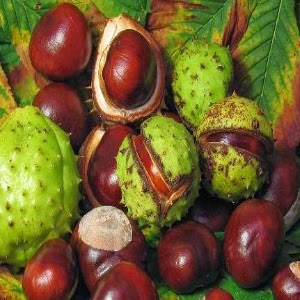
Like I said, you find conkers on a Horse Chestnut tree. But in fact they are poisonous to eat (I think for humans and other animals including, ironically, horses). Despite the name, the tree is not a sibling of the 'Chestnut' tree, which produces slightly similar looking fruits ..which are edible and quite nice roasted on a bonfire or used in cakes!

It was a big deal to find the biggest conkers, and one game British children played involved drilling a hole through the nut, threading a string through it, then bashing it against a rival conker. The aim is to crack your opponent's conker, then you win! A conker that has defeated one rival nut is called a 'one-r', two nuts a 'two-er' etc. I am not sure if 'Conkers' is still played much by UK kids, it is an old fashioned game, and fairly rare during my early years in a rural UK town. But there is a World Conkers Championship (which adults also enter) held annually in England today! I think this is a modern festival.


And remember!

The conker or Horse Chestnut - do not eat this!
 
The slightly fuzzier Chestnut - quite tasty when cooked!
 
 
Credits for conker game photos: Bookdrum.com; Woodlands Jnr School in Kent.