Showing posts with label Traditions. Show all posts

Sunday, 7 May 2023

Foraging in the UK (& wild garlic pesto)

Foraging has a trendy edge to it in the UK, where I am currently. It is the act of picking leaves, fruits and fungi from the wild to eat. These are often also ingredients you wouldn't normally find in supermarkets.

Tbh I have a friend in Hokkaido, Japan, who forages while hiking and cooks her finds. And during my rural UK childhood, it was very normal to collect things like wild blackberries from local hedgerows to make jam or a pie at home. It's an old practice worldwide.

In fact there is legislation around UK foraging, and you need permission from the landlowner to do it. Some of this is to do with tresspassing laws, plus there is a long list of wild plants and fungi which have been protected by law since 1981. So get an OK from the farmer, wildlife trust, or whoever else owns the land before you start! (This also applies to digging up wild plants to use in a garden etc.) Most sites do not allow commercial foraging, for obvious reasons of scale and unfair profit.

In the past couple of decades (one of which I was overseas for) organic and natural foods have become much more desirable to Brits. This is due to concerns over pesticides harming both humans and our ecosystems, and the environmental impacts of large-scale agriculture in general. I've mentioned before the complex class systems of the UK. And the popularity of organic foods is seen as a fairly middle-class thing. Not least because they are so much more expensive to buy.

What could (in theory) be more organic than foraged things growing wild? AND (in theory) they're also free! UK celebrity chefs like Hugh Fearnley Whittingstall have also popularised unusual, local, responsibly foraged ingredients at home. So you can see how the trend has grown from just something country people did occasionally to make pie. 

The number of foraging Brits also spiked further over the pandemic - as people spent more time outdoors, and in their kitchens.

There are of course, other concerns for foraging besides the law - not least that you need to be a real expert on plants and fungi! Many items look very similar to the untrained eye - but some can be highly  poisonous to eat. There are also some ingredients which must be prepared properly for safe eating (even our common potato is incredibly toxic, unless cooked and used in the right way - not that potatoes grow wild here!) 

Wild garlic growing

The Pesto

ANYWAY. I got gifted a bunch of wild garlic from our local woodland. They have strict rules on foraging, which is allowed to a certain weight per home individual after permission. There's a £5000 fine if you forage without a permit! One experienced forager had overpicked, and so handed the surplus back to the park. And since I volunteer there sometimes, I was offered some. 

I had never clapped eyes on wild garlic before, tbch, but was advised that pesto was an easy and tasty recipe for it. (I had not made pesto before, either).

Foraged

I improvised, due to affordable ingredients I could find in our local supermarket, and looked up a few pesto recipes to get a vague idea of what to do - the rest was a 'taste as you go' experiment!  Here is what I did:

Very carefully washed each garlic leaf separately! I might have been being paranoid here, but was thinking dogs and foxes, and the fact garlic grows on the ground! Laid the leaves out to dry (I have reused the paper towels, of course). 

I separated out the buds with stalks for salads.

Ingredients: wild garlic leaves/stalks, crushed walnuts, grated parmesan, olive oil, lemon juice. 

Wanged amounts in a blender until I got the texture and taste I wanted. (FYI the leaves break down to a much smaller volume).

The flavour: a cross between garlic and watercress, I think. The pesto is quite subtle, but with a garlic undertone. And ideally would be best married with homemade or fresh pasta to showcase this. Freezes well in individual portions, though try to defrost overnight in the fridge (microwaving will totally wilt the leaf content). 

The raw buds in salad are really delicious - slightly creamy flavoured even, but with a mild garlic kick. 

Here's the final dish made with cheapo pasta - will try to source a more upmarket carb for the next portion!


Thursday, 22 April 2021

Britain: the National Dunk

Oh look, I have been absent from Blogger for a while, and all the formatting has broken! ANYWAY, until I have time to fix it, this: 

Unlike East and Southeast Asians*, Brits traditionally drink tea with milk (and sometimes sugar). I don't think milky tea is popular in other European countries. Italy, France, Spain are definitely more into coffee as their national beverages. 

In the UK we also have a habit of dunking sweet biscuits into the tea, and then nibbling on the soaked biscuit. In the modern day, this has an effect of part-melting and warming chocolate biscuits, and softening others. (The duration of your dunk is important for this - too long and whole confection just collapses into your drink..)

Dunking also happens in other Western cultures, but perhaps with coffee and/or more specific biscuit types (biscotti in Italy, for example, or stroopwafels in the Netherlands).

History

Apparently the ancient Romans used to dunk hard, crunchy bread into wine. And more recently in Europe, 16th century sailors would dip their rock-hard biscuit rations into hot drinks, simply to make them edible. When British Victorians invented the formal 'afternoon tea' and Queen Victoria herself was seen to dunk her biscuits, the trend caught on, and was thereafter exported to countries such as the US and Australia. 


In Britain, most cookie types can be dipped, and we just do it with tea. Click here for the Wheel of Dunkability and find out which UK biscuit you are! (The chocolate digestive is apparenty the national favourite.) 


* The exception might be modern 'dessert-style' teas such as Taiwanese bubble tea, or matcha and houjicha drinks from Japan. 

** English learners: sweet, crunchy confections are known as 'biscuits' in the UK, and 'cookies' in America. Though we do also understand the term 'cookie' in the UK. 


 Also on this blog:

Biscuits and some issues with US & UK English


Wednesday, 4 March 2020

The Humble Hot Water Bottle (East and West)

The hot water bottle (or hot-water bottle) is a British invention. It is used to warm your bed during cold winter months.

The basic is a rubber (or now PVC) flat bottle, which you fill with very hot water, stopper securely and then keep in bed. More recent ones also have furry covers, which makes them quite cuddlesome (and retain heat for longer)! You can put the hot water bottle into your bed maybe 15 minutes before sleep. So covers are nice and warm when you get inside :)

I am a big fan of the (particularly modern) hot water bottle! I have never been crazy about electric blankets (fear of electrocution?) and also the bottle is more economical/eco-friendly. Girls also use hot water bottles for tummy cramps, and I've used one to alleviate back pain after an injury.

My family used these warmers when I was a child. Back then the rubber bottles didn't have covers and I think some were slightly corroded, leading to the most unpleasant experience of one bursting in bed - fortunately without burns, but half a litre of water in bed during winter was NOT welcome! (You can reduce this risk by avoiding boiling water to fill- which helps preserve the materials. Modern PVC is also less likely to corrode.) 

As with many cultures, people in the chilly UK have used bed-warming items for centuries. Like metal pans filled with coals, even early hot water bottles made from metals or clay. The rubber bottle idea was first introduced in the 19th century - as rubber became a more common material in the West. And then patented by a Croatian engineer in the early 1900s. 

In Japan, there is a similar, soft-covered item known as a 'yutanpo' (()ぽ) - made from rubber, metal or ceramic. The idea is traditional, though, similarly, there are modern versions, including electronic ones, apparently! I am not sure how widely used yutanpo are. Most of the places I've visited in Japan used electric blankets to heat beds. Though a friend on a ski trip in icy Hokkaido recently said that they used yutanpo overnight. (If you use yutanpo in your home in Japan, please do add a comment!)

I've also read a few expat blogs with concerned Brits unable to find nice, covered, hot water bottles in the US - though I guess they can now be ordered online if necessary!

Below is my trusty, British hot water bottle. Happy snoozing.


Japanese yutanpo with cover.
Yutanpo photo credit - eBay 


Also on this blog:
Chillblains
Ovens. And kitchens (where I rightly belong)


Friday, 14 February 2020

Valentine's Day (East & West)

I'm currently in London, and February 14th looms. In the West, this is Valentine's Day. Tbh I'm not keen on pressurised commercial festivals (as they are now). Some can be upsetting for certain groups (which is only just becoming recognised now) and today, generally, they're just a gimmick for retailers to make cash. Over £1 billion (USD 1.3 billion, SGD 1.8 billion) is spent annually in the UK for Valentine's Day. So one can see the commercial savvy in pushing celebrations! But sometimes, even if you don't like the hype, these festivals can be interesting culturally, or historically. 

So here goes!

In the UK today (if we celebrate it!)
February 14th is supposedly a festival of romance. And it's symbolised by hearts, cupids, pink things, doves, chocolates, roses, and perhaps poetry. As children, it was traditional to send an anonymous card to the person (or people) we had a crush on, signing it "?" or "Your Valentine". Supposedly leaving the recipient flattered and wondering who liked them. The card might be sent in the post, or (more usual) left inside your crush's desk or locker! Of course, this also left the people who did NOT receive any cards feeling left out or slightly ridiculed. So some friends would agree to send cards to each other, just so that we had at least one, and looked like we were part of the day.

For adults, very occasionally, anonymous cards or sometimes flowers will be sent (usually from men) to a love interest on Valentine's Day. Retail pressure also suggests that existing couples should go out for overpriced meals, and buy each other expensive and unimaginative gifts! (Red roses, chocolates and things shaped like hearts...) Or just gifts, generally. Prices in restaurants, and for themed gifts rise especially. Traditionally, for heterosexual couples, it was the man's responsibility to arrange Valentine's activities and presents. Today it is increasingly either party. Or none!

How it started
Valentine's Day's origins are Christian, but the romance part is not. 

February 14th is officially the Feast of St Valentine in the church calendar*. It actually could  celebrate more than one Saint Valentine (apparently there are several Christian saints with this name!) For the UK, it usually relates to Valentine of Rome and Valentine of Terni - who were both early Christian priests, martyred in the 3rd century AD. Probably. (They might have actually been the same guy - such is the haziness of history!)

A bit is known about Valentine of Rome. It seems he was imprisoned for - among other things - presiding over marriages to prevent men going to war (at the time forbidden under Roman law - as young single men were required for fighting). It is also said that he restored the sight of a young blind girl, sending her a letter before his execution, signed 'your Valentine'. Fair enough. But not super romantic.

The lovey-dovey concept was introduced to the public over a millennium later. With the cultural / social fashion of "courtly love"**, promoted by Chaucer (famous English poet) and other artsy types in the 14th century. Although it seems there were no existing traditions, the church feast day suddenly became associated with giving flowers, cards signed 'your Valentine', and professing romantic love. These sentiments were reiterated in later art and literature. And have endured to this day. 

Some sources state that February 14th was adopted from the early (pre-Christian) Roman fertility festival of Lupercalia. This idea has some logic, and tbh, a lot of popular pagan festivals were rebranded by the early Christian church, in a kind of smart change-management exercise. But this theory for Valentine's Day has apparently now been thrown out by experts. 

In Japan today
As with several Western concepts, Japan has adopted Valentine's Day but tweaked it to its own style. The idea was first imported by a confectioner in the 1930s. And today there are two Valentine's Days in Japan - one for women, and one for men. I have never been in Japan during these festivals. But this is what I've gathered from friends and research!

February 14th is specifically for women to gift chocolates or sweets to men. And they do not all have to be romantic interests. Two types of chocolate exist for the occasion: "giri-choko" [義理チョコobligation chocolates] which are bog-standard chocolate gifts for male friends or family; and "honmei-choko" [本命チョコ real, or love chocolates] which are special or homemade, and gifted to actual partners or crushes. Also, the recipient of honmei-choko can reject the gift if he's not interested in the giver (harsh! Though it's apparently rare). In some cases, Valentine's can become very expensive for women, especially if they feel they should buy giri-choko for their whole office.

White Day, then takes place on March 14th. This was introduced in 1978 by the National Confectionery Industry Association to redress the expenses of Valentine's Day for women - and also to make more money for the industry, natch! This is when men give gifts to women. Usually returning the favour of giri-choko, or upping the honmei-choko to a bigger or better gift (I guess if the romantic feelings are reciprocated!) 

Openly gay singles and couples can apparently choose which day they wish to gift any honmei-choko, though it seems being openly gay in Japan is less common than it is in the West.

Although it is modern and entirely industry-invented, there is a little more sense to the Japanese system! Depending on the situation, there is a chance that an open honmei-choko gift could lead to actual chances of romance a month later, or on the day. The anonymous British card-giving is sort of useless. Because while it protects the secret sender from embarrassment or rejection, nothing practical can really come of it!

As in the West, not everybody in Japan thinks Valentine's and/or White Day is a great idea, and not everybody celebrates them. But it is still a big, national deal, which hugely boosts the revenues of retailers and confectioners!


* Some, but not all, Christian churches recognise the Feast of St Valentine. As I've mentioned before, there are MANY different kinds of Christianity, and variations for their festivals and other things.

** Courtly love was not a grunge star, but a literary concept started in France, and seen in the works of Chaucer and others. It was designed to entertain the medieval nobility, and emphasised stories of (lovesick) gentlemen wooing ladies in a very chivalrous way. Ultimately, Valentine's is an equivalent of future generations taking the sentiments of the Hollywood romcom seriously, and carrying them out as an annual tradition, attached bogusly to a religious feast!

Photos: part of this year's Valentine's display in London's famous Fortnum & Mason; gifts for him, for her, for anyone! :) 

Also on this blog:
Stuff Valentine's. Here's a much better Western festival to celebrate this month
Christianity (slightly) Defined...


Wednesday, 20 November 2019

The Twelve Days of Christmas - a revelation!

Christmas, like Chinese New Year, Divali and other big festivals officially lasts for some days. Twelve of them, for Church of England (Protestant) Christianity*. Who knew?

From around the 6th century, 'Christmas' has traditionally started on 25th December and lasted until 6th January - a day known as Epiphany. This period is known as the Christmas Season, or sometimes Christmastide. And it includes a whole raft of Christian festivals I had never heard of, including St Stephen's Day on December 26th, the Feast of the Circumcision of Christ (!) and a feast for Mary (Jesus's mother) on New Year's Day. Feasting, worship, Christmas cake, carol-singing and other things are supposed to take place over this Christmas Season. And giving gifts (often one for each of the twelve days) was a custom to reflect the Christian story of the wise men bringing gifts for the infant Jesus. There is actually a traditional festive song which we still sing across Europe, which describes (a bit theatrically!) gifts given over the Twelve Days of Christmas. But I wonder how many children know what, or when, the twelve days really are? (I certainly didn't!)

In Christianity, Epiphany is the day when the wise men (or 'Magi') made their visit to the newborn Jesus. And for the Church of England, it marks the end of the traditional Christmas Season. The night before is known as Twelfth Night, which was also a time for extra partying (and is the title of a famous Shakespearean play).

But all this gets confusing, because today's rituals are quite different. In modern day, fairly secular, Britain, for example, the three main festival days are probably Christmas Eve (24th December), Christmas Day (25th) and Boxing Day (26th) - the latter two being public holidays. We don't really recognise Twelfth Night or Epiphany any more, except perhaps as a vague indicator that we should remove Christmas decos before 6th January. (And I think that idea is also corrupted from another Christian festival!)

In 2019, the "Christmas Season" is more likely to reflect Advent - the period leading up to Christmas Day and Boxing Day. I suspect not least because Christmas is mostly about modern retail sales, as people rush out to prepare for the public holidays. But we also have carol-singing and other less commercial activities during Advent as well now. And children's advent calendars do often (misleadingly!) include images from the Twelve Days of Christmas song - although it is rather early. 

Some modern UK businesses close down from Christmas Day to 2nd January. But this is also a commercial decision because so many staff will take the period between Christmas and New Year public holidays for annual leave. It tends to be a 'dead time' for a lot of European business!

Anyway, here is a video of the Twelve Days of Christmas song. This was originally a French rhyme from the 18th century, and set to music in 1909. The first present, a partridge, would have been gifted on Christmas day :) 


Plus: Lyrics to the Twelve Days of Christmas


* FYI there are many different branches of Christianity, Western and Eastern, and even just within the UK. And many of them celebrate Christmas slightly differently. I've used the most common one in the UK, and the one I know best (though my family is not particularly religious!)


Also on this blog:
Christmassy Things: Christmas! 
Gold, Frankincense and Myrrh
メリ~クリスマス: and The Big Shutdown!
London at Christmas: The Advent Calendar
Christianity (slightly) Defined...

Thursday, 21 June 2018

Anecdotal Note on the British Class System

OK, the British class system is a lot less pronounced now than it used to be. As I've mentioned before, it's socially crass (and occasionally illegal) today to judge others negatively based on their class. (And yes, this should cut up and down across all groups.) 

But there are still things which are commonly acknowledged as indicative of certain classes. And these are sometimes gently mocked in the UK, particularly by the classes which actually exhibit them. For example: the eating of Mediterranean chickpea spread, hummus. Hummus is cheap and ubiquitous in UK supermarkets, but has long been considered a 'middle class' thing - alongside pesto, sundried tomatoes*, craft beers and other artisan foods. Holidays to places like Tuscany in Italy, the South of France, spas or yoga retreats also fall into this category. Middle class people (and the media) will make jokes about this. I suppose what makes some of these things 'middle class' is that they're slightly unusual, popular with other middle classes - or are a sign that you consider yourself cultured in some way. Why have fancy Greek hummus on your toast, when you could just have good old, traditional English jam?

The other day I was reminded of a conversation with a creative (middle class) UK friend, just before I started business school outside London. I should probably preface it by explaining that SPAR is similar to a less glamourous 7-Eleven convenience store chain.

Friend: What's the town like near campus? 
Me: It's a village. Really basic. There's nothing there, only a SPAR. 
Friend: Oh, a spa! How lovely! Well that's something.


* (I think the Mediterranean foods thing kicked off when middle class British Prime Minister Tony Blair once stated he liked eating Italian pasta with sundried tomatoes - and was lambasted by press for saying it!) 


Also on this blog:
Unravelling the British Class System


Tuesday, 29 May 2018

Bonkers British Festivals no3: Cooper's Hill Cheese-Rolling

This happened yesterday, actually. And it's another one which looks suspiciously dangerous. Despite involving cheese.

Basically, on each Spring Bank Holiday, a village in Gloucestershire rolls a large local cheese down a particularly steep hill. And then a whole bunch of people race down the hill in order to catch the cheese. I'm not sure how many people have actually succeeded - turns out the nine pound cheese can reach speeds of around 70 mph (110km/h) and is pretty lethal with momentum! But what makes this seemingly mundane tradition famous, is the crazy falling, flinging and rolling of the humans.

There are ambulances on hand these days, and injuries / hospitalisation are common - from falling down the hill, or being hit by the thunderous cheese... In fact recent competitions have apparently used a safer, foam cheese instead. And burly 'catchers' are employed to catch the flying people at the end of the race. The full title of the event: Cooper's Hill Cheese-Rolling & Wake, does make one wonder what the 'wake' actually refers to*!

Winners - basically the first to the bottom of the hill - receive a real cheese as their prize.

This festival is another one which now draws spectators and participants from around the globe. But like the Ottery Tar Barrels, it's an old, local event with obscure origins. Not much has been recorded about it historically, and theories range from roots in a Pagan fertility rite or celebration of Spring (using other foods), to a ritual  left by Phoenicians occupying Southern Britain (?! sounds iffy). Until recently, cheese-rolling was held on Whit Monday - a moveable date in the Christian calendar.

There seem to be current issues with the organisation of this event, its safety, crowd sizes and other things. It still runs, but seemingly in a rather loose way! Today several cheeses of varying size are also rolled, and there are a few heats of the race.

The cheese itself is Double Gloucester - a reddish, semi-hard, fairly strong-tasting one from the region. Quite nice melted on toast, actually. Though you might feel differently if hit by a 110 km/h, hurtling nine pounds of it.


Bit more about event arrangements here: https://www.facebook.com/BrockworthCheeseRoll/

*English learners: a 'wake' usually refers to a vigil, or solemn, social reception after a funeral. But apparently it can also mean 'festival' in some parts of the UK. 
'Iffy' is informal British English. It means unlikely, unreliable or suspicious. 

Also on this blog:
Bonkers British Festivals no2: The Burryman
Bonkers British Festivals no1: The Ottery Tar Barrels


Tuesday, 22 May 2018

Malaysia's Zombie Love Affair

Well, we've all been in one of those, right?

But anyway, Malaysia as a nation seems to have a thing for zombies. Often comedy ones. I don't know if this is echoed across Thailand and other SE Asian nations (Thailand makes some excellent, non-comedy horror movies, btw). It's not a thing here in Singapore. But on various visits to Kuala Lumpur I have noted posters for locally-made zombie films - usually featuring Malay actors very poorly disguised as campy ghouls. (This seems to be part of the appeal!) 

My Malaysian zombie intro was many moons ago with an English-subbed version of comedy zombie stalwart, Mamat Khalid's Zombi Kampung Pisang (Banana Village Zombie) - which is hilarious / ridiculous, deliberately low-budget, and worth watching. Currently the genre can also be seen on public transport, teaching us social etiquette!


I've tried to do a bit more cursory research on Malaysia's comedy-horror and zombie flicks, but most articles / clips come up in Malay, which I only have a rudimentary grasp of! Here are a couple more tasters anyway (including additions from Khalid). Tbf an excellent grasp of the dialogue is prob not required! 

Zombi Kilang Biskut  (Biscuit Factory Zombies) a follow up to Zombi Kampung Pisang
KL24: Zombies  Malaysians with American accents (?!) in this B-movie 
Hantu Kak Limah Balik Rumah   (Ghost Sister Lime Comes Home?!)


PS The Pontianak and other Asian female ghosts
These movies also feature a local folkloric ghoul: the Pontianak (a female vampire/zombie). The Pontianak is supposed to be a vengeful spirit who suffered a stillbirth, was  stillborn, or died in childbirth. The Pontianak can take on the guise of animals, or a beautiful woman to trick innocent men (those dastardly beautiful women, all evil spirits I tell you!) Oddly - or, probably, not so oddly as I suspect there's a historical link! - traditional female ghosts across East / South East Asia have similarities, and look the same: with the long-hair/white-dress thing going on. (See also types of  Japanese Yūrei made famous in The Ring and other classic films.) 


Also on this blog:
My Fave Horror Movies - East & West (distilled!) 


Sunday, 29 April 2018

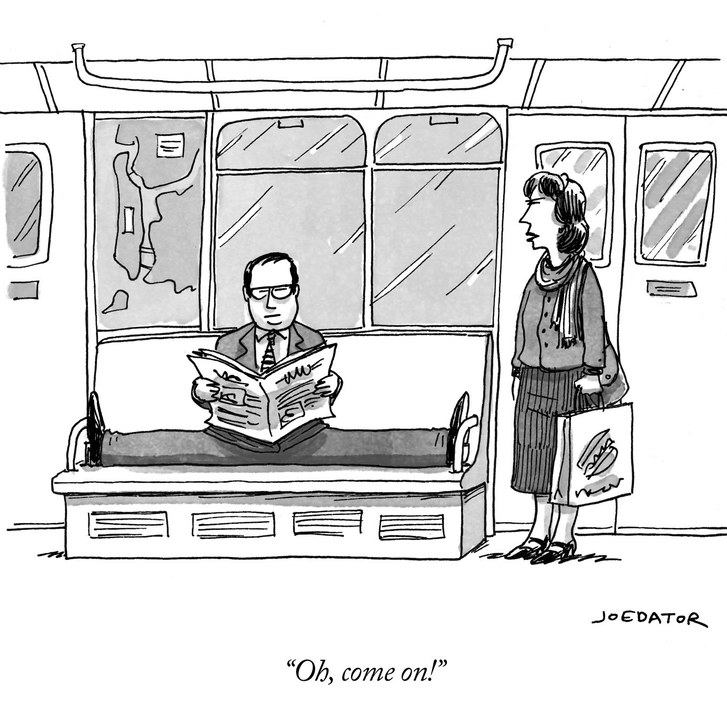
Manspreading

This is the act of men sitting (usually on public transport / in cinemas etc) with their legs so widely splayed apart, that it makes things uncomfortable for the people sitting either side.

OK, turns out there has been a lot of world controversy over manspreading, internet campaigns shaming spreaders (which I don't particularly agree with) and backlashes. But the bottom line is that manspreading (or as it's known among my friends 'attempting the box splits') in public is just plain inconsiderate. And there does seem to be an odd propensity for men to 'spread' and crush females more than other males. Even worse are the spreaders who also stretch their arms out along the backs of their adjoining seats (as one might to a known partner!) It's kinda disrespectful to do all this to any stranger's space. And it's not uncommon to experience being crushed like this in London / Western cities.

But manspreading does not really exist in SE Asia. I have experienced it once from a Chinese guy in Singapore (in five years of living/commuting here!). And, really - praise the Lord! - what relief to be able to travel in relative spatial comfort!

Alright, I know that in general, East Asian men don't have the long legs that some Westerners do. And I do have sympathy with really tall guys anywhere who try to fit into cramped seating. So anyone over 6' 3" (190cm) can probably be exempt from 'spreading' criticism. But even Western men of normal or smaller height spread. A show of machismo? Territorial marking? Ill-fitting jeans?? Thong underwear?? All of the above? 

Whatever the reason, it's not attractive. And not very nice. And I've got to the point where I will politely tell any spreader to kindly remove his leg / arm from my space.

My experience is that in East Asian culture, men - socially and otherwise - are probably less likely to do macho, chest-beating, 'look-at-me'. Which some (FYI not all!) Western men do. I don't know about other cultures. Over in SE Asia, it's just not really the thing to do macho displays on places like public transport. Which possibly explains the lack of manspreading thereon?

OR, Asian men just make wiser fashion choices?

As I've said before, there is still a heap of stuff I admire about the West. But manspreading is certainly not one of them! 

Seems The New Yorker has the same sentiments!


Also on this blog:
Pseudo-ku : the curse of the 'intellectual'

Wednesday, 18 April 2018

Work-life-balance East and West

East Asia is famous for tough office hours and dedication to work. "The industrious East" is still a global brand, which has been upheld by the recent economic track records of places like Japan and China. Many cultural aspects from East Asia have also influenced South East Asia (Chinese diaspora, general modelling on successful 20th century practices). And there is a huge energy of growth and change in the whole region - which you don't feel in the peaking (peaked?) West. 

So, all good for Asia*, right? Well, maybe not. My observations of, and conversations about, the Asian work ethic have been unexpected... 

2015-17 was a fairly momentous time for the marketing industry in Japan. Tragically, a young Tokyo employee at ad agency Dentsu died of overwork. In fact the occurrence is not uncommon in Japan: there were apparently 84 deaths in 2016 linked to overwork. There is even a word for it: 過労死 (karoshi - overwork death). The marketing industry worldwide also has a deservedly bad rep regarding employee work and pay. Long hours for free are regularly expected - even factored into  agency business models. It used to be bad enough in Europe; you can only up the ante in Asia. But what was different about the Dentsu tragedy, was public outcry, and an open trial of company executives. Which actually highlighted working hours as a problem. And Dentsu was found guilty of breaching employment legislation. Whether the company's resulting (microscopic) fine, or alleged changes to working hours, really affect things going forward, though, who knows. It seems the death was perhaps more the result of company culture and tacit expectations. Which might not be unique to Dentsu. Or Japan.

In many parts of Asia, 'hard work' in the office does not mean the same thing it does in Europe. It means long hours. Sometimes very long hours. But not necessarily productive ones. 

There are reasons for this. For example, in many East Asian countries (and countries with East Asian influence) it has traditionally been seen as bad form - or a loss of face - to leave the office before your boss does. And your boss (who might be on a humungous salary to justify such long hours) could stay very late. So the tacit ruling is that everyone has to stay very late. It's not about productivity, or results, but a show of 'honour'. 

Japanese friends have told me that they would regularly (deliberately) spend hours during the day 'filling' time (on Facebook, having tea etc) because they knew they would be honourably in the office until 9pm anyway. Even if they had no work to do! 

My experiences in Singapore were not dissimilar. People would complain of the long hours they worked (and they often did!) but I'd note that during the day there was a lot of sitting around, chatting, smoking and doing nothing work-related. This quite shocked me, when I first arrived from London. I'd imagined the pace would be the same, but just for longer - hence 'the industrious East'! In fact the pace was a lot more laid back overall, and 'stretched out' - probably due to decades of this long-hours/late-night expectation. Even in the trendier workplaces, where more reasonable hours were apparently operated, there was an expectation of 24/7 instant availability via phone or email, which was regularly used (so no time is your own!) I know from experience that out-of-hours contact is rarely necessary in my profession (once? twice? across my entire career!) But in Asia there was still a vibe that it had to be done regularly to 'appear industrious'. 

Chats with colleagues also revealed that although a practice might be 'traditional' or 'honourable' it can still be - and was! - resented.


Yep, an inevitable negative of the long-hours thing, is that people lose out on their own lives. Time with friends, family, to pursue hobbies, sports, romantic time, down time, cultural time, inspiration time, adventures, and all sorts of other things get scuppered for the long-hours office culture. Sometimes even without the compensation of extra pay. And many Asian people loathe it. It seems that regardless of region or culture, people worldwide have similar basic needs. And being able to own your own time - or at least a decent proportion of it - is one of them. (To lose this time while actually doing nothing important at the office seems like a double whammy to me!) 

In the UK (in my industry, at the same relatively senior level) the working style was different. I'm not saying that it was the perfect solution, or that it was stress-free - in fact in many was there was higher stress. But we worked pretty intensely during the day. It means that we could get the business results, and still leave on time to enjoy our evenings and weekends. And there is increasingly a culture where nobody is quietly frowned-upon for doing so.

For example, I'd get in at 9am, make a coffee, then be at my desk constantly, 100%  occupied with work tasks, until lunchtime. And the same in the afternoon. Meetings were ideally kept short, direct, to minimise 'lost time'. No lolling around, chatting or social media (except during lunch hour if I wanted to). Business school was a further refining of this work-style - with most teams working to Pareto to maximise returns on (very) limited time. That was part of the training. 

Misconception: so the Asian view that Europeans 'have it easy' is not quite correct. We work very hard, but we try to work smart, so that we can also enjoy 'life outside'.  Plus many companies now encourage this, and judge us on our results, not time at our desks, or on our phones. 

For most EU countries, the maximum legal employee working hours per five-day week is 40 (48 for a six-day week). It's averaged out, and there are exemptions for some professions. But eight hours per day is the standard rule. And economies do not seem to have suffered for it. In fact some of Europe's most work-life-balance aware countries (Germany, France, The Netherlands, Sweden) are also its most prosperous. 

Management experts (albeit probably Western ones!) agree that happy, enriched people, with a handle on their own time, actually have higher productivity and buy-in during their shorter work hours, and benefit businesses more. (Resentful ones, obviously, far less!) And for the creative industries especially, I always wonder how great ideas can flourish if experiences / inspirations are limited to the workplace. 

I'm not doing a whole 'West is Best' thing here (most of you already know that I'm fairly aware of that bias!) And one can't argue with the success of the Asian tigers. People do things differently. And achieve goals differently. But when described to my Asian colleagues, they nearly all thought the more intense Euro-style sounded pretty good, especially if it allowed evenings and weekends on their own terms. In fact, some of the younger people already had exit dreams and plans: to step out of the rat-race once they were solvent, and opt for more work-life-balance. 

I've noted East and South East Asian countries are often places of contradictions. In many ways they can be socially ultra-conservative, staunchly unwilling to alter tradition. But this alongside (or perhaps because of?) fast economic growth, agility, innovation and change. 

The work-life aspect is one social tradition which might change soon for this region. And we can probably thank the Millennials for this! There are some things I admire greatly about the new Millennial generations over here. While they're labelled as faddy and entitled (which is sometimes true) they're also questioning a few daft traditions, and turning them on their heads. 

Low-conception (an aside!) 
I also have a theory about the declining birth-rates in countries like Japan and Singapore. A drop governments and economists have worried about for a while. Of course it is a problem with some complex socio-economic roots. But if you're in the office until 9 or 10pm daily, this seriously limits your social time (finding a partner), time for getting to know him/her, or romance WITH an existing partner. AND probably the energy to feel generally happy, relaxed and romantic in the first place. Does this help bring on healthy new generations of bouncing babies? In my view, Asia's long-hours office culture seems to be at odds with a lot of the region's traditions of children and family, as well as modern economic considerations. Increased work-life-balance could be a serious win-win for Asia! 


* I'm using 'Asia' to apply to the East and South East Asian countries mentioned in this post. For ease. I do realise that it's a huge continent full of diversity. Just as Europe is. (And I've also referred to Europe in the general sense, to make broad comparisons with East and South East Asia).

** The Pareto Principle suggests that 80% of results come from 20% of your tasks. So that 20% should be identified, and strongly prioritised. 


Also on this blog:
People, damage limitation, Dentsu and debacles


Wednesday, 20 December 2017

Japan: And the Kanji of the Year is...

Discovered (and actually understood!) at a Japanese language event last night - Japan has a Kanji of the Year. Kanji are the Chinese-style characters used as one of Japan's writing scripts. 

This accolade is a modern invention, set up in the 1990s by the Japanese Kanji Proficiency Society, apparently. A nice piece of PR by them! And I guess it works especially well in Japan, where (unlike in the West, for example) written characters are not only practical words, but used in calligraphy as a respected and nuanced visual art form. Calligraphy also has connections to Zen Buddhism.

The Kanji of the Year is awarded in December each year, based on votes for the most used or topical one encapsulating the previous 12 months. The topical aspects might relate to Japanese or world events. The annual announcement takes place at the famous Kiyomizu-dera (Kiyomizu temple) in Kyoto, where a calligrapher priest will create the word on a large scale. 

2017's Kanji of the Year was   (kita = North) reflecting global and national concerns over developments in North Korea, and some natural events in Northern Japan.  In 2016 and 2012 it was   (kin = gold or money) due to Olympic successes, financial changes and other world events. 2015's Kanji was (an = safety) echoing world terrorist attacks and new laws in Japan.


Photo credit: theguardian.com/AFP/Getty


Monday, 4 December 2017

Chuggers

The chuggers are out in SE Asia. It's that time of year. Even in Malaysia - which I'm always a bit surprised about, because it is an officially Muslim country! (And tbh Christmas is not a big celebration in any SE Asian country, bar perhaps the Philippines). In fact the chugging phenomenon has just started in places like Singapore and Kuala Lumpur. And I'm not keen on chugging here, any more than I was in London!

The word chugger is an amalgam of 'charity' and 'mugger' (someone who violently robs you). They are the people in bright logo t-shirts, who appear in busy shopping areas usually before Christmas, accosting you to make money subscriptions to (usually large, famous) charities. 

I might have mentioned before that even if we don't actively practice the religion, a lot of European countries still have some 'Christian values' at the core of society. I only really noticed this after moving to Asia; I just (inevitably) thought they were 'normal values' until then! Things like compassion and giving are quite key in the West. Which they are not, necessarily, in Asian countries. Many friends in Singapore, for example, simply could not comprehend why successful Western countries like Germany were considering offering alms to refugees. Why would you invite such problems, and costs, if you're a prosperous nation? Why would you not simply protect your own? Well, part of the initial European sentiment, in my opinion, comes from centuries of religious background. As well as centuries of politico-historical, good and bad stuff we have hoped to learn from. (Though obviously, the recent refugee crisis ended up being a lot more difficult - and a whole debate in its own right...)

But anyway, this cultural aspect of compassion + Christianity is why chuggers particularly target pre-Christmas in Western countries.

Hang on, though, giving to charities is good, right? Especially if it's in your culture. So why would these groups get the 'chugger' name, and what are they doing wrong? Well, quite a lot, as it turns out. Though this view probably depends on whether you are a big charity, or a member of the public.

My earliest memory of chuggers in the UK was in the 1990s. And back then they were seen (as they are currently in SE Asia) as quite a novelty, and surely a good thing. But as time has passed, chuggers have become more favoured with the charities, and less favoured with the public. 

Chuggers are usually not volunteers who work for the charities they are pushing. Most come from organised agencies which specialise in hiring out teams of them (often college students), especially over the Christmas period. This third party aspect provides some useful business benefits (and, apparently, legal get-outs) for the charities. And to differentiate, if the person who is fundraising wants your bank details (and might not be happy for you to simply give a one-off donation or drop cash into their box) they are probably a chugger, rather than a regular 'street fundraiser'.

Stats say that around 80% of the UK public today loathe chuggers. This is for a number of reasons, including that many of the teams can employ aggressive, misleading, or pressuring tactics, be invasive, or try to make you feel guilty for not subscribing to the particular charity they're marketing. The 'good' ones are trained to spot the most likely types of pedestrian, target them, and use specific trigger phrases to 'make' them sign up (or 'make us feel' we should sign up). 'Make' is not a great aspect here. There are all sorts of clever and not-very-Christmassy tactics used to 'make' the public hand over their bank details for the subscription.

Most agency chugger teams work on a base + commissions/bonus basis. So for a start, the integrity, knowledge and passion of these people can come into question. Some marketers see this as an old-fashioned viewpoint, and flag up that chugger training practices have improved, and that bad press is the real reason for the public dislike of them. And it's true, the UK right-wing press, especially, is negative about chuggers. But either way, chugging is big business, and the chuggers' motivation might not be the cause they're pushing at you, but their own bonuses. This is also why one-off donations might be refused: the chuggers' KPIs are based on signing up bank details for long-term subscriptions.

I guess irritation, intimidation or politics aside, there is just something a bit off about the chugger as a person 'doing good'. Which at the same time is what they're trying to tell us we must be. Why should we be made to feel guilty for not supporting a charity, when the people pressuring us don't support it either? And are just making us feel bad for their own Christmas pocket-money? There's a big disconnect there, and I can't help thinking that if big scale is the only way to effectively fundraise today, surely a better model can be found?

The fast-growing number of chuggers has also been an issue. In early teens London*, at this time of year, there used to be teams on practically every street corner. Each one wanting to stop you and talk to you, and make you sign up to a different charity. Having to interact with one, polite, fundraising team each day on your commute can be charming - even if you don't agree with their cause. But eight or ten different teams of them? Shopkeepers have complained that as soon as chuggers set up outside their stores, they lose custom. Because people want to avoid the stress of being chugged, and will shop elsewhere.  


Another key aspect is that (possibly because of the culture) many UK people already support and/or have donations subscriptions to charities. In fact the UK public are consistently in the top 12 in the World Giving Index. But these are not causes we've been chugged or coerced into supporting. They're ones we've chosen ourselves, because we particularly appreciate the work they do, or the values they stand for. They could be any kind of charity - individuals all have their own, personal reasons for support. And that's another reason why being endlessly accosted on the street is not appreciated. Some people are perfectly capable of choosing their own causes.  

[Compassion Fatigue - ie so many causes simultaneously pushing at you, that you just switch off from all of them- is also a very real problem at this time of year in the UK.]

Chuggers can give charities a bad name. And in fact, several of the large UK charities will not use them. Though many others do. If we've had aggressive or irritating experiences with third-party chuggers, we trust that charity a little bit less - and for general marketing goals, trust is quite important! In fact some academic research from The Netherlands has shown that the majority of people sign up for subscriptions, not because they agree with the charity's work or ideals, but because it's the fastest way to shut down an uncomfortable and exhausting human interaction: refusing under (repeated) pressure. That in itself surely puts chugging into one of those most unsavoury and unethical of marketing practices? It is deliberately making the public into a kind of victim to achieve its goals. And that's not nice. Hence, perhaps, the widespread dislike of chuggers.

Despite many UK press articles (even in some moderate / liberal press!) comments and opinion pieces, complaining about chuggers - even calls for bans in some regions - the practice has continued to grow. For one reason: direct and repeated pressure on pedestrians is hugely effective in getting money in to charities. Apparently the returns for using chugger agencies come in at about 3:1. Which is quite significant. It's nasty - but it works.

Some years ago I remember talking to a friend (who works for a large NGO) regarding their use of a particularly ditzy celebrity as ambassador. The celeb seemed to have minimal grasp on anything related to the cause, but just wanted to be 'seen' as fashionably charitable for PR purposes. My friend agreed with me entirely: it was bad. But, she said, this celebrity was so popular that her mere presence boosted donations hugely from certain demographics. And what the charity needed to carry out its work, was cash. When there are pressing, maybe life-and-death, situations at hand, it doesn't really matter how the money comes in. As long as it comes in. 

There is also an argument (which I strongly suspect does not apply in Asia yet, but could in places like London) that not all chuggers are college students making holiday money. Some genuinely destitute people also find work with the chugging agencies, and it can prove an important lifeline for them to get back 'up on their feet' and into society. I don't know what the actual statistics for this are, but that could be one more positive and genuine angle. 

Either way, if you don't enjoy being accosted on street corners, or every time you use the escalator in your mall, there are other ways of donating or subscribing to good causes! At any time of year. And when you can do your own online research and decision-making, in your own time. (And if supporting charities is just not your thing, that is OK too!) 


* I've been in Asia for most Christmases since then, so can't comment on more recent years!

You can check out the latest World Giving Index here: World Giving Index 2017


Tuesday, 28 November 2017

Christianity (slightly) Defined...

For some reason among many of my Asian friends, there is a slight misunderstanding about Christianity. The common view among educated Japanese friends, for example, seems to be that you might be Christian, or Catholic. That they're two separate things. In fact Catholics are Christians, and they're one of many (many!) branches of Christianity. 

Christianity seems to be popular as a modern thing in a lot of Asia (in Chinese diaspora communities, for example, as well as in South Korea, apparently). And of course there are the older, large communities in places such as the Philippines, which are more likely to be Catholics. But Christianity is not the big and ancient deal here that it is in Europe. So I guess for those practicing other religions or philosophies, it's not so widely understood either.

In fact, there are a gazillion types of Christianity! All are Christians, and believe in Jesus, but might believe or practice slightly differently. The different groups are often referred to as 'denominations', and within those there might be other variations and offshoot groups! Some might be modern variations, some quite ancient ones. Examples of these groups and sub-groups are Eastern Orthodox, Protestants, Catholics, Methodists, United Reformists, Anglicans, Baptists, Presbyterians etc. There are many more. The Catholics are the largest denomination globally.

My British family (self included) would not call themselves at all religious (and of course the Asian and other global family includes all sorts of other philosophies and faiths too!) but we are theoretically Protestants, which in the UK is sometimes also called Church of England (though there are few layers in between, I think!). Protestantism was formed about 500 years ago and now makes up about 40% of Christians worldwide. In rural England, I was also sent to a Catholic Convent taught by nuns for primary school education (because it offered the best local schooling!) And I remember that the Catholic children there would do certain things like 'take communion' (which to a child entailed eating an interesting-looking biscuit and drinking from a goblet offered by a priest!) which the other, non-Catholic children would not. But we all muddled in and said the same prayers (a lot of them - start of day, end of day; before meals, after meals!) and it was generally quite accepting for everyone. 

Unlike many parts of Asia, religion is seen as a fairly personal thing in the modern UK. You don't need to state it on any official documents, and it is considered rude socially (and I think illegal professionally) to ask anyone which religion they practice. You can choose to practice strictly or vocally, or not at all.  (Though in general people don't enjoy being preached to about religions in social or professional situations either!) There is no official religion in the UK, and in modern times I think it might be considered 'multi-faith', though Christianity (in various forms) has been the main one for some centuries.

Photo: The famous cathedral of Notre-Dame de Paris, in Paris, France, looking pretty at night. (This one is Catholic, and was built about 700 years ago :) )


Photo credit: Wikipedia 

Also on this Blog: 
November the 5th, fireworks and gruesome murder


Wednesday, 22 November 2017

On or Off? The Shoe Thing

A SE Asian friend recently commented how disgusting it was that some people wore outdoor shoes inside the house.

In most cultures in East and South East Asia, shoes are removed before entering any home. In Japan, even the tiniest apartments are usually designed with a hallway space for changing and leaving shoes. And across SE Asia, most places will have similar spaces, and/or racks for shoe storage outside the front door.

Inside Asian homes either bare feet or house slippers are worn. Which (assuming the home is also kept clean) ensures much more hygienic floors.

But in Europe, we often wear our outside shoes indoors.

For most UK homes, wearing shoes inside - or not - is usually just family preference. Some owners prefer guests to remove footwear; others don't. My family - which has Asian influence - would remove shoes and wear warm socks or slippers inside. But unless the outdoor shoes are very muddy or dirty (and don't forget there are hefty doormats for wiping them before entry, too) it is not generally seen as disgusting or insulting to wear them inside.

There are reasons for this. It is not just Europeans being unhygienic!

In East/SE Asia, traditionally, floors were/are used for sitting and sleeping on. But in many parts of Europe we have never really done that. Floors have one purpose: walking on. And not barefoot (too cold!) Even basic Anglo Saxon homes - in England, over 1000 years ago - used benches to sit on, and raised beds to sleep on. And earlier Roman counterparts had even smarter furniture!

Due to harsh winter climates, modest Anglo Saxon homes, for example, also housed livestock for part of the year. The family depended on these creatures for milk, meat, etc - because there is no harvest for the bleak months - and nobody wanted these precious animals to die of cold. But obviously, nobody wants to sit on THAT floor, either!

Reconstructed Anglo Saxon home
Regardless of creatures, a European floor would also be the coldest, dampest and draughtiest place to be. Far better (and maybe healthier) to be on something elevated, like a bench or a chair. You'll probably find public announcements even today in the West (plus countless parents instructing their children) "Keep Your Shoes Off the Furniture". We also don't want to sit in outdoor dirt!

Basically, floors have never been a social place in the UK, and many other European cultures.

In tropical SE Asia, by comparison, the cooler floor area was a good place to be. Also, the architecture in places like early Malaysia and Indonesia was different - with traditional wooden buildings raised above the soil. This was to allow air to circulate underneath, and through the floor - for even better cooling! In the absence of winters, livestock were kept underneath the building, not inside. So it made perfect sense to use the already raised floor as a seating, social and eating space.

Malay 'kampung' home raised on stilts

Even in temperate climates like Japan, traditional buildings were generally raised a little above the ground. And the floor - covered with tatami - was (and still is sometimes today) used for sitting and sleeping. So again, it was imperative that floors were immaculate and free from outside dirt. 

There is also some suggestion that Chinese cultures believed that barefoot walking (for foot stimulation) at home was good for health. As well as it being comfortable in warmer climates. So, yep, very clean floors desirable all round!


Japanese tatami
To go to an Asian home today and not remove your shoes, would be considered very uncouth and possibly even an insult for the host. Even though you will probably find IKEA chairs and beds there, just like everywhere else in the world. Remove the footwear! (And ensure you have clean socks and/or a decent pedicure!) Though interestingly, I have never come across an Asian office where shoes are removed.

Another, lesser, modern factor in the UK is the simple practicality of storing shoes. Smaller Western homes or apartments might not be equipped with hall or 'porch' areas to leave shoes. Because it is not an obligatory part of our culture. And you would not wish to leave them in any common space outside your home (which can be done very happily in places like Singapore) because there is a likelihood of theft! Items left outdoors in the cold would also become quickly damp and rot. So quite often, shoes are stored somewhere else in the family home - such as in a wardrobe or closet away from the entry area.

Anyway, my rule for European homes? Be prepared to remove your shoes, and ask the host as you arrive if s/he would like you to, or not. A stack of shoes near the doorway could be a clue that this household prefers socks and house slippers indoors! Asian homes, obviously: always remove :) 


*Incidentally, 'slippers' are two different things in the UK and SE Asia. In SE Asia, the word refers to rubber 'flip-flops'. In England, the word means soft, usually warm, fabric or sheepskin shoes specifically for indoors and bedrooms. 

Photo creds: Anglo Saxon home via W&G Robinson; Tatami room courtesy of loveartlab; flip-flops/slippers - havaianas.