Showing posts with label .Malaysia. Show all posts

Monday, 30 December 2019

After Asia: Very Poor Quality Housing and an Inconsiderate Culture

Any Brit living in APAC (unless, perhaps, they are a millionaire) will say that the living conditions in the UK/London are terrible by comparison to those in many local countries. It is one of those things which I never really clocked, until I lived abroad. I was utterly miserable in most of my British accommodation, but - like a lot of Brits here today - flatly refused to believe it was anything other than 'normal'. Well, poor living conditions are normal for regular-earners in the UK. But they're not, necessarily, elsewhere in the world. And, even more bizarrely, UK rent and accommodation outstrips almost every other city in the world for high cost (and cost relative to salary). 

Here are the main issues: 

Old Buildings
Most accommodation in the UK is in old buildings. And not designed for modern, high-density living. Today's scenario sees the 'high-density' houses built in, say, the 1930s, now subdivided into many poorly converted, even smaller (and hyper-expensive!) apartments. Old buildings handle temperatures poorly (a lot of drafts and heat-leakage in winter; lack of ventilation in summer). And because they were never intended to be apartments, you'll find tiny kitchens, lack of bathrooms, and - due to the poor quality, old, conversions: no privacy or soundproofing whatsoever.

I've lived in plenty of shares where you would have four professionals queuing desperately each morning for use of the ONE bathroom (which will inconveniently also contain the only toilet) before work. Woe betide anyone who gets sick and might need it more frequently! 

A 'fully modernised' London conversion will mean the interiors, kitchen fittings etc will be upgraded. But the structure, and lack of soundproofing, will remain the same. In most period conversions it is common to hear your neighbours': 
- Conversations
- Arguments 
- Chopping / cooking sounds
- Television
- Music
- Washing machine
- Entertaining   
- Doors and drawers being closed
- Snoring 
- Walking around (especially if you are below them or somebody has wood floors)
- Sexual exploits in bed.

This constant noise pollution has been the single most stressful aspect for me and many of my friends. It can badly impact your mental and physical health. Working and commuting in London is exceptionally high-stress. You really do need to be able to relax and wind-down when you are at home. But the neighbour noise will often prevent this. Any one converted apartment can adjoin six or more others which you can hear. You would have to be very lucky to have considerate, quiet, people in all of them! (And even if you do, the high turnover of tenants in places like London means that that could change at any time!) 
 

The Inconsiderate Culture
Western and Eastern cultures have many differences! Modern British culture, for example, is very thoughtful regarding diversity, people's human rights, support for those struggling/in need and many other good things. But this traditionally does not extend into living at home. Again, I've only really noticed this after having eight years elsewhere for comparison! It's not to say that individual people are not considerate in our homes. In previous shares I've been in, we tried to operate a 9-9 rule. This means that we don't put on music, washing machine, do repairs or make other anti-social noise before 9am or after 9pm. Just because we knew neighbours would hear all of it! But many people are either simply not aware, or believe it is their right to do as they please within their own homes. Including playing loud music or TV, and having loud parties. This, in the UK's non-soundproofed, poor quality housing - is highly problematic! Bass and sub-woofer (both very popular in the UK, and obviously not even in existence when these old properties were built!) can carry down an entire row of subdivided, old houses. As a musician friend of mine pointed out, residential housing is simply not equipped to deal with bass. And if it is old, flimsy residential housing too....

There are no operational authorities in places like London to deal with neighbour noise. The under-resourced police are trying to handle shootings and stabbings; and a couple of decades ago, they handed neighbour disturbance responsibility to the equally under-resourced local councils (who in reality can do nothing - as many of us have discovered). People in the UK generally do not abide by laws in the way people might in some Asian countries - not least because authorities are so ill-equipped to enforce them! Modern condos with their own security or block-management are almost non-existent in London. The only option is to try to confront the neighbours yourself. And even if done very tactfully, this often gets an aggressive or rebellious reaction with volume being turned UP, just to spite you. Because Westerners generally don't like being told what to do.


Alcohol can also play a key role here (and recreational drugs, which are also common). If people are drunk, it is less likely they'll be aware of the noise they're making. In some cases it is dangerous to approach noisy neighbours. So a vast percentage of noise just persists. If you rent, the trick is to never sign a long-term lease, and always have a get-out clause. Just in case the noise is unbearable after you move in!

In two of my homes in APAC, I did suffer noise disturbance, but it was not the norm. (I lived in a whole host of quiet homes during my eight years!) The instances in Asia were 1) a location where it turned out boy-racers would speed their Ferraris at night (not neighbours, per se) and 2) an actual powerful, gang-related resident, who the block management were unable to control (though they did try). Aside from having block management, or also security in some cases, most housing in SE Asian cities is also modern, and purpose-built / insulated. And often with rooms or outdoor space away from the apartments, for people to practice musical instruments, or have parties etc if they want to. Parties are closed down at 10pm, to allow other residents to sleep. And if you want to celebrate late, or have loud music, people will go out to a bar or club to do it. But aside from all this 'design', the cultures I lived amongst simply were not into playing sub-woofer, getting drunk, or having loud parties at home. It's just not the deal. And anyone who tried to do the above would immediately be shut down by complaining neighbours - as the general vibe was that it's obstructing others' rights to peace and quiet if you do it! (Some friends and I were shut down from even having a quiet BBQ-side chat one night - because it was disturbing some of our neighbours from their sleep. Our reaction: An apology and immediately quieting down. Not pump up the volume to spite them!)

The combo of culture and poor quality housing in the UK is a high stress one. And something I pitied my London friends having to endure, as soon as I moved overseas! In the UK, period homes have gained a reputation (perhaps developed cleverly by real estate agents?) of being 'characterful' and therefore more desirable.. . But however beautiful your apartment might look, if you can't use the toilet, get peace, sleep or relax when you need to, it isn't even really a 'home'. AND on top of rent, your costs for heating will rocket as so much is lost through old structures. There is no longer any appeal for me! If I have to stay longer in London, I hope to rent an apartment in one of the city's very rare, modern condominiums. It's unfashionable, but you can't put a price on having peace and privacy at home! 

A typical London terrace. These old houses will now have been subdivided into many small flats!

Also on this blog: 
After Asia: a dearth of smartphones in public!


Tuesday, 24 September 2019

Ipoh and Creme Caramel - the Global Dessert

This Christmas I joined some friends on a trip to Ipoh, a Malaysian town situated somewhere between Kuala Lumpur and Penang.

The town itself is interesting. Quite Chinese-influenced (Malaysia's ethnic populations are Malay, Chinese and Indian) Ipoh today is a blend of authentic old stuff, alongside some quite smart and thoughtfully conceived hipster places.  So you'll find interesting, locally-executed, modern  cafes and boutique b+b's, alongside fab old peranakan architecture and Chinese hawker stalls. I guess what makes Ipoh currently different from some other towns in this region, is that it has yet to become properly touristy (ie a plasticated and homogenised 'Asia' for foreign audiences) or too gentrified like the now very beautifully restored (and expensively desirable!) heritage areas of Singapore. A lot of Ipoh still has unique charm. Be it the old stuff - which is still reminiscent of the 60s and 70s in this region - or the new, which has definite Malaysian roots.

One detail which slightly surprised me in the old Chinese hawker places, however, were ubiquitous period posters for what looked suspiciously like my mother's homemade English creme caramel dessert. It's the first time I'd seen such ads in this region. And yep, it was the same dessert!

Creme caramel is an old European recipe. The name is French, but the pudding's exact origins might be French or Spanish. In the 20th century it became especially popular across Europe, including being on-trend in 1970s and 80s Britain (when my mother used to make it!)

But the Brits didn't introduce it to old colonial Malaya. Seems this tasty pudd was imported way before that, by the Portuguese in the 1500s, and it began to gain Southeast Asian popularity from there! Although I'd never encountered it before, turns out creme caramel - known in Malaysia as caramel custard - is a fairly traditional and popular recipe with all the ethnic communities there.

In fact, this dessert was introduced variously by the Spanish, French and Portuguese to all sorts of historical colonies and trading partners worldwide. And you will still find variants on these old recipes in Latin America, India, The Philippines, Japan, Vietnam and elsewhere! Who knew?

A truly universal pudding :)

Caramel custard image in Ipoh

This post was first drafted in 2018.


Thursday, 21 March 2019

After Asia: a dearth of smartphones in public!


There are hardly any smartphones on show in public in London! Compared with SE Asia, that is. 

Travel on any public transport in Singapore, Kuala Lumpur, or Bangkok, and almost everyone will be on their phone, often with loud games or Malay/Hokkien/Thai dramas playing openly. 

Not so in London. Ride the Tube here, and there will be a few people quietly on their phones, a lot reading the free newspapers (Evening Standard, Metro) given out at stations, or listening to music on headphones. Almost zero noise apart from talking, and the vehicle itself.

Some of this is because there is high crime in London. Waving an expensive device is not wise, and some friends using their phones in public have literally had the gadgets snatched by fast-running thieves! Having said this, places like Kuala Lumpur are hardly famous for their low-crime. And yet it's smartphones a-gogo over there! 

Also, there is currently no signal on the London Underground (aka Tube) - you can register to access a poor one in stations only, but most people don't. A comprehensive 4G network is set to launch this year.  But, apart from occasional teens, people here rarely make phone noise where there is a signal either. 

It seems there are differences in culturally-acceptable sounds. In the UK, for example, loud - sometimes disturbing - racket around public drunkenness, sports events, or house-parties - is tolerated. Or at least people do it, and others are powerless to change it. These kinds of noise pollution simply don't occur in somewhere like Singapore. Anyone holding a loud house-party there would be very unpopular - the general sympathy lying with any neighbours having to endure it. And people would push to have it shut down.

But while this kind of racket happens a lot in London, talking in the cinema, for example, or a blaring device in a restaurant (both common in SE Asia!) are absolutely unacceptable. And people rarely do either. 

Anyway, my stop comes up soon. I'm writing this on an old, undesirable device, while quietly listening to my iPod on the way across London :)


Sunday, 28 October 2018

The Apam Balik Kakigori


South East Asia is nothing if not diverse. Historically (and partly because places like Singapore and Malaysia were along key maritime trade routes) there has been a huge mishmash of interesting things - and people - melding local influences. Today, Japan and S Korea are fashionable throughout the region, and so you'll find these East Asian colours reflected in South East Asia's  clothing, make-up, food, tech, music, brands, design and more. 


And here's a typical hybrid: the Apam Balik Kakigori. Which I was treated to on my birthday this year, in Kuala Lumpur, Malaysia. 

Apam Balik is a traditional Malaysian crepe - with Indian origins. It's a folded coconut/rice pancake, containing crushed peanuts, sweetcorn, and sugar. Variations might include fragrant pandan and other ingredients. Apam (appam or aappam) is the name of this pancake in Malayalam or Tamil - as it comes from Southern India. Balik literally means 'to go or come home' in Malay; in this case referring to the folded, turnover aspect of the pancake. 

Kakigori (yes even more kakigori!) is a Japanese shaved-ice dessert, with modern versions quite trendy in hipster cafes region-wide. 

So this was a hipster version of a Japanese dessert, nodding to a traditional Malay sweet, which was already nodding to India. And (even though I am currently quite obsessed with all kakigori) it was also delicious! 


The sweet cream / topping was flavoured with pandan (with lime meringue pieces, actually!) Then there was corn-custard, and surprise sweetcorn and crushed nuts inside the fluffy ice construction.


An apam balik hawker stall in Malaysia
* Pandan is a leaf which gives flavour, fragrance and a vibrant green colour to many South East Asian dishes.


Photo of apam balik stall: HungryGoWhere

Tuesday, 28 August 2018

Cyberjaya

This is Malaysia's purpose-built, hi-tech town and science park. At around 30km², tech-enabled Cyberjaya is situated in Sepang, on the outskirts of Kuala Lumpur, anchoring the country's so-called Multimedia Super Corridor.  The town was launched in 1997 with the aim of establishing Malaysia as a go-to/vibrant hub for, well, technology, science, and R&D in ASEAN - and, later on, globally.  (Cyberjaya was created alongside Putrajaya* - a new hub for government.)

Tbh, this seems pretty smart to me. As time has told, tech has become a humdinger in this region (I think moreso than in the West). The agility and speed of nations in SE and E Asia is quite staggering at times; and as they develop and grow, new ideas (tech) are adopted and rolled out quickly. There isn't the cynicism of the West, nor existing alternatives or old ways. Because a lot of these countries are 'new'. So in my view, Malaysia's government (plus McKinsey) was pretty shrewd with the Cyberjaya plan.

But I remember there were lots of jokes locally in the late 90s - heard via my brother who was in KL at the time - about how Cyberjaya would never work. How it was all talk without functionality (and, it certainly seems, local buy-in). Then the place launched, and I kinda heard nothing more. I read that there was a world-class, state-of-the-art 3D movie-making facility there, and a multi-media (now outdated term?) university. But no more news.

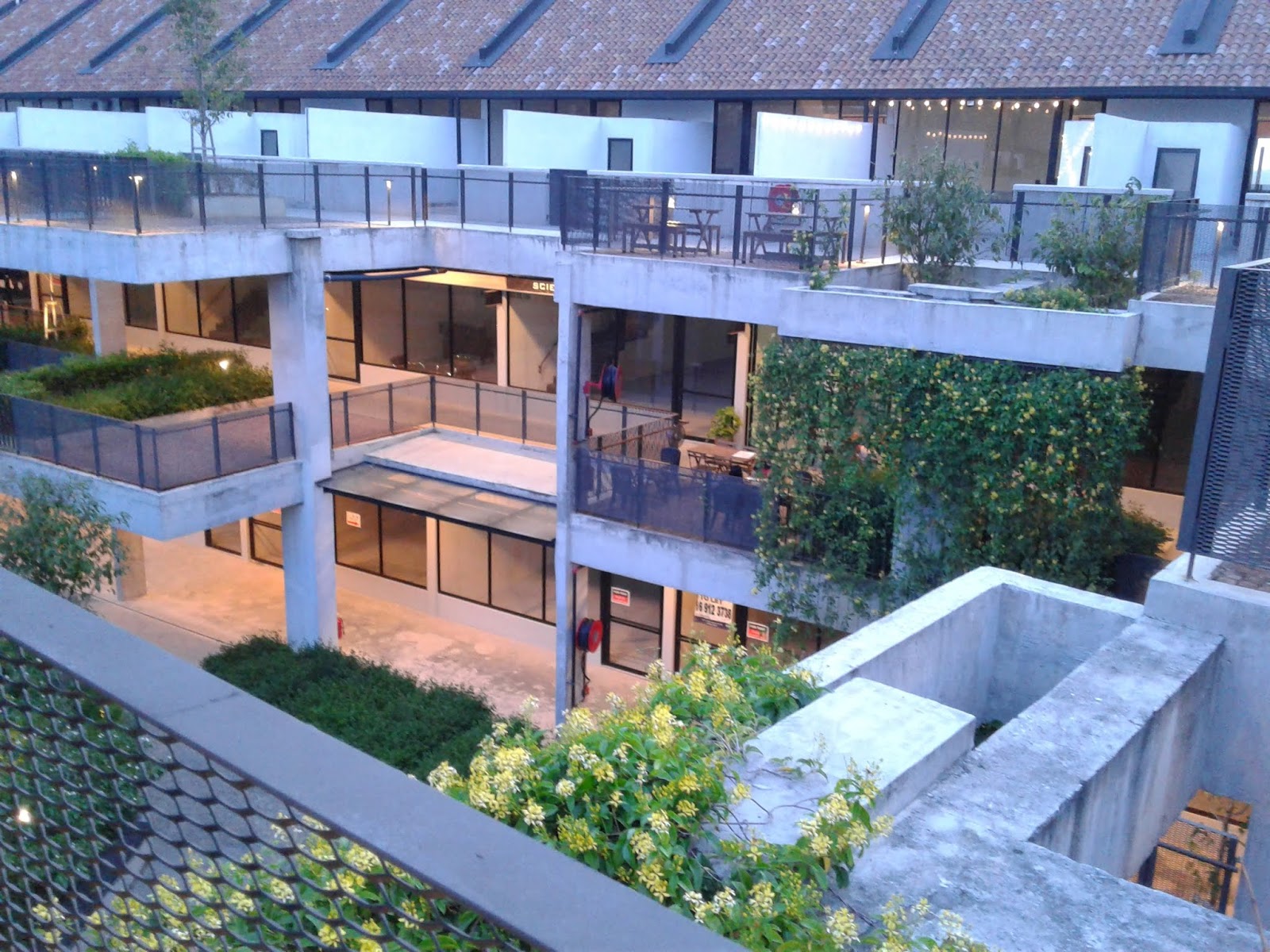
About a year ago, a business colleague from the UK had a meeting in Cyberjaya. His feedback: "A bit of a ghost town". And this week I actually joined friends (with a car) for dinner there. In fact we were visiting a new development, which my pals had worked with. And it was pretty nice! Opened only about a year ago, Tamarind Square is a complex of interestingly designed boutique office and shop spaces - I would say mainly catering for SMEs, although there's a larger retail area with a flagship (?) grocer's, 24-hour bookshop, and other stores. The entire space is bound together by gardens and walkways with creepers. There's a great new-community feel to the place, and I can imagine a smart, young crowd working and collaborating there - with hipster cafes, al fresco eateries, and yoga spaces on hand. Currently however - and OK, this place is pretty new (and not entirely complete) - it is a bit of a ghost town too.


So what happened to Cyberjaya? Well, I didn't get to explore the whole area, but from our drive to Tamarind Square, it seems a lot still is under construction. And to be fair, 1997 saw the onslaught of the Asian Financial Crisis - which was tough for many nations and saw this project being propped up by government. There are tax incentives, and almost no restrictions on foreign talent if you set up in Cyberjaya (as a foreign company?) and I've read that many big globals (IBM, Wipro, BMW etc etc) do have a presence there. And the district is apparently profitable. But it still has that ghostly air. 

Kuala Lumpur and suburbs also still suffer from inadequate public transport. And while the cleaner air of Sepang might appeal, it turns out there is currently only one train station to serve both Cyberjaya and Putrajaya. (And it's part of the KLIA Express - a non-interlinked line!) There are limited buses, too, apparently. But it took quite a drive for us to get from KL out to Cyberjaya - and from what I saw, a lot of the new district is quite sparse. Personally, even with a car, I would not be tempted to invest in a swish residential unit there, and would find it a difficult commute for work: it's too isolated, with not enough locally (yet) to make it worth a relocate. If others are thinking like me, then there is a chicken-and-egg situation going on. Retailers etc will move in when there's footfall. But people won't settle without amenities and retail.

My Malaysian friend had an additional explanation: Cyberjaya was too early. The government was smart to think about it, but the rest of the nation (public, workers, businesses) weren't switched on to tech, and didn't have today's fashionable entrepreneurial spirit back in 1997. So I guess the project lost brand momentum. And if anything needs sparky, up-to-date and forward-looking brand momentum, it's probably tech/R&D. There is also national government support for the majority ethnic group in Malaysia, which (it has been argued) discourages the survival instinct which could be applied to other visionary projects in this region - Singapore as a whole country might fall into this category! - and gets the workforce behind national growth and eventual success.

There are probably 110 other things to consider in Cyberjaya's story. But I really hope that it does become a successful R&D hub, or ASEAN Silicon Valley. Two new MRT stations are set to open in the next five years. That would be a (n overdue) great step in the right direction imo. And who knows, maybe today's creative, entrepreneurial, yoga-loving, crowd will be part of the solution, too? 


Here's some blurb: 
Cyberjaya Malaysia
Tamarind Square 


* Jaya in Malay means 'success' and is applied to countless towns, districts (even stores) across the country. I guess for good luck.


Tuesday, 22 May 2018

Malaysia's Zombie Love Affair

Well, we've all been in one of those, right?

But anyway, Malaysia as a nation seems to have a thing for zombies. Often comedy ones. I don't know if this is echoed across Thailand and other SE Asian nations (Thailand makes some excellent, non-comedy horror movies, btw). It's not a thing here in Singapore. But on various visits to Kuala Lumpur I have noted posters for locally-made zombie films - usually featuring Malay actors very poorly disguised as campy ghouls. (This seems to be part of the appeal!) 

My Malaysian zombie intro was many moons ago with an English-subbed version of comedy zombie stalwart, Mamat Khalid's Zombi Kampung Pisang (Banana Village Zombie) - which is hilarious / ridiculous, deliberately low-budget, and worth watching. Currently the genre can also be seen on public transport, teaching us social etiquette!


I've tried to do a bit more cursory research on Malaysia's comedy-horror and zombie flicks, but most articles / clips come up in Malay, which I only have a rudimentary grasp of! Here are a couple more tasters anyway (including additions from Khalid). Tbf an excellent grasp of the dialogue is prob not required! 

Zombi Kilang Biskut  (Biscuit Factory Zombies) a follow up to Zombi Kampung Pisang
KL24: Zombies  Malaysians with American accents (?!) in this B-movie 
Hantu Kak Limah Balik Rumah   (Ghost Sister Lime Comes Home?!)


PS The Pontianak and other Asian female ghosts
These movies also feature a local folkloric ghoul: the Pontianak (a female vampire/zombie). The Pontianak is supposed to be a vengeful spirit who suffered a stillbirth, was  stillborn, or died in childbirth. The Pontianak can take on the guise of animals, or a beautiful woman to trick innocent men (those dastardly beautiful women, all evil spirits I tell you!) Oddly - or, probably, not so oddly as I suspect there's a historical link! - traditional female ghosts across East / South East Asia have similarities, and look the same: with the long-hair/white-dress thing going on. (See also types of  Japanese Yūrei made famous in The Ring and other classic films.) 


Also on this blog:
My Fave Horror Movies - East & West (distilled!) 


Wednesday, 16 May 2018

How to BOGOF in SE Asia

FYI, I recently went for cocktails with a friend in Singapore. And obviously we picked a bar with a deal on. In this case, the deal was "1 for 1 Cocktails". Which sounds like a normal sale to me: you get one when you pay for one. But in Singapore, it actually means you get TWO when you pay for one. Hmmm...

In Britain, the same deal would usually be expressed as 2 for 1. Or Buy One Get One Free (BOGOF). 

I guess maybe the Singaporean phrase implies 'like for like'? Or is a version of an ambiguous  Western one I'd never heard of: Buy One, Get One (?)

Meanwhile, over in Malaysia, the same deal is expressed by the grammatically mysterious - but actually easier to understand - BOFO: Buy One Free One. Which is reminiscent of some diplomatic trade of political prisoners. (Also  variations: Buy One Free Two; Buy Two Free One, etc, depending on how lucky you are.)  

Anyway, hope that's cleared things up for some of you global shoppers out there. Probably time to blog off. Tarrah.  


PS In the UK, the term "bog-off!" is slang meaning "very strongly GO AWAY". It should not be used if talking to a boss. And has nothing to do with bargains.


Tuesday, 24 April 2018

Not Matcha of the Day: the meaning of "ickypooooo!"

OK, this cost about 2 Ringgit (US 50c / UK 37p) from a convenience store at the airport. And it has that ominous word 'flavoured' on the label. So I wasn't expecting an authentic green tea experience; just a refreshing drink. But really, ickypooooo! 

It's basically green, hyper-mega-ultra-sugared milk. Good grief! I could almost feel my pancreas groaning as I tasted this, and had to chuck it (the drink, not the pancreas) in the bin. Do people really let their kids drink stuff like this? (Please don't let your kids drink this!) 

As I've mentioned before, hyper-sugar is a modern Malaysian special - which is borne out by the new world-topping diabetes levels there. Goodday products are manufactured locally in Malaysia, which probably explains the (surely illegal elsewhere?!) sweetness. All I can say is: AVOID!


Badday: diabetes in a box

English learners: 'ickypoooooo!' is not a real word. It means roughly the same as 'eieeeeeewww!'  (or the Japanese きもおおおいいい) i.e. disgusting, or a noise indicating a recoil. Ickypooooo has a sort of old-fashioned, upper class edge to it, though. And it's used in a slightly humorous way because of this.


Thursday, 19 April 2018

#RefuseTheStraw update

I can't remember which week this is. But I've been failing massively with this initiative in Malaysia, not to mention a general daily encrustation with other plastics (bags, water bottles, takeaway packaging.. ). (I'm on the hoof at the moment, so in temporary accommodation, without kitchen etc!)

It's not good. 

But what's a bit better is the acquisition of a reusable steel straw. FINALLY! In fact I was hoping to receive a set in a birthday package - but it turned out that six out of eight parcels sent from the UK were 'lost' (apparently most likely stolen) in the Malaysian postal system. And the straws went too. 

So how delighted was I to find that some friends have set up a scuba travel company, and they're also supporting #RefuseTheStraw as part of its conservation efforts. And for merch, I managed to purchase a very jolly box with a steel straw, cleaner, and clips for keeping my own - reusable - chopsticks. (The box is also made of old shells, apparently, and is biodegradable..) 

How to proceed with hawker drinks, and a few other traditional things here, remains to be seen. But everything else requiring a straw can now be plastic-free for me. A small step in the right direction. Huzzah! 


(More images from my ample hand modelling portfolio..)

If anyone is interested in scuba holidays, btw, you can check out my friends' site here:
https://www.scuba-concierge.com/


Also on this blog:
Operating #RefuseTheStraw in Asia: Week 1 
Bags of Fun! Eco Practices East and West


Saturday, 10 March 2018

A Tale of Two Poké

Poké. A thing from Hawaii. And my new obsession.

OK, poké (pokay) is a little pretentious and fashionable in SE Asia right now. But it is still very delicious. And perhaps after some months in Malaysia, where it is next to impossible to find not-unhealthy food (another blog post about that soon!) it seemed even more satisfying. But anyway, I would thoroughly recommend trying these bowls out.

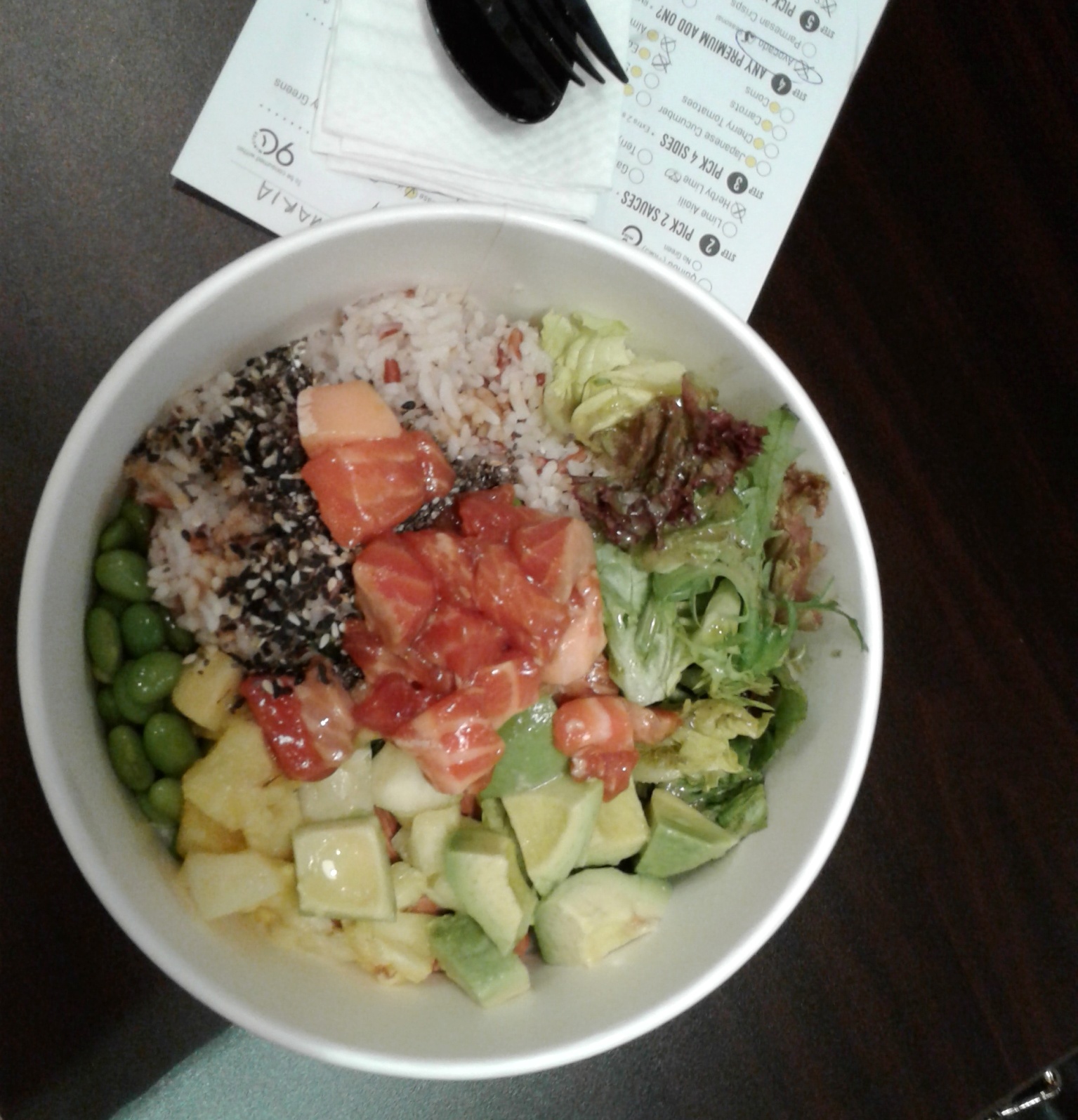
What is it / are they? Poké is a Hawaiian mixed salad with Japanese influence. (There is a large Japanese community in Hawaii, as some of you probably know.) It is made with raw fish, traditionally tuna, with sauces and chopped veggies and fruits added. I think Poké was originally a starter, but today's global outlet bowls are usually served on rice, and are large enough for a main meal. The Poké here in SE Asia tends to involve a choice of standard fish/protein with marinade, rice, salad leaves, and then a whole range of veggies, fruits, nuts and seeds to top it. Vegetarians can opt for tofu instead of fish. All these items are picked using a tick-sheet, which you hand in to the cashier. And if you can opt for a decent, chemical-free, sauce to go on top, it's a pretty healthy meal!

Here are two outlets I've visited in SE Asia:

Aloha Poke, Singapore
Pros: VERY delicious! Not least because the fish marinades were so flavourful you didn't require additional dressing. All bowls include lime, though you can choose another dressing if you want it. I had wasabi salmon and upsized to add peppered tuna. The other toppings were fairly standard and to my taste: avocado, fish roe, edamame, seaweed, pineapple etc. Good quality ingredients.
Cons: Avocado (which you pay extra for) was just a small ice-cream scoop of mashed fruit. Service was surly. 
Price: SGD16.90/ MYR50.22/ GBP9.27 / USD12.84  (upsized, with two proteins + avocado)
Seating: yes.
Branch I visited: Aloha Poke, Citylink Mall by City Hall MRT, 1 Raffles Link, #B1-65, Singapore 039393
http://www.alohapoke.com.sg/


The Fish Bowl, Kuala Lumpur, Malaysia
Pros: Also tasty, but given the difference in price, a very good deal! You also pay extra for avocado, but it's a generous portion and well worth it. The usual toppings are here with more nuts and seeds to pick from at no extra cost. Sweet/sour mango is tasty. Nice friendly team serving you.
Cons: You need to pick the more flavoursome ingredients / toppings here to avoid a slightly bland experience. The bowl comes undressed, and the optional dressings include some unhealthy (and I suspect chemical!) options, so choose carefully! Fish roe was poor quality (processed?) Again, given the reasonable price here, one just needs to choose well; the other ingredients are fresh and healthy.
Price: SGD7.37 / MYR21.90 / GBP4.04 / USD5.60  (for one protein + avocado. To upsize for extra protein and toppings costs an additional MYR6.00)
Seating: four small tables, but larger groups can use the general food hall seating area.
Branch I visited: The Fish Bowl, Pavilion mall food hall (between Papa Rich and Beard Papa!) Level 1, Jalan Bukit Bintang, Bukit Bintang, 55100 Kuala Lumpur 


Monday, 22 January 2018

Matcha Addiction: Uji Cha (Malaysia) matcha latte

This place popped up in one of Malaysia's suburbs recently. There used to be a Tsujiri matcha house there, but they seem to have been replaced by this locally-owned outlet Uji Cha. (Uji Cha is actually the name of a traditional green tea produced in the Uji region in Japan; but I can't find any reference to this cafe chain being in Japan, and Google lists it as a Malaysian company.) The  branding and imagery for this store actually looks a lot like the previous cafe, though!

It's a shame that the Tsujiri franchise shut down, but I was curious to try its replacement on a recent visit. 

Unfortunately in Malaysia - now one of the world's leaders for diabetes and obesity - it is hard to get away from ultra-sugar and chemicals in foods. (A subject for another post, I think!) And things like sugar being addictive, a vicious cycle has emerged - where shops add more of it to their products - because the addicted public now prefer to buy items which have even higher sugar / chemical content. For me (having resided in healthier places like Singapore and London) I was thus slightly suspicious of what the recipes might be in this locally-run place. Japanese desserts and drinks are famously low on sweetness - which is part of their appeal. Would this Japanese-branded store offer authenticity?

In short: no! Unlike its predecessor, this cafe offers a menu far more focused on high-sugar desserts, with Americanised additions like chocolate chips and candy toppings. And when I inquired regarding their matcha latte, the staff - a friendly duo who used to work at the Tsujiri too! - warned me that the matcha latte would be very sweet and I might not like it. So I asked if they could serve me one with minimum syrup/sugar added. And they kindly obliged! 

The matcha latte was made using the traditional bowl/whisk method, which was quite nice. Though sugar is still added. Then the hot milk is poured in. The 'regular' portion costs the same as Tsujiri's, but you get a smaller cup for the price. 

The verdict: 
The drink had a bitter edge to it, from the actual matcha powder added. This is good. But the overall experience was very much like hot water + sugar + a small amount of matcha. Not much creaminess or depth. And it was still very sweet, even though they had added only a fraction of the recipe's sugar quota. 

For the small portion for my price, this was disappointing. And the drink was not good enough to go back for. My overall advice would be to get your matcha elsewhere. (You can check my Matcha Addiction label on this blog for reviews of better places!)

It might even have to be *gasp!* Starbucks 'without syrup' packet matcha for me, if I visit that suburb again! 


Monday, 11 December 2017

Coochie coo chiku

I tried chiku fruit this week for the first time in about 20 years! And they're yummy. OK, they might not look that yummy - but like so many things in Asia, you can't judge by looks alone!

Chiku (sometimes spelled ciku in Singapore/Malaysia) grow all over the tropics, and are called variously sapodilla, zapote, chiko, sapoti, sapota, dilly, lamoot, and chicosapote in other places. It seems the fruit originated in Latin America and might have been introduced to Asia via the Philippines. 

 Chiku require peeling, and the flesh is caramel coloured, with cold, black seeds/stones. In fact the fruit texture and flavour is not unlike a custard-apple - soft and sweet, and slightly gritty, but the chiku has a sort of burnt-caramel undertone. The glassy black seeds are similar too (and should not be chewed or eaten). But the two fruits are not related. 

If you see chiku on your tropical travels, give them a try! 


English learners: Coochie coochie coo is a meaningless, affectionate, phrase usually used with babies. Especially if they're being tickled or cuddled. :) 

Thursday, 7 December 2017

Matcha Addiction: latte at the Nayuta chocolatier

This place is an upmarket Japanese chocolatier, which opened this year in the Isetan flagship store in Kuala Lumpur. Very nice interior, and the homemade, Asian-themed, chocs looked great (though pricey!) But they also have a cafe, so I thought I'd try out their matcha latte.

The Verdict 
I had this drink hot. And in fact it was more of a matcha cappuccino, as there was a thick layer of milk froth on top.  Underneath, the actual green part was pretty good: bitter, with a creamy edge. Fairly authentic. But lasted for about five slurps.

The place (very quiet when I visited, on a workday afternoon) scores top marks for presentation - European style with a little biscuit, and a glass of water. And service was good. In fact the drink arrived lukewarm, and they very politely remade me a new one when I requested it hotter. 

Price was RM14.90 (GBP2.75 / SGD4.90) which is kind of OK for such a posh outlet - the portion was small, but the next door Starbucks charges RM17.90 for a plastic cup of packet-mix matcha. A larger, longer-lasting drink would have been nice, though.

I'd return to this place for the nice experience (and a quiet place to work) more than the actual drink, however. My favourite matcha houses also offer authentic, bitter green tea, but much larger portions for the price! 


Nayuta is located on the Ground Floor, Isetan, Lot10, Kuala Lumpur, Malaysia.

Also on this blog:
Isetan's new concept in Kuala Lumpur: 'The Japan Store'


Monday, 4 December 2017

Chuggers

The chuggers are out in SE Asia. It's that time of year. Even in Malaysia - which I'm always a bit surprised about, because it is an officially Muslim country! (And tbh Christmas is not a big celebration in any SE Asian country, bar perhaps the Philippines). In fact the chugging phenomenon has just started in places like Singapore and Kuala Lumpur. And I'm not keen on chugging here, any more than I was in London!

The word chugger is an amalgam of 'charity' and 'mugger' (someone who violently robs you). They are the people in bright logo t-shirts, who appear in busy shopping areas usually before Christmas, accosting you to make money subscriptions to (usually large, famous) charities. 

I might have mentioned before that even if we don't actively practice the religion, a lot of European countries still have some 'Christian values' at the core of society. I only really noticed this after moving to Asia; I just (inevitably) thought they were 'normal values' until then! Things like compassion and giving are quite key in the West. Which they are not, necessarily, in Asian countries. Many friends in Singapore, for example, simply could not comprehend why successful Western countries like Germany were considering offering alms to refugees. Why would you invite such problems, and costs, if you're a prosperous nation? Why would you not simply protect your own? Well, part of the initial European sentiment, in my opinion, comes from centuries of religious background. As well as centuries of politico-historical, good and bad stuff we have hoped to learn from. (Though obviously, the recent refugee crisis ended up being a lot more difficult - and a whole debate in its own right...)

But anyway, this cultural aspect of compassion + Christianity is why chuggers particularly target pre-Christmas in Western countries.

Hang on, though, giving to charities is good, right? Especially if it's in your culture. So why would these groups get the 'chugger' name, and what are they doing wrong? Well, quite a lot, as it turns out. Though this view probably depends on whether you are a big charity, or a member of the public.

My earliest memory of chuggers in the UK was in the 1990s. And back then they were seen (as they are currently in SE Asia) as quite a novelty, and surely a good thing. But as time has passed, chuggers have become more favoured with the charities, and less favoured with the public. 

Chuggers are usually not volunteers who work for the charities they are pushing. Most come from organised agencies which specialise in hiring out teams of them (often college students), especially over the Christmas period. This third party aspect provides some useful business benefits (and, apparently, legal get-outs) for the charities. And to differentiate, if the person who is fundraising wants your bank details (and might not be happy for you to simply give a one-off donation or drop cash into their box) they are probably a chugger, rather than a regular 'street fundraiser'.

Stats say that around 80% of the UK public today loathe chuggers. This is for a number of reasons, including that many of the teams can employ aggressive, misleading, or pressuring tactics, be invasive, or try to make you feel guilty for not subscribing to the particular charity they're marketing. The 'good' ones are trained to spot the most likely types of pedestrian, target them, and use specific trigger phrases to 'make' them sign up (or 'make us feel' we should sign up). 'Make' is not a great aspect here. There are all sorts of clever and not-very-Christmassy tactics used to 'make' the public hand over their bank details for the subscription.

Most agency chugger teams work on a base + commissions/bonus basis. So for a start, the integrity, knowledge and passion of these people can come into question. Some marketers see this as an old-fashioned viewpoint, and flag up that chugger training practices have improved, and that bad press is the real reason for the public dislike of them. And it's true, the UK right-wing press, especially, is negative about chuggers. But either way, chugging is big business, and the chuggers' motivation might not be the cause they're pushing at you, but their own bonuses. This is also why one-off donations might be refused: the chuggers' KPIs are based on signing up bank details for long-term subscriptions.

I guess irritation, intimidation or politics aside, there is just something a bit off about the chugger as a person 'doing good'. Which at the same time is what they're trying to tell us we must be. Why should we be made to feel guilty for not supporting a charity, when the people pressuring us don't support it either? And are just making us feel bad for their own Christmas pocket-money? There's a big disconnect there, and I can't help thinking that if big scale is the only way to effectively fundraise today, surely a better model can be found?

The fast-growing number of chuggers has also been an issue. In early teens London*, at this time of year, there used to be teams on practically every street corner. Each one wanting to stop you and talk to you, and make you sign up to a different charity. Having to interact with one, polite, fundraising team each day on your commute can be charming - even if you don't agree with their cause. But eight or ten different teams of them? Shopkeepers have complained that as soon as chuggers set up outside their stores, they lose custom. Because people want to avoid the stress of being chugged, and will shop elsewhere.  


Another key aspect is that (possibly because of the culture) many UK people already support and/or have donations subscriptions to charities. In fact the UK public are consistently in the top 12 in the World Giving Index. But these are not causes we've been chugged or coerced into supporting. They're ones we've chosen ourselves, because we particularly appreciate the work they do, or the values they stand for. They could be any kind of charity - individuals all have their own, personal reasons for support. And that's another reason why being endlessly accosted on the street is not appreciated. Some people are perfectly capable of choosing their own causes.  

[Compassion Fatigue - ie so many causes simultaneously pushing at you, that you just switch off from all of them- is also a very real problem at this time of year in the UK.]

Chuggers can give charities a bad name. And in fact, several of the large UK charities will not use them. Though many others do. If we've had aggressive or irritating experiences with third-party chuggers, we trust that charity a little bit less - and for general marketing goals, trust is quite important! In fact some academic research from The Netherlands has shown that the majority of people sign up for subscriptions, not because they agree with the charity's work or ideals, but because it's the fastest way to shut down an uncomfortable and exhausting human interaction: refusing under (repeated) pressure. That in itself surely puts chugging into one of those most unsavoury and unethical of marketing practices? It is deliberately making the public into a kind of victim to achieve its goals. And that's not nice. Hence, perhaps, the widespread dislike of chuggers.

Despite many UK press articles (even in some moderate / liberal press!) comments and opinion pieces, complaining about chuggers - even calls for bans in some regions - the practice has continued to grow. For one reason: direct and repeated pressure on pedestrians is hugely effective in getting money in to charities. Apparently the returns for using chugger agencies come in at about 3:1. Which is quite significant. It's nasty - but it works.

Some years ago I remember talking to a friend (who works for a large NGO) regarding their use of a particularly ditzy celebrity as ambassador. The celeb seemed to have minimal grasp on anything related to the cause, but just wanted to be 'seen' as fashionably charitable for PR purposes. My friend agreed with me entirely: it was bad. But, she said, this celebrity was so popular that her mere presence boosted donations hugely from certain demographics. And what the charity needed to carry out its work, was cash. When there are pressing, maybe life-and-death, situations at hand, it doesn't really matter how the money comes in. As long as it comes in. 

There is also an argument (which I strongly suspect does not apply in Asia yet, but could in places like London) that not all chuggers are college students making holiday money. Some genuinely destitute people also find work with the chugging agencies, and it can prove an important lifeline for them to get back 'up on their feet' and into society. I don't know what the actual statistics for this are, but that could be one more positive and genuine angle. 

Either way, if you don't enjoy being accosted on street corners, or every time you use the escalator in your mall, there are other ways of donating or subscribing to good causes! At any time of year. And when you can do your own online research and decision-making, in your own time. (And if supporting charities is just not your thing, that is OK too!) 


* I've been in Asia for most Christmases since then, so can't comment on more recent years!

You can check out the latest World Giving Index here: World Giving Index 2017


Wednesday, 22 November 2017

On or Off? The Shoe Thing

A SE Asian friend recently commented how disgusting it was that some people wore outdoor shoes inside the house.

In most cultures in East and South East Asia, shoes are removed before entering any home. In Japan, even the tiniest apartments are usually designed with a hallway space for changing and leaving shoes. And across SE Asia, most places will have similar spaces, and/or racks for shoe storage outside the front door.

Inside Asian homes either bare feet or house slippers are worn. Which (assuming the home is also kept clean) ensures much more hygienic floors.

But in Europe, we often wear our outside shoes indoors.

For most UK homes, wearing shoes inside - or not - is usually just family preference. Some owners prefer guests to remove footwear; others don't. My family - which has Asian influence - would remove shoes and wear warm socks or slippers inside. But unless the outdoor shoes are very muddy or dirty (and don't forget there are hefty doormats for wiping them before entry, too) it is not generally seen as disgusting or insulting to wear them inside.

There are reasons for this. It is not just Europeans being unhygienic!

In East/SE Asia, traditionally, floors were/are used for sitting and sleeping on. But in many parts of Europe we have never really done that. Floors have one purpose: walking on. And not barefoot (too cold!) Even basic Anglo Saxon homes - in England, over 1000 years ago - used benches to sit on, and raised beds to sleep on. And earlier Roman counterparts had even smarter furniture!

Due to harsh winter climates, modest Anglo Saxon homes, for example, also housed livestock for part of the year. The family depended on these creatures for milk, meat, etc - because there is no harvest for the bleak months - and nobody wanted these precious animals to die of cold. But obviously, nobody wants to sit on THAT floor, either!

Reconstructed Anglo Saxon home
Regardless of creatures, a European floor would also be the coldest, dampest and draughtiest place to be. Far better (and maybe healthier) to be on something elevated, like a bench or a chair. You'll probably find public announcements even today in the West (plus countless parents instructing their children) "Keep Your Shoes Off the Furniture". We also don't want to sit in outdoor dirt!

Basically, floors have never been a social place in the UK, and many other European cultures.

In tropical SE Asia, by comparison, the cooler floor area was a good place to be. Also, the architecture in places like early Malaysia and Indonesia was different - with traditional wooden buildings raised above the soil. This was to allow air to circulate underneath, and through the floor - for even better cooling! In the absence of winters, livestock were kept underneath the building, not inside. So it made perfect sense to use the already raised floor as a seating, social and eating space.

Malay 'kampung' home raised on stilts

Even in temperate climates like Japan, traditional buildings were generally raised a little above the ground. And the floor - covered with tatami - was (and still is sometimes today) used for sitting and sleeping. So again, it was imperative that floors were immaculate and free from outside dirt. 

There is also some suggestion that Chinese cultures believed that barefoot walking (for foot stimulation) at home was good for health. As well as it being comfortable in warmer climates. So, yep, very clean floors desirable all round!


Japanese tatami
To go to an Asian home today and not remove your shoes, would be considered very uncouth and possibly even an insult for the host. Even though you will probably find IKEA chairs and beds there, just like everywhere else in the world. Remove the footwear! (And ensure you have clean socks and/or a decent pedicure!) Though interestingly, I have never come across an Asian office where shoes are removed.

Another, lesser, modern factor in the UK is the simple practicality of storing shoes. Smaller Western homes or apartments might not be equipped with hall or 'porch' areas to leave shoes. Because it is not an obligatory part of our culture. And you would not wish to leave them in any common space outside your home (which can be done very happily in places like Singapore) because there is a likelihood of theft! Items left outdoors in the cold would also become quickly damp and rot. So quite often, shoes are stored somewhere else in the family home - such as in a wardrobe or closet away from the entry area.

Anyway, my rule for European homes? Be prepared to remove your shoes, and ask the host as you arrive if s/he would like you to, or not. A stack of shoes near the doorway could be a clue that this household prefers socks and house slippers indoors! Asian homes, obviously: always remove :) 


*Incidentally, 'slippers' are two different things in the UK and SE Asia. In SE Asia, the word refers to rubber 'flip-flops'. In England, the word means soft, usually warm, fabric or sheepskin shoes specifically for indoors and bedrooms. 

Photo creds: Anglo Saxon home via W&G Robinson; Tatami room courtesy of loveartlab; flip-flops/slippers - havaianas. 


Thursday, 26 October 2017

Coconut balloon bomb #snackette

This is a coconut. Scooped, whole, from its shell - with the coconut water safely inside, like a small water-filled balloon! A friend introduced me to them at a posh supermarket in Kuala Lumpur, and it's the first time I'd seen coconuts prepared this way. There was a team of guys doing the scooping and potting in-store.

And it was delicious! :)

The advantages: it's easy and quick to eat, without all the messy scraping and time required of a regular whole coconut. Plus you get to eat/drink every bit. The disadvantages: plastic packaging. Though I have managed to wash and re-use my pot. It's only a little more expensive than buying a whole coconut in the supermarket (I think it was around Malaysian RM7 - about £1.25 or USD1.65). 


Thursday, 7 September 2017

This is what it looks like! Balonglong / Kedongdong

Oh yes. Time to sit down and contain your unmitigated excitement, readers! I found the balonglong/kedongdong fruit in Malaysia. Smaller than I thought - these are peeled - and like a sour, slightly dry Granny Smith to eat. (Maybe stick with the juice. Unless you enjoy sour, dry apples..) 


Further reading on this blog:
Balonglong, kedongdong... 


Monday, 14 August 2017

Pretty Pool Pix (plus attitudes to water: East and West)

As some of you know, my toddling years were spent in SE Asia. And when we returned to England (I was about 5 or 6 years old) I was enrolled at the local village school. When summertime, and thus swimming-time, rolled around, I was so surprised that many of the local British children were frightened of water. How could this be? To me, and my friends and cousins in SE Asia, water was the most brilliant, fun thing around! Because we'd frolicked in it very naturally, all our young lives. 

Water is just not a big deal in the UK. Obviously, this is largely climate-related. It's rare to find swimming pools, because they have to be either heated, and/or indoors (both very expensive). And even when heated, outdoor summer pools can be an inhospitable, toe-numbing endurance test! Except for the very brave, outdoor swimming is also seasonal - maybe 3-4 warmer months per year if you're lucky. Indoor, pay-for, municipal pools are year-round, but are often a noisy, grubby, crowded, chlorine fug; for practical exercise, not relaxation! The concept of being in water plus daily calm or fun, is just not a thing in Britain.

But my love of water hasn't wavered since tropical childhood. Be it the ocean (both on and below the waves now!) or pottering at a man-made pool. It's not just the activities, but also the light, colour and sound of water which are so appealing. And it's great to be back in SE Asia, where so many places have swimming pools. Here are some photos of them I've taken over the months. I haven't swum in all of them! :)

Click Any Photo for Slideshow  


More reading on this Blog:
Beach life in England...


* English-learners: 'pottering' is an informal British English word, meaning 'doing relaxed, insignificant activities' or 'doing nothing in particular'.