Showing posts with label Opinion. Show all posts

Wednesday, 4 May 2022

Matcha Addict - Jenki, London

Oh my! 

Jenki is a hipster 'matcha bar' in London's touristy Spitalfields Market. But it's one of maybe three (?) matcha outlets in the entire city, so I felt I had to give it a go. 

I excitedly ordered an iced matcha latte, which cost me £4. (S$8 / US$5)

Sadly the go-to (again!) for this was soy or oat milk (which are trendy in the UK) and I had to specify cow's milk. But OK.

The Verdict: It tastes just like iced milk! I could not detect any matcha at all in this drink and had to add sugar just to get some flavour from it. I mean it looks great. Nice colour green (usually a sign of quality) and gradient. Plus it sounded great on the website. But I have no idea why people would purchase this stuff, when you can have a very nice cup of milk and ice at home! 

Tbh a spectacular case of style over substance (plus what I find a depressing acceptance by Europeans for inauthentic Japanese things as the 'real deal'!) Am not surprised this place was full (not of Asians!) given its design and location. But really, avoid and take your cash elsewhere!


Jenki: https://www.jenki.co.uk/

Matcha Addict - DIY Matcha Latte in London!

In an endless quest to get my fix of the excellent Green, I purchased this affordable matcha powder in an Asian food store in London. 

Two things to note here: 

1) There are different grades of matcha powder, ranging from high-end (usually bright green) delicious, to low-end (often a sludgier brown) which might be more suited for cooking. Yes matcha biscuits, pastries, puddings, cakes and all sorts exist too! Generally you get what you pay for.

2) A lot of 'Japanese' and 'Korean' things sold in the UK are actually Chinese. This applies to almost everything, including restaurants. And most times UK people don't know the difference. This especially applies if the Asian product is affordable or on the high street. 

You can buy reasonably authentic matcha powder in London. But it will cost you! Usually you're looking at around £8-10 for 100g. Which I haven't been able to justify budget-wise yet, especially as I'm not very expert at making the tea myself. So when I saw this on sale for £1.98 it seemed stupid not to try it. 

It's Chinese. And I was not expecting great quality for the price! 

The powder is a sludgy olive green. Low grade! (And does resemble green paint pigment, which I hope it's not.) And the flavour is very bitter, without creaminess. It took me several tries to get the balance of milk, powder, sugar, water optimised for a latte. And I don't have a fancy frother or whisk. But then it was perfectly drinkable in small doses! I say small doses because more than 1 cup gave me headaches, as coffee would. (High quality matcha does not.) Or could it be the paint powder aspect kicking in...?

The verdict: really not bad. Probably meant for cooking, not drinking. But a reasonable 1 cup/day fix if you're desperate - for a very good price. And tbh I suspect this is what many London cafes use when they serve matcha. 

Not sure I'd buy it again because of the headache factor, but it gave me a good chance to experiment with DIY matcha lattes. I might lash out on a better quality, Japanese, powder now I know how. It would still be considerably cheaper than the whopping prices London cafes charge for matcha drinks!


Looks a little more minty here than irl!


Matcha Addict - Japan House, London

Well, I've been generally uninspired living in London (over a pandemic) so not been blogging about cultural things much. 

As things vaguely reopen here, I have managed to pop out and try occasional matcha drinks, though. So here to follow is a possible slew of drink reviews! 

First up is first-drunk. The hot matcha latte from London's (overrated) Japan House. I visited for the first time, to see an exhibition, and maybe get some authentic Japanese inspo in Europe. The space is basically an expensively-priced, sparse, retail outlet of Japanese things for tourists, and some un-cosy seating. Even London's Japan Centre is exciting by comparison! (And it's not exciting.) Plus the JH exhibition was meh. But they DO have a drinks bar serving matcha and occasional Japanese sweets.

This mid-sized latte came in at around £4 (S$8 / US$5) No pretentious 'coconut rice milk' etc mucking around, just regular cow's milk = good (I guess you can ask for alternatives if you're vegan, lactose intolerant blah blah). 

The verdict: Drinkable. Tastes like decent matcha as-made-in-the-UK (not creamy bitter like the Asian offerings, but a passable tea). I wouldn't go back to pay this price for it. 


Japan House, London: https://www.japanhouselondon.uk/


Thursday, 28 November 2019

After Asia: Sniffing (East and West)

I sniff a lot. I trained myself to do it while living in SE Asia. I don't mean sniffing to smell things, but sniffing with a cold nose. And it's problematic while I'm in the UK! Here's why:

In the UK (for some reason) it is considered extremely uncouth / unpleasant to make noises with your nose in public. Most of the UK year is cold, and people are likely to have runny noses - because of the low temperatures, allergies, or actual mild illnesses. But the custom is that you handle these symptoms by dabbing, or blowing into a tissue (or in the old days, a fabric handkerchief). If there's any kind of noise required, it is considered polite to make it in the bathroom with a tissue (and wash your hands afterwards). But for a 'cold nose' from outdoors, for example, you'd dab with a paper tissue, even in public. 

British toddlers are taught "Don't sniff, blow," as parents countrywide reach for tissues to help them. Medically, in fact, there doesn't seem to be much to back nose-blowing (and a few things which suggest it's harmful). The UK preference for a blow over a sniff seems to be mainly just one of tradition, and I guess the gross-out factor of the audio?

In Singapore (and I believe Japan, and some other East Asian countries) the opposite is true. Tissues and handkerchiefs are considered disgusting - because they potentially spread germs. And thus it is much more polite to sniff, rather than blow or dab. In Singapore, this can be taken to the extreme, with full-on nasal-honking and other loud noises from men and women in public. I still find these  outbursts tough to take - because I was brought up in Western culture! 

But after finding out about it, I agree with the lighter aspects of sniffing. Tissues (and worse, non-disposable handkerchiefs) really ARE quite revolting, especially if hands are not washed after use. And while I was living in Singapore, I caught on with the light sniffing trend. (People in the tropics do still get colds, and snuffles from overzealous aircon and other changes in temp!)

SO, a few winter months in the UK, and it looks like I'll need to re-train myself all over again. And invest in banks of paper tissues. A few people have given me odd looks when sniffing (odd looks = a passive British way of expressing 'eeiiw'!) just as I thought 'eeiiw!' when I first moved to Singapore! And it's endless runny-nose-weather in London, so I'd best get with the programme! But I still struggle with the snotty tissue/hanky concept - and prefer to at least chuck after one use. I mean, Asian or not, shouldn't we all be doing that anyway, to limit the spread of winter germs?

:)


English learners: "get with the programme" is a colloquial phrase which means to keep up and follow what others are doing.

Also on this blog:
On or Off? The Shoe Thing 


Photo credit: livingwell.borges.com

Tuesday, 10 September 2019

After Asia: The UK Does Not Do Tech

It's true! 

When I first moved to Singapore eight years ago, I remember being slightly horrified that so many things were online and automated. Because to me, anything using technology would be at best unreliable for use. THAT is because I'd been living in the UK! I was delighted to find that in Singapore (and nearby countries) technology works 99% of the time. And it actually does what people had trumpeted it should: make our daily lives simpler, more efficient and less stressful! 

That last statement certainly did not apply to the UK in 2011. But shockingly, I find it still doesn't now! I had coffee with a Japanese friend quite soon after I returned and was having problems with internet service. And she basically laughed, and coined the title of this post: "The UK does not do tech!"

OK, of course technology exists in the UK, but in a vast majority of cases for regular humans, it just doesn't work. I know Brits will be hopping up and down going 'But it does work!' - but compared to even some developing countries in APAC, it really doesn't! Here are four examples from my recent time in London: 

1. Supermarket checkouts have been automated. There could be maybe 20 self-service machines in a larger store now. And regardless of whether you agree with automation or not, at the very least, that should mean no queuing for the customer. But it's almost guaranteed that 50-60% of machines will be Closed or Out of Service. Or in service, but break down while you're using them. So tellers no longer get paid, and customers still wait in long queues.

2. A large number of MRT stations (especially outside central Zone 1) are no longer manned. Again, a controversial move driven by cost, and there have been concerns over passenger safety etc. But it means that at some stations we rely solely on the machines for any queries or transactions. And again, 50% of the machines don't work! Or they will work for just one of the several services they're supposed to provide. But it might not be the one you need! I mean, a basic would be to allow people to buy tickets/travelcards, no? But I've been stranded at stations several times with groups of frustrated passengers - at a bank of machines all rejecting our cards and spitting out our cash.

3. Home internet breaks down! This is something I had completely forgotten could happen! In SE Asia, it's a given that your net is provided 24/7 - 365. Just like water, or electricity. And a company which couldn't do that would probably fold quite fast! And in fact, while living in Kuala Lumpur, we'd actually have power and water outages, but the net provider was solid throughout! (Well, apart from during the power failures obviously!) In the UK, net can fail completely, for weeks in some cases (as experienced with a terrible provider here called VirginMedia) and with ridiculously difficult processes to contact customer services, who are also not interested in helping! I am actually amazed that this company hadn't folded. But I guess the bar is set very low for service and tech, so people still go back to them? (Home internet is also very expensive in the UK!)

4. Online services do not work. Some do, and occasionally commercial outfits - such as my bank - have actually improved in the past eight years. But try to (again) buy a train ticket, order medication, or do other important things online, and there's a high chance that it won't work. AND it will probably require hours of your time and stress discovering this! AND old-fashioned systems have often been removed in favour of the non-functional tech - so you're left with no way forward! The centralised (non-MRT) train ticket systems are so atrocious that my flatmate (who needs to travel regularly for business) will actually make the trip across London to visit the station offices and buy in person. It takes a few hours of his day, but he says still saves time over attempting to do anything online! None of this seems very first-world.

Like I've said before, compared to the APAC region, the pace of change in the UK is very slow. But it has been EIGHT YEARS since I left, not eight months. And I find the continued inability to make tech work wholly perplexing! There are many, many very smart people here, who know how to do the various facets of tech. Famously, the internet was even invented by a Brit! So why, in 2019, does tech infrastructure still work so poorly? Sure, it's a bigger country than Singapore. And there's existing infrastructure to overcome (?) to put in the new. But making a basic website transaction work? Or getting reliable internet access for a home in central London? What's going on there? The failures happen across both government and commercial systems. Is there just terrible management managing the people who know about tech? A dearth of talent for one, vital facet of tech? One can't argue with the fact that technology is our present and future - so it seems unlikely that poor investment is the problem, especially at commercial level. Or - like the VirginMedia example - has the bar of performance for consumers just been set so low in the UK, that organisations just don't really care or try? 

It's not good news for our economy, though! Safety and ethics aside, wasting hours of working people's time, leaving them stranded at stations, or without medications, because of bad systems does not put us in a good position! Especially when other parts of the world have harnessed technology and are racing ahead with it. 

Hopefully I will at least be able to publish this post successfully! 


Photo credit: Twitter

Sunday, 18 November 2018

After Asia: some unexpected viewpoints on the UK. Intro...

One thing about being an ('integrated'*) expat, is that you get to see your own country from a new angle. I'm not sure if this can be done without a fairly decent chunk of years overseas - and perhaps living in a very contrasting culture helps, too.

When I moved from the UK to Singapore in 2012, I found a lot of things new and peculiar. And yes, also difficult. OK, Singapore partly lives up to its reputation as 'Asia 101' for Westerners. Because most systems are in English, and many things work in a Western-logical way. But if you bother to scratch beneath this convenient surface, it's Asia. This shouldn't be a surprise, right? It looks Western / international, but the value systems underlying the place are not Western. They're Chinese (or I guess Chinese diaspora). With a few other influences - including Malay, Indian - thrown in. And a few aspects which are - as other Chinese diaspora generations in the region will testify to - just uniquely Singaporean. 

Also, working a regional job has allowed me to interact a bit with others around APAC, and view their takes on people, business, politics too.

Attitudes and assumptions - socially perhaps more than in business for me, anyway - are different from what I was used to in the UK. Some of these differences are actually very fundamental (even for a half-Asian person!) but you don't necessarily register this until a bit of time in the new place. I think this is partly because SE and E Asian cultures are relatively a little reserved about expressing opinion; so you need to take the time to stop and quietly observe and take in what others are doing / prefer doing. And also because it is very easy to just make an assumption - a fundamental understanding, even - that one's own 'right and wrong' is correct. This is not entirely a Western-arrogance thing. It exists, I suspect, for most people on this planet! We think and feel that our values are right, because we've known them all our lives, and because a majority of people around us - in our own countries, societies, cultures - think similarly.

But living overseas has highlighted this for me: our value systems might be right for us. Or they might be partially right / pretty good. But there are actually a whole bunch of really quite radically different value systems out there! And not everything in our own setups IS necessarily the right or best way.

So my viewpoints have changed over six+ years in SE Asia. There are European values which I still think are enduringly sound. But others which I really do question now - because it's such a drastically different (while also functional) story in Asia.

I guess on one level this could be viewed as a bit of a mindf***. Having one's lifelong foundations rocked about like this. And living overseas has most certainly had its alienating challenges at times! But actually I feel very grateful for this new group of perspectives.

So, I'm now back in London for a few months. And it feels rather strange! I've been enjoying it. But (or perhaps because) I feel like a tourist visiting my own city. A lot is familiar and comfortable - because I've lived in London for most of my adult life. But I'm currently still outside, looking-in, with some interest and/or bemusement! 

Coming up in this series are some things - from the small and ridiculous, to the larger and more serious - which I have noted as stand-out and different during this stay. 


The New Yorker cartoon

*An expat who doesn't remain ghetto-ised with other expats from their own nation (there are a lot of these!) but tries to make local friends, understand the operations, language and culture of the new place.


Thursday, 21 June 2018

Anecdotal Note on the British Class System

OK, the British class system is a lot less pronounced now than it used to be. As I've mentioned before, it's socially crass (and occasionally illegal) today to judge others negatively based on their class. (And yes, this should cut up and down across all groups.) 

But there are still things which are commonly acknowledged as indicative of certain classes. And these are sometimes gently mocked in the UK, particularly by the classes which actually exhibit them. For example: the eating of Mediterranean chickpea spread, hummus. Hummus is cheap and ubiquitous in UK supermarkets, but has long been considered a 'middle class' thing - alongside pesto, sundried tomatoes*, craft beers and other artisan foods. Holidays to places like Tuscany in Italy, the South of France, spas or yoga retreats also fall into this category. Middle class people (and the media) will make jokes about this. I suppose what makes some of these things 'middle class' is that they're slightly unusual, popular with other middle classes - or are a sign that you consider yourself cultured in some way. Why have fancy Greek hummus on your toast, when you could just have good old, traditional English jam?

The other day I was reminded of a conversation with a creative (middle class) UK friend, just before I started business school outside London. I should probably preface it by explaining that SPAR is similar to a less glamourous 7-Eleven convenience store chain.

Friend: What's the town like near campus? 
Me: It's a village. Really basic. There's nothing there, only a SPAR. 
Friend: Oh, a spa! How lovely! Well that's something.


* (I think the Mediterranean foods thing kicked off when middle class British Prime Minister Tony Blair once stated he liked eating Italian pasta with sundried tomatoes - and was lambasted by press for saying it!) 


Also on this blog:
Unravelling the British Class System


Sunday, 29 April 2018

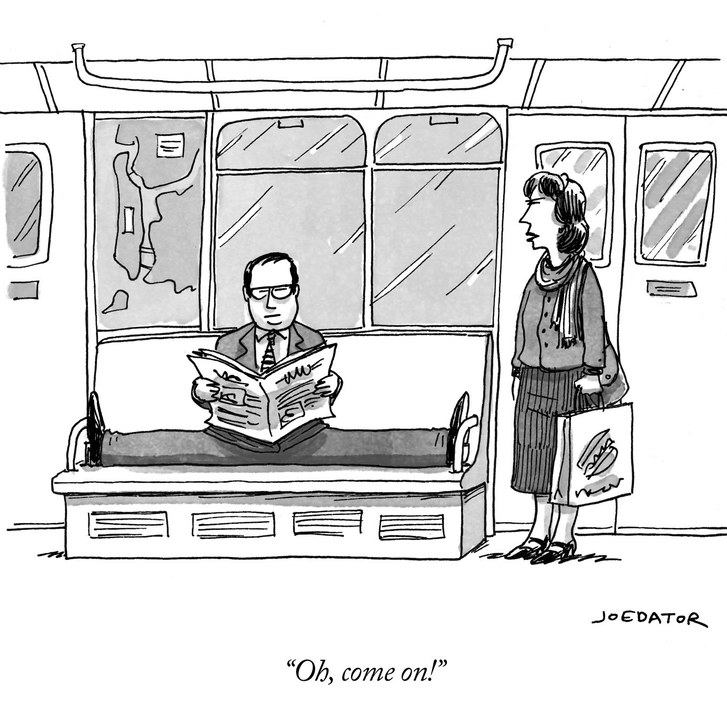
Manspreading

This is the act of men sitting (usually on public transport / in cinemas etc) with their legs so widely splayed apart, that it makes things uncomfortable for the people sitting either side.

OK, turns out there has been a lot of world controversy over manspreading, internet campaigns shaming spreaders (which I don't particularly agree with) and backlashes. But the bottom line is that manspreading (or as it's known among my friends 'attempting the box splits') in public is just plain inconsiderate. And there does seem to be an odd propensity for men to 'spread' and crush females more than other males. Even worse are the spreaders who also stretch their arms out along the backs of their adjoining seats (as one might to a known partner!) It's kinda disrespectful to do all this to any stranger's space. And it's not uncommon to experience being crushed like this in London / Western cities.

But manspreading does not really exist in SE Asia. I have experienced it once from a Chinese guy in Singapore (in five years of living/commuting here!). And, really - praise the Lord! - what relief to be able to travel in relative spatial comfort!

Alright, I know that in general, East Asian men don't have the long legs that some Westerners do. And I do have sympathy with really tall guys anywhere who try to fit into cramped seating. So anyone over 6' 3" (190cm) can probably be exempt from 'spreading' criticism. But even Western men of normal or smaller height spread. A show of machismo? Territorial marking? Ill-fitting jeans?? Thong underwear?? All of the above? 

Whatever the reason, it's not attractive. And not very nice. And I've got to the point where I will politely tell any spreader to kindly remove his leg / arm from my space.

My experience is that in East Asian culture, men - socially and otherwise - are probably less likely to do macho, chest-beating, 'look-at-me'. Which some (FYI not all!) Western men do. I don't know about other cultures. Over in SE Asia, it's just not really the thing to do macho displays on places like public transport. Which possibly explains the lack of manspreading thereon?

OR, Asian men just make wiser fashion choices?

As I've said before, there is still a heap of stuff I admire about the West. But manspreading is certainly not one of them! 

Seems The New Yorker has the same sentiments!


Also on this blog:
Pseudo-ku : the curse of the 'intellectual'

Wednesday, 18 April 2018

Work-life-balance East and West

East Asia is famous for tough office hours and dedication to work. "The industrious East" is still a global brand, which has been upheld by the recent economic track records of places like Japan and China. Many cultural aspects from East Asia have also influenced South East Asia (Chinese diaspora, general modelling on successful 20th century practices). And there is a huge energy of growth and change in the whole region - which you don't feel in the peaking (peaked?) West. 

So, all good for Asia*, right? Well, maybe not. My observations of, and conversations about, the Asian work ethic have been unexpected... 

2015-17 was a fairly momentous time for the marketing industry in Japan. Tragically, a young Tokyo employee at ad agency Dentsu died of overwork. In fact the occurrence is not uncommon in Japan: there were apparently 84 deaths in 2016 linked to overwork. There is even a word for it: 過労死 (karoshi - overwork death). The marketing industry worldwide also has a deservedly bad rep regarding employee work and pay. Long hours for free are regularly expected - even factored into  agency business models. It used to be bad enough in Europe; you can only up the ante in Asia. But what was different about the Dentsu tragedy, was public outcry, and an open trial of company executives. Which actually highlighted working hours as a problem. And Dentsu was found guilty of breaching employment legislation. Whether the company's resulting (microscopic) fine, or alleged changes to working hours, really affect things going forward, though, who knows. It seems the death was perhaps more the result of company culture and tacit expectations. Which might not be unique to Dentsu. Or Japan.

In many parts of Asia, 'hard work' in the office does not mean the same thing it does in Europe. It means long hours. Sometimes very long hours. But not necessarily productive ones. 

There are reasons for this. For example, in many East Asian countries (and countries with East Asian influence) it has traditionally been seen as bad form - or a loss of face - to leave the office before your boss does. And your boss (who might be on a humungous salary to justify such long hours) could stay very late. So the tacit ruling is that everyone has to stay very late. It's not about productivity, or results, but a show of 'honour'. 

Japanese friends have told me that they would regularly (deliberately) spend hours during the day 'filling' time (on Facebook, having tea etc) because they knew they would be honourably in the office until 9pm anyway. Even if they had no work to do! 

My experiences in Singapore were not dissimilar. People would complain of the long hours they worked (and they often did!) but I'd note that during the day there was a lot of sitting around, chatting, smoking and doing nothing work-related. This quite shocked me, when I first arrived from London. I'd imagined the pace would be the same, but just for longer - hence 'the industrious East'! In fact the pace was a lot more laid back overall, and 'stretched out' - probably due to decades of this long-hours/late-night expectation. Even in the trendier workplaces, where more reasonable hours were apparently operated, there was an expectation of 24/7 instant availability via phone or email, which was regularly used (so no time is your own!) I know from experience that out-of-hours contact is rarely necessary in my profession (once? twice? across my entire career!) But in Asia there was still a vibe that it had to be done regularly to 'appear industrious'. 

Chats with colleagues also revealed that although a practice might be 'traditional' or 'honourable' it can still be - and was! - resented.


Yep, an inevitable negative of the long-hours thing, is that people lose out on their own lives. Time with friends, family, to pursue hobbies, sports, romantic time, down time, cultural time, inspiration time, adventures, and all sorts of other things get scuppered for the long-hours office culture. Sometimes even without the compensation of extra pay. And many Asian people loathe it. It seems that regardless of region or culture, people worldwide have similar basic needs. And being able to own your own time - or at least a decent proportion of it - is one of them. (To lose this time while actually doing nothing important at the office seems like a double whammy to me!) 

In the UK (in my industry, at the same relatively senior level) the working style was different. I'm not saying that it was the perfect solution, or that it was stress-free - in fact in many was there was higher stress. But we worked pretty intensely during the day. It means that we could get the business results, and still leave on time to enjoy our evenings and weekends. And there is increasingly a culture where nobody is quietly frowned-upon for doing so.

For example, I'd get in at 9am, make a coffee, then be at my desk constantly, 100%  occupied with work tasks, until lunchtime. And the same in the afternoon. Meetings were ideally kept short, direct, to minimise 'lost time'. No lolling around, chatting or social media (except during lunch hour if I wanted to). Business school was a further refining of this work-style - with most teams working to Pareto to maximise returns on (very) limited time. That was part of the training. 

Misconception: so the Asian view that Europeans 'have it easy' is not quite correct. We work very hard, but we try to work smart, so that we can also enjoy 'life outside'.  Plus many companies now encourage this, and judge us on our results, not time at our desks, or on our phones. 

For most EU countries, the maximum legal employee working hours per five-day week is 40 (48 for a six-day week). It's averaged out, and there are exemptions for some professions. But eight hours per day is the standard rule. And economies do not seem to have suffered for it. In fact some of Europe's most work-life-balance aware countries (Germany, France, The Netherlands, Sweden) are also its most prosperous. 

Management experts (albeit probably Western ones!) agree that happy, enriched people, with a handle on their own time, actually have higher productivity and buy-in during their shorter work hours, and benefit businesses more. (Resentful ones, obviously, far less!) And for the creative industries especially, I always wonder how great ideas can flourish if experiences / inspirations are limited to the workplace. 

I'm not doing a whole 'West is Best' thing here (most of you already know that I'm fairly aware of that bias!) And one can't argue with the success of the Asian tigers. People do things differently. And achieve goals differently. But when described to my Asian colleagues, they nearly all thought the more intense Euro-style sounded pretty good, especially if it allowed evenings and weekends on their own terms. In fact, some of the younger people already had exit dreams and plans: to step out of the rat-race once they were solvent, and opt for more work-life-balance. 

I've noted East and South East Asian countries are often places of contradictions. In many ways they can be socially ultra-conservative, staunchly unwilling to alter tradition. But this alongside (or perhaps because of?) fast economic growth, agility, innovation and change. 

The work-life aspect is one social tradition which might change soon for this region. And we can probably thank the Millennials for this! There are some things I admire greatly about the new Millennial generations over here. While they're labelled as faddy and entitled (which is sometimes true) they're also questioning a few daft traditions, and turning them on their heads. 

Low-conception (an aside!) 
I also have a theory about the declining birth-rates in countries like Japan and Singapore. A drop governments and economists have worried about for a while. Of course it is a problem with some complex socio-economic roots. But if you're in the office until 9 or 10pm daily, this seriously limits your social time (finding a partner), time for getting to know him/her, or romance WITH an existing partner. AND probably the energy to feel generally happy, relaxed and romantic in the first place. Does this help bring on healthy new generations of bouncing babies? In my view, Asia's long-hours office culture seems to be at odds with a lot of the region's traditions of children and family, as well as modern economic considerations. Increased work-life-balance could be a serious win-win for Asia! 


* I'm using 'Asia' to apply to the East and South East Asian countries mentioned in this post. For ease. I do realise that it's a huge continent full of diversity. Just as Europe is. (And I've also referred to Europe in the general sense, to make broad comparisons with East and South East Asia).

** The Pareto Principle suggests that 80% of results come from 20% of your tasks. So that 20% should be identified, and strongly prioritised. 


Also on this blog:
People, damage limitation, Dentsu and debacles


Thursday, 18 January 2018

Adblocking – the 'them and us' of marketing?

TWO APPARENTLY UNRELATED THINGS

1: Anyone who's studied business is probably familiar with a version of this rivetingly artistic diagram. It's a model of a marketer's wish-list, and it is achieved by building their target customers' trust. With increasing trust, sales, repeat sales, even valuable advocacy and partnerships can be possible. Hurray! 


2: Some examples of crap tech.
  • Instagram puts up horrendous recreational hunting videos on my suggestions page, because it has noted that I like 'wildlife'. Yep, both involve animals. But they're ABSOLUTELY not the same thing.
  • Just after hols, I reviewed the very nice resort I'd visited, on TripAdvisor. On the next web page I opened, a banner flashed up urging me to book a holiday at this resort. Well I was only there yesterday... do I want to book again, now? No. Do I want this orange animated thing flashing at me? No.
 
WHY THEY FIT TOGETHER

Like 90% of people in APAC today (apparently), I love my adblockers. Hitherto irritating experiences with platforms like YouTube (which temporarily made me switch to Veoh and other options) have once again become interesting and engaging. Because I go in there to view specific content, to learn, be entertained, escape and enjoy. Not to have trashy ads telling me to buy buy buy (or that I 'NEED a website!'). And I certainly don't go online for the learning, enjoying thing, to find content that is really advertising masked heavily as something else. (Known rather euphemistically in the industry as 'native advertising'!)

And yet I've just been reading an article (for and by marketers) discussing exactly the above but suggesting the way forward is to be even sneakier and tech-smart about getting their client's brands under the noses of us adblocking public who don't want them. It's all about speed of upload and targeting, apparently. Or is it?

OK, targeting sounds smart. And I don't think anyone will argue that it's most certainly better than the 'spray and pray' of yesterday (which is still happening today – website, anyone?). But there are some problems with this too:
  1. Some people don't like their data and behaviours being tracked, aggregated and used to 'target'. I don't know what the stats for this are in APAC, or even if we have a choice, but for many, it's not a trust-builder
  2. A lot of the tech for so-called 'targeting' seems to currently fall way short of having even basic common sense. (That's where the recreational hunting and trip example come in.)
  3. The whole concept of speed and targeting might be missing the point entirely. Because adblocking suggests that we don't want ads.

The rise of adblocking (and also the new, EU-style, protective data privacy laws which are set to hit Singapore this year) both seem to be approached by marketers and their agencies as 'evils' which need to be overcome or circumvented in clever ways. And of course all businesses need to monetise, and to sell, otherwise, no point. But what seems to be have been lost from this whole, high-cash, high-energy, marketers' circle is that thing with the unglamourous ladder: customer TRUST.

So is a new ladder emerging? Where the value chain for humans in the digital age is not about building trust to achieve sales, advocacy and co. But brands being clever and non-transparent enough to trick or pressure us into buying products instead - and use paid 'advocates' to trick us a bit more? Where the brands/marketers and their customers are opponents in a sort of tacit battle of wits?

To be honest, perhaps this is working. Or working well-enough. There seem to be big bucks invested in it. Though that 90% keenness on adblocking might be problematic here!

OR does a different model need to be found, to build trust via more transparent and thoughtful means which genuinely include and respect the customer? Maybe marketers need to jump off the 'pushing ads' hamster wheel and think of something else entirely?

Some outfits are already exploring avenues such as rewarding users who view / engage with their ads. And my personal opinion is that consumer choice of WHEN to view is key: I don't want an annoying orange banner flashing pointlessly at me now; but in a year's time when I'm actually booking another trip, I might like to ask for its help.(SEM, anyone?) 

Let's see how this one pans out!


PS: I don't NEED a website. And if I do, this particular outfit – which barked at me 20x daily on YouTube for so long - will be the first provider deleted from my list!

PPS: And I don't work in sales. I'm just a consumer :) 


Monday, 4 December 2017

Chuggers

The chuggers are out in SE Asia. It's that time of year. Even in Malaysia - which I'm always a bit surprised about, because it is an officially Muslim country! (And tbh Christmas is not a big celebration in any SE Asian country, bar perhaps the Philippines). In fact the chugging phenomenon has just started in places like Singapore and Kuala Lumpur. And I'm not keen on chugging here, any more than I was in London!

The word chugger is an amalgam of 'charity' and 'mugger' (someone who violently robs you). They are the people in bright logo t-shirts, who appear in busy shopping areas usually before Christmas, accosting you to make money subscriptions to (usually large, famous) charities. 

I might have mentioned before that even if we don't actively practice the religion, a lot of European countries still have some 'Christian values' at the core of society. I only really noticed this after moving to Asia; I just (inevitably) thought they were 'normal values' until then! Things like compassion and giving are quite key in the West. Which they are not, necessarily, in Asian countries. Many friends in Singapore, for example, simply could not comprehend why successful Western countries like Germany were considering offering alms to refugees. Why would you invite such problems, and costs, if you're a prosperous nation? Why would you not simply protect your own? Well, part of the initial European sentiment, in my opinion, comes from centuries of religious background. As well as centuries of politico-historical, good and bad stuff we have hoped to learn from. (Though obviously, the recent refugee crisis ended up being a lot more difficult - and a whole debate in its own right...)

But anyway, this cultural aspect of compassion + Christianity is why chuggers particularly target pre-Christmas in Western countries.

Hang on, though, giving to charities is good, right? Especially if it's in your culture. So why would these groups get the 'chugger' name, and what are they doing wrong? Well, quite a lot, as it turns out. Though this view probably depends on whether you are a big charity, or a member of the public.

My earliest memory of chuggers in the UK was in the 1990s. And back then they were seen (as they are currently in SE Asia) as quite a novelty, and surely a good thing. But as time has passed, chuggers have become more favoured with the charities, and less favoured with the public. 

Chuggers are usually not volunteers who work for the charities they are pushing. Most come from organised agencies which specialise in hiring out teams of them (often college students), especially over the Christmas period. This third party aspect provides some useful business benefits (and, apparently, legal get-outs) for the charities. And to differentiate, if the person who is fundraising wants your bank details (and might not be happy for you to simply give a one-off donation or drop cash into their box) they are probably a chugger, rather than a regular 'street fundraiser'.

Stats say that around 80% of the UK public today loathe chuggers. This is for a number of reasons, including that many of the teams can employ aggressive, misleading, or pressuring tactics, be invasive, or try to make you feel guilty for not subscribing to the particular charity they're marketing. The 'good' ones are trained to spot the most likely types of pedestrian, target them, and use specific trigger phrases to 'make' them sign up (or 'make us feel' we should sign up). 'Make' is not a great aspect here. There are all sorts of clever and not-very-Christmassy tactics used to 'make' the public hand over their bank details for the subscription.

Most agency chugger teams work on a base + commissions/bonus basis. So for a start, the integrity, knowledge and passion of these people can come into question. Some marketers see this as an old-fashioned viewpoint, and flag up that chugger training practices have improved, and that bad press is the real reason for the public dislike of them. And it's true, the UK right-wing press, especially, is negative about chuggers. But either way, chugging is big business, and the chuggers' motivation might not be the cause they're pushing at you, but their own bonuses. This is also why one-off donations might be refused: the chuggers' KPIs are based on signing up bank details for long-term subscriptions.

I guess irritation, intimidation or politics aside, there is just something a bit off about the chugger as a person 'doing good'. Which at the same time is what they're trying to tell us we must be. Why should we be made to feel guilty for not supporting a charity, when the people pressuring us don't support it either? And are just making us feel bad for their own Christmas pocket-money? There's a big disconnect there, and I can't help thinking that if big scale is the only way to effectively fundraise today, surely a better model can be found?

The fast-growing number of chuggers has also been an issue. In early teens London*, at this time of year, there used to be teams on practically every street corner. Each one wanting to stop you and talk to you, and make you sign up to a different charity. Having to interact with one, polite, fundraising team each day on your commute can be charming - even if you don't agree with their cause. But eight or ten different teams of them? Shopkeepers have complained that as soon as chuggers set up outside their stores, they lose custom. Because people want to avoid the stress of being chugged, and will shop elsewhere.  


Another key aspect is that (possibly because of the culture) many UK people already support and/or have donations subscriptions to charities. In fact the UK public are consistently in the top 12 in the World Giving Index. But these are not causes we've been chugged or coerced into supporting. They're ones we've chosen ourselves, because we particularly appreciate the work they do, or the values they stand for. They could be any kind of charity - individuals all have their own, personal reasons for support. And that's another reason why being endlessly accosted on the street is not appreciated. Some people are perfectly capable of choosing their own causes.  

[Compassion Fatigue - ie so many causes simultaneously pushing at you, that you just switch off from all of them- is also a very real problem at this time of year in the UK.]

Chuggers can give charities a bad name. And in fact, several of the large UK charities will not use them. Though many others do. If we've had aggressive or irritating experiences with third-party chuggers, we trust that charity a little bit less - and for general marketing goals, trust is quite important! In fact some academic research from The Netherlands has shown that the majority of people sign up for subscriptions, not because they agree with the charity's work or ideals, but because it's the fastest way to shut down an uncomfortable and exhausting human interaction: refusing under (repeated) pressure. That in itself surely puts chugging into one of those most unsavoury and unethical of marketing practices? It is deliberately making the public into a kind of victim to achieve its goals. And that's not nice. Hence, perhaps, the widespread dislike of chuggers.

Despite many UK press articles (even in some moderate / liberal press!) comments and opinion pieces, complaining about chuggers - even calls for bans in some regions - the practice has continued to grow. For one reason: direct and repeated pressure on pedestrians is hugely effective in getting money in to charities. Apparently the returns for using chugger agencies come in at about 3:1. Which is quite significant. It's nasty - but it works.

Some years ago I remember talking to a friend (who works for a large NGO) regarding their use of a particularly ditzy celebrity as ambassador. The celeb seemed to have minimal grasp on anything related to the cause, but just wanted to be 'seen' as fashionably charitable for PR purposes. My friend agreed with me entirely: it was bad. But, she said, this celebrity was so popular that her mere presence boosted donations hugely from certain demographics. And what the charity needed to carry out its work, was cash. When there are pressing, maybe life-and-death, situations at hand, it doesn't really matter how the money comes in. As long as it comes in. 

There is also an argument (which I strongly suspect does not apply in Asia yet, but could in places like London) that not all chuggers are college students making holiday money. Some genuinely destitute people also find work with the chugging agencies, and it can prove an important lifeline for them to get back 'up on their feet' and into society. I don't know what the actual statistics for this are, but that could be one more positive and genuine angle. 

Either way, if you don't enjoy being accosted on street corners, or every time you use the escalator in your mall, there are other ways of donating or subscribing to good causes! At any time of year. And when you can do your own online research and decision-making, in your own time. (And if supporting charities is just not your thing, that is OK too!) 


* I've been in Asia for most Christmases since then, so can't comment on more recent years!

You can check out the latest World Giving Index here: World Giving Index 2017


Monday, 13 November 2017

What is "Going For A Cheeky Nando's"?

Blowing.The.Lid. *Unfeasible Shock* Yep, 'Cheeky Nando's' doesn't mean anything! This phrase became used a few years ago, in the UK, to confuse (US) foreigners who couldn't understand 'cheeky', and then for young Brits to create really long, non-sensical explanations for it. The whole process is an urban joke! (Not invented by the restaurant). Cheeky in British slang could imply 'local, fun, a bit naughty'. If anything here, it refers to the local 'naughtiness' of inventing bogus explanations of the slang to foreigners. Which, though it was a phenomenon at the time, and has doubtless spawned many inventive and creative outpourings, is also rather dumb and irritating. 

No!
(Yes)

The best option with this phrase is to ignore it - or enjoy the amusement of listening to the young Brits' complex, serious, joke responses to you if you ask what it means. (It just means eating a meal in Nando's chicken restaurant, ultimately.) 

The whole joke has (hopefully) gone out of fashion now. Though it was so popular at one point that many neutral people have since nicknamed the dining chain 'Cheeky Nando's'.

Hope that's cleared that up!  

Feeling oddly hungry now... 


Note to English learners: 'blowing the lid' on something means exposing it. (As if you are removing the lid on jar, to show what is really inside.) It usually refers to something bad or criminal, which needs to be exposed!


Monday, 23 October 2017

November the 5th, fireworks and gruesome murder

I was watching some fabulous Deepavali fireworks the other night, and it prompted a Japanese friend to recommend various regional displays back home - for a whole variety of traditional festivals. Japan is famous for a myriad of beautiful and lengthy firework displays, in fact. (And, rather nicely, the Japanese characters for fireworks are 花火 (hanabi) - literally fire blossoms!) All this happy stuff made me think about my own country. 

We don't use fireworks so much in the UK. Of course fireworks are a Chinese invention, so you might expect them to be more part of East Asian traditional culture. But the rest of the world has also had access to these pyrotechnics for some centuries! 

In Britain, more recently, we have official New Year's displays in large centres like London - echoing similar shows in Paris, Sydney, Singapore and other world cities. And we might have other official one-off shows for very special happy occasions (royal wedding, Olympics etc).

But traditionally, there's only one day when we would have firework displays countrywide: November the 5th - or 'Guy Fawkes Day'. And it's actually slightly gruesome! 

This 'celebration' is entirely political spin mongering, though over time it has become an accepted  tradition. Which is a sneakily clever, and not unusual, practice worldwide! 

November the 5th commemorates the day in 1605, when Guy Fawkes (and a bunch of other people) were foiled from blowing up English Parliament - which in those days included the King - with gunpowder. Fawkes and his cohort were Catholics, who wanted to assassinate the Protestant King James I, so that he would be replaced by a Catholic monarch.  (The struggle between Catholic and Protestant Christian wings - both in terms of faith and political power - was a big deal across Europe in those days.) Fawkes wasn't even the leader of the rebel group, a chap called Robert Catesby was. But Fawkes has become the brand figurehead for the conspiracy - possibly because he was the first one caught with gunpowder under the parliament building.

In the end, the treasonous group was hung, drawn and quartered. Which is a very nasty way to go - and a fairly grim thing to celebrate in the 21st century! OK, the initial idea was supposedly that we celebrate the survival of King James - with a brilliant piece of 17th century PR: countrywide fireworks, and bonfires to burn effigies of Fawkes. But frankly, the last part seems a bit personal! 

As the saying goes: one man's rebel is another man's freedom-fighter. And Catholics were persecuted in England at the time (though apparently through measures already in place when James came to power, and which he was pressured not to slacken despite his own more lenient personal views). Assassination is obviously not a good thing! But public hanging and disembowelment is not either. 

How we celebrate it
Traditionally, also with local firework displays, often accompanied by a bonfire. Fairgrounds may also be set up temporarily by cities, towns and villages countrywide - for the week surrounding November 5th. Due to the proximity in date to Halloween, community celebrations are sometimes a mish-mash of both events. (As I've mentioned before, a big Halloween with costumes, trick-or-treating etc is not a British thing - that was imported from America during the late 20th century!) Small towns might have their own, individual, local customs (such as tar barrel rolling!) which have become associated with the date, too.

In the 20th century and earlier, local children would often create the Guy Fawkes effigy to be burned on the bonfire. And go door-to-door around the village asking for donations, with the traditional plea "A penny for the Guy?". I'm not sure how popular this aspect is today.

As a child I thoroughly enjoyed the fairground candy floss, rides and excitement, the fireworks and bonfire celebrations. I assumed the explosive fireworks were a nod to the gunpowder (which might be true!) And I only knew that the effigy was supposedly of a very evil person called Guy Fawkes, who tried to do wrong against a blameless state. The reality is, unsurprisingly, probably a bit more complex than this! 

Like many modern and informed British people today - I'm not crazy about the Guy Fawkes thing now, and prefer to enjoy fireworks at New Year's or for royal weddings! Here's a happy use of fireworks - which hopefully will become the new tradition - for the 2016/17 New Year. It includes   homages to David Bowie and Prince who died in 2016, and there are references to all sorts of diversity, if you know British culture and music!


Further reading on this blog:
Halloween
Bonkers British Festivals no1: The Ottery Tar Barrels


Sunday, 19 March 2017

Bags of Fun! Eco Practices East and West

OK, possibly not all that much fun... 

I've been in Malaysia recently, and noted with some pleasedness that plastic bags were in short supply. Now, some supermarkets make you pay if you want a plastic bag; and most other outlets will ask you ambiguously 'Plastic?' when you purchase an item. ('Plastic?' being typical SE Asian economy-English for 'Would you like a plastic bag for that?') The cutback is apparently a new national directive. And most of the time we indeed do not require 'plastic'. 

The UK and other countries in Europe have had more stringent practices for some years. Plastic bags - most of which are non-bio-degradable, but also bio-degradable ones - cause big problems worldwide. Improperly disposed-of, they clog drainage (I recently worked with a project in the Philippines, where this was the issue and put communities at huge risk during flood times) and have all sorts of detrimental effects on wildlife on land and in the ocean. Even when they're thrown away properly they bung up landfill, and the eventual breakdown releases polluting chemicals into the soil. In fact, even their ingredients and manufacture degrade the environment, and emit polluting chemicals. Bio-degradable bags are not much better. They still require manufacture - with sometimes even more toxic ingredients - and 'bio-degrading' can just mean they release their  pollutants faster. Some conditions and climates mean they won't break down at all. 'Bio-degradable', it seems, does not mean the same as 'eco-friendly'.
 
Of course, for consumer convenience, no bags can be pain in the arse. In the UK, you usually cannot answer 'yes' and get a plastic bag - you have to pay. Large chain supermarkets will charge you 5p (or 5 cents or equivalent) for each plastic bag if you have forgotten to keep a recyclable alternative in your own handbag. The big brand chains probably profit from this; the whole deal is certainly a better bet for them financially, regardless of whether they care for the environment or not (and I would hazard a guess that 'not' applies in many cases, though they might try to greenwash it!) But the cash savings are an incentive to make them comply. Some studies have also shown that if certain areas have bag bans, consumers are more likely to shop just outside that area, for their own convenience (though admittedly the source for one study was Plastics Today ^^). So, the directives have to be blanket, and nationwide. 

I am not a particular eco-warrior. I just grew up in a region where eco has been a big, legislated, educationally-supported, deal for some decades. I got used to carrying my backpack, or an extra tote, around in London. It wasn't 100% convenient, but everyone had to do it, so fair enough. (We pack our own groceries in UK supermarkets, btw - in Asia, cashiers often do it for you.) 

Having been in Asia for a while and learned a little more, I feel a bit more strongly. I am a keen SCUBA diver - which is something I highly recommend, especially in SE Asia, a world hotspot for fantastic marine life. But it's depressing to see bags (and plastic bottles) littering the shores. Or plastic wrapped around remote corals and other suffering marine life. Some are also mistaken for jellyfish and eaten, leading to death for the unsuspecting creature. These are improperly disposed-of bags, of course. And the entire bag-pollution problem is a complex mix of social, educational, economic and political factors which I'm not qualified to outline. But if there are a lot less bags circulating, one can only hope there is a lot less to 'mis-dispose' of too.


Meanwhile...
Next door to newly bag-free Malaysia, affluent Singapore is a very different story. I was shocked when I first moved there and discovered that you get plastic bags with everything - sometimes a double layer! - and in supermarkets, nearly every item will be bagged separately. For a modest six-item shop, for example, you could easily carry four separate plastic bags home. I spent months annoying queuing shoppers and cashiers alike, by trying to insist on one bag only. (I've since discovered that SE Asian economy-English 'No need!' is required for this too. A polite English 'It's OK, I really only need one bag for the groceries!' gets you nowhere! But it's still often an unpopular request.)

More perplexing still, most supermarket bags in Singapore are printed with something like 'Let's protect our environment!' or 'Use bags sparingly'. When the supermarkets practice the exact opposite! A trip to Fairprice or Cold Storage can start to resemble an ironic performance art piece.

So what's going on there? In general, wealthy Singapore tends to be a few steps head of its poorer neighbours, and things are also usually fairly smartly organised. (In fact, on balance, I'd often say better organised than in the UK). But I've not noticed much genuine eco-awareness there yet. There's a bit of 'lifestyle' eco-awareness - ie it's fashionable in some circles to be seen as modern and eco-aware; and corporates do clumsy 'bolt-on' CSR projects to pick up litter etc. But whether this translates into daily eco-aware routine and action, I'm not sure. Recycling at household level seems to be a fairly superficial process, and it's not widely done. I also remember being told off at my office several times, for not reboiling a full kettle each time I made coffee. Because somebody might want to reheat it and make a drink later in the day. This is considerate to potential coffee drinkers, but I'd been taught since teen years in the UK, that you should only boil as much as you need. To avoid waste (of fuel/energy). And be more environmentally positive. In Europe, boiling a full kettle for no direct purpose is viewed as hugely irresponsible!

In fact, Singapore is currently listed at 14 in the global Environmental Performance Index. It is the only Asian nation in the top 30! (Japan comes in next, at 39. Malaysia is no. 63)(And yes, the top 10 are all in Europe!) So something must be being done right at Singapore's higher levels. But day-to-day eco awareness, and certainly the misuse of plastic bags, seems to require some work. 


You can check out the 2016 EPI rankings and report here: http://epi.yale.edu/country-rankings


*FYI for English-learners, 'pleasedness' is not an official word. It is 'poetic license' as neither 'satisfaction' nor 'pleasure' had quite the correct meaning! 


Friday, 20 January 2017

Party Etiquette - English style

There are inevitable cultural differences between East and West. And over my time living in Asia I have encountered a quite a few regarding party etiquette - particularly between Japanese expat groups and my own expectations (which are fundamentally British).

Things which seem totally 'the norm' for me, are not for others. In fact some things I perceive as downright rude, but then have to realise that this is what cultural understanding is all about (especially if the protagonists are not rude people generally, or if the behaviour is common!) Cultures are, after all, not just about interesting festivals and cuisine - but a whole array of more complex things to do with value systems, perceptions, expectations and behaviours - including  what is considered 'good manners'.

So since it has been party season, I thought I'd outline what we generally do and expect in the UK regarding socialising. Tbh I think the below expectations are probably fairly applicable to adults for several cultures in the West. So perhaps this post will help eliminate a few misunderstandings. Or help any non-Brits socialising in the UK! And yes, it is not only East Asian cultures which are minefields of manners for foreigners... ^^


If You're A Guest 
DO
  • Arrive late. 15-20 minutes late is polite for a small dinner party at someone's home. It is actually rude to arrive at the time stated on the invitation! And very rude to arrive early. For large events (at a hired venue for example) even later is OK. This 'social lateness' custom is the opposite from business-related meetings, where, of course, being early is good! 
  • Bring a gift for the host. Usual gifts are alcohol, chocolates or maybe flowers.  The host might share it with the guests, or keep it for another time.
  • Decline an invitation if you need to. It is not rude to politely decline an invitation in Western cultures. As long as you give the host plenty of advance warning that you cannot go. It is actually rude to not respond, or imply you will go but not attend! If you have accepted, you should attend the event.
  • Offer to help clear up before you leave at the end of the night (for a dinner party or BBQ, for example). This applies to men and women! 
DON'T
  • Bring an extra person unexpectedly. This applies especially to smaller events. Usually the invitation will state the names of who is invited. If you have to bring an extra person, check if it is OK with the host well in advance.
  • Suggest that everyone does something else that is different from the host's invitation! For example, if you've been invited to a BBQ at home, don't suggest everyone goes to a fairground down the road instead! (This has happened a couple of times in Asia!)

Birthdays: usually it's OK to just bring the chocolates, wine or flowers for a normal dinner party. If the birthday is at a bar, it is custom to buy the host a drink instead.


If You're The Host 
DO  
  • Provide enough food for everybody, and as much alcohol / drinks as you can. For events at home, hopefully the guests will bring some drinks to help out. (See above) The goal is that guests should never go hungry or thirsty! 
  • Ask regarding any dietary requirements in advance, if you are cooking for a dinner party. Some guests might be vegetarian, for example, or have a food allergy, or follow religions banning certain meats. If you are able to accommodate some of these, it will probably be appreciated :)
DON'T
  • Charge guests any fee for a private event!!! Never never never! (And this does happen with some home parties and BBQs in Asia - sometimes even without a mention of it on the invite!) The role of the host in Western cultures is to provide everything for your guests - ie hospitality. No money should ever change hands, and it is beyond rude to ask for any. Even if a costly venue has been hired, the host will cover those costs him/herself. If you cannot afford the event, don't hold one. (Or opt for a cheap / informal picnic or something instead!)


***
 
Photo credits: 1950's dinner party - kitschycuisine.com; 1950's BBQ  - Pinterest.

(Apols for dodgy layout, again. Blogger doing its usual things... :/ )