Monday, 23 October 2017

November the 5th, fireworks and gruesome murder

I was watching some fabulous Deepavali fireworks the other night, and it prompted a Japanese friend to recommend various regional displays back home - for a whole variety of traditional festivals. Japan is famous for a myriad of beautiful and lengthy firework displays, in fact. (And, rather nicely, the Japanese characters for fireworks are 花火 (hanabi) - literally fire blossoms!) All this happy stuff made me think about my own country. 

We don't use fireworks so much in the UK. Of course fireworks are a Chinese invention, so you might expect them to be more part of East Asian traditional culture. But the rest of the world has also had access to these pyrotechnics for some centuries! 

In Britain, more recently, we have official New Year's displays in large centres like London - echoing similar shows in Paris, Sydney, Singapore and other world cities. And we might have other official one-off shows for very special happy occasions (royal wedding, Olympics etc).

But traditionally, there's only one day when we would have firework displays countrywide: November the 5th - or 'Guy Fawkes Day'. And it's actually slightly gruesome! 

This 'celebration' is entirely political spin mongering, though over time it has become an accepted  tradition. Which is a sneakily clever, and not unusual, practice worldwide! 

November the 5th commemorates the day in 1605, when Guy Fawkes (and a bunch of other people) were foiled from blowing up English Parliament - which in those days included the King - with gunpowder. Fawkes and his cohort were Catholics, who wanted to assassinate the Protestant King James I, so that he would be replaced by a Catholic monarch.  (The struggle between Catholic and Protestant Christian wings - both in terms of faith and political power - was a big deal across Europe in those days.) Fawkes wasn't even the leader of the rebel group, a chap called Robert Catesby was. But Fawkes has become the brand figurehead for the conspiracy - possibly because he was the first one caught with gunpowder under the parliament building.

In the end, the treasonous group was hung, drawn and quartered. Which is a very nasty way to go - and a fairly grim thing to celebrate in the 21st century! OK, the initial idea was supposedly that we celebrate the survival of King James - with a brilliant piece of 17th century PR: countrywide fireworks, and bonfires to burn effigies of Fawkes. But frankly, the last part seems a bit personal! 

As the saying goes: one man's rebel is another man's freedom-fighter. And Catholics were persecuted in England at the time (though apparently through measures already in place when James came to power, and which he was pressured not to slacken despite his own more lenient personal views). Assassination is obviously not a good thing! But public hanging and disembowelment is not either. 

How we celebrate it
Traditionally, also with local firework displays, often accompanied by a bonfire. Fairgrounds may also be set up temporarily by cities, towns and villages countrywide - for the week surrounding November 5th. Due to the proximity in date to Halloween, community celebrations are sometimes a mish-mash of both events. (As I've mentioned before, a big Halloween with costumes, trick-or-treating etc is not a British thing - that was imported from America during the late 20th century!) Small towns might have their own, individual, local customs (such as tar barrel rolling!) which have become associated with the date, too.

In the 20th century and earlier, local children would often create the Guy Fawkes effigy to be burned on the bonfire. And go door-to-door around the village asking for donations, with the traditional plea "A penny for the Guy?". I'm not sure how popular this aspect is today.

As a child I thoroughly enjoyed the fairground candy floss, rides and excitement, the fireworks and bonfire celebrations. I assumed the explosive fireworks were a nod to the gunpowder (which might be true!) And I only knew that the effigy was supposedly of a very evil person called Guy Fawkes, who tried to do wrong against a blameless state. The reality is, unsurprisingly, probably a bit more complex than this! 

Like many modern and informed British people today - I'm not crazy about the Guy Fawkes thing now, and prefer to enjoy fireworks at New Year's or for royal weddings! Here's a happy use of fireworks - which hopefully will become the new tradition - for the 2016/17 New Year. It includes   homages to David Bowie and Prince who died in 2016, and there are references to all sorts of diversity, if you know British culture and music!


Further reading on this blog:
Halloween
Bonkers British Festivals no1: The Ottery Tar Barrels


Thursday, 7 September 2017

This is what it looks like! Balonglong / Kedongdong

Oh yes. Time to sit down and contain your unmitigated excitement, readers! I found the balonglong/kedongdong fruit in Malaysia. Smaller than I thought - these are peeled - and like a sour, slightly dry Granny Smith to eat. (Maybe stick with the juice. Unless you enjoy sour, dry apples..) 


Further reading on this blog:
Balonglong, kedongdong... 


Monday, 14 August 2017

Pretty Pool Pix (plus attitudes to water: East and West)

As some of you know, my toddling years were spent in SE Asia. And when we returned to England (I was about 5 or 6 years old) I was enrolled at the local village school. When summertime, and thus swimming-time, rolled around, I was so surprised that many of the local British children were frightened of water. How could this be? To me, and my friends and cousins in SE Asia, water was the most brilliant, fun thing around! Because we'd frolicked in it very naturally, all our young lives. 

Water is just not a big deal in the UK. Obviously, this is largely climate-related. It's rare to find swimming pools, because they have to be either heated, and/or indoors (both very expensive). And even when heated, outdoor summer pools can be an inhospitable, toe-numbing endurance test! Except for the very brave, outdoor swimming is also seasonal - maybe 3-4 warmer months per year if you're lucky. Indoor, pay-for, municipal pools are year-round, but are often a noisy, grubby, crowded, chlorine fug; for practical exercise, not relaxation! The concept of being in water plus daily calm or fun, is just not a thing in Britain.

But my love of water hasn't wavered since tropical childhood. Be it the ocean (both on and below the waves now!) or pottering at a man-made pool. It's not just the activities, but also the light, colour and sound of water which are so appealing. And it's great to be back in SE Asia, where so many places have swimming pools. Here are some photos of them I've taken over the months. I haven't swum in all of them! :)

Click Any Photo for Slideshow  


More reading on this Blog:
Beach life in England...


* English-learners: 'pottering' is an informal British English word, meaning 'doing relaxed, insignificant activities' or 'doing nothing in particular'. 


Tuesday, 25 July 2017

Isetan's new concept in Kuala Lumpur: 'The Japan Store'

For those who haven't come across it, Isetan is a Japanese department store with branches worldwide. There used to be one in London, even (I'm not sure if there is still? I think there are plans to relaunch one there). Like its other half, Mitsukoshi, Isetan is a regular department store, but selling quality Japanese products as well as global brands. 

Click on photos for slide show
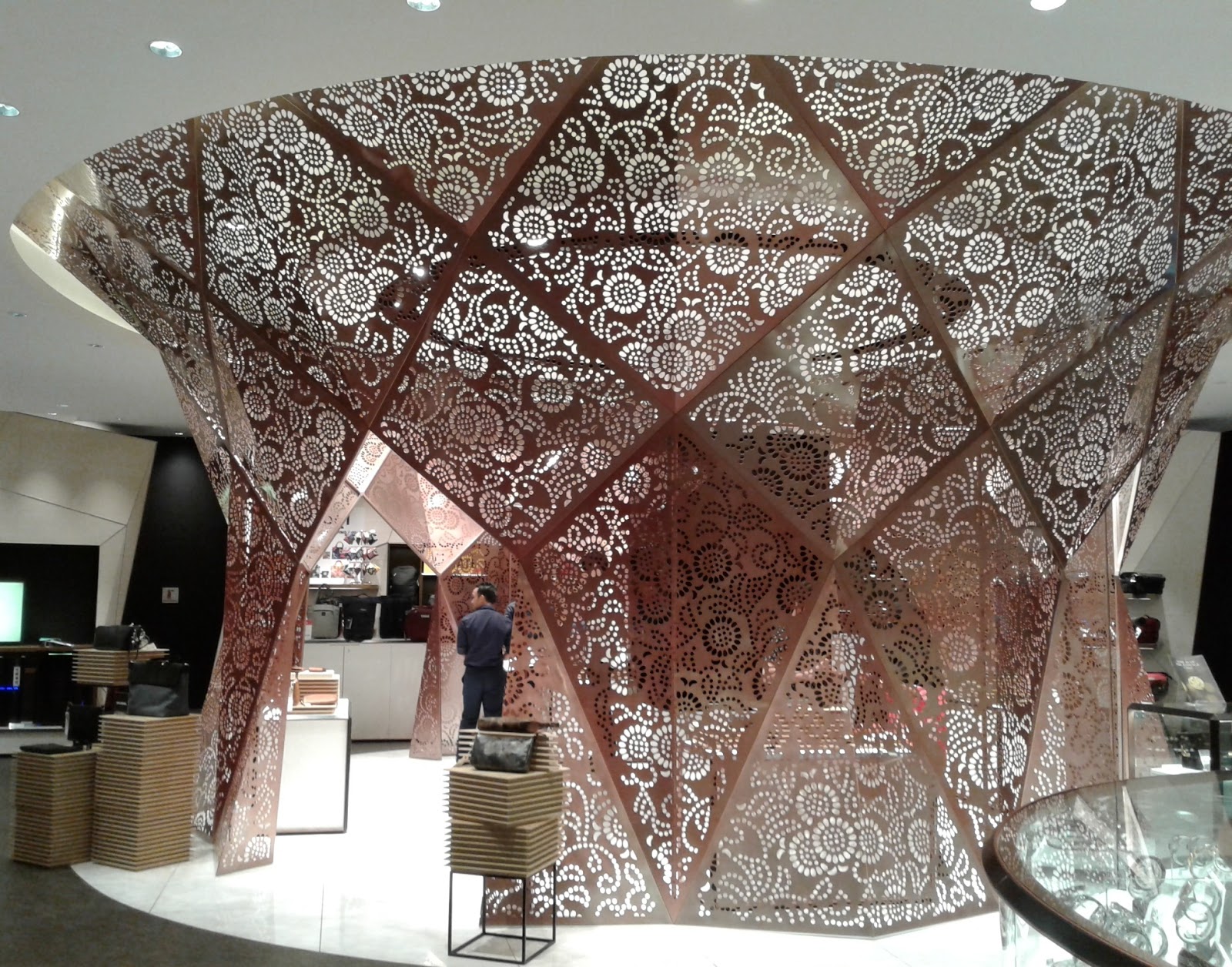
So I was quite surprised to visit the old one in Kuala Lumpur's Lot10 mall recently. This Isetan has had a major refit, and rebrand! Labelled 'The Japan Store' the new version shopping experience was a bit of a treat to walk around. Each storey of the building was named and themed, concessions were situated in artsy pods reminiscent of The Serpentine Gallery's summer pavilion commissions. There were hipster cafes, breakout and work areas. Products were arranged and curated more like an art gallery than a department store. On the top level are Japanese restaurants, and the basement food hall is now a very Japan affair, with exclusively high-end Japanese foods, eateries, drinks and liquor. It was like walking into a nicely designed store IN Tokyo. (And I have to say, after a dearth of anything affordable and fresh/unfried in KL, I was delighted to find a healthy Japan-style salad bar there too!) 


Interestingly, there is more than one Isetan in KL, and the others are still regular department stores. So this one is a specific flagship, and I would guess set up to differentiate the brand from the plethora of identikit mall anchors around the city. The Lot10 store itself is in an odd location - it sits back, on the edge of Bukit Bintang's retail strip, in what is by Asian standards an 'old' mall (generally viewed as 'less desirable' over here). A new MRT has just opened nearby-ish, but the real draw of this area seems to be the outsized, dull and flashy Pavilion Mall complex at the other end. Perhaps this is why Isetan chose to refurb this particular branch? To give people a reason to walk the extra metres for a uniquely Japanese experience - rather than just bypass Isetan entirely while heading to the flash? The other large (and far more prominent) stores in the Lot10 mall are Zara and H&M, however. Which surely pull in not-so-style-conscious youngsters with limited cash. So I don't think this ready-made footfall would be of much use to Isetan! 


My query is whether this fab new concept store actually sells anything. Or perhaps high-sales are not its primary objective?? (Can this be the case in retail? Could retail space be so cheap in KL as to support an almost pure 'branding exercise'?) The new store is beautiful and classy, but the items scarce, and pricey. It was nearly empty when I visited (on a Thursday late afternoon). Even the cafes were quiet. Japanese products and style are more respected and fashionable in SE Asia than in Europe, for example. But I'm not sure with the same groups who would also have the incomes to regularly shop at this store. Japanese expats - with both the cash and inclination to frequent it - would be an obvious market. But there is only a tiny number of them in Kuala Lumpur, especially compared to somewhere like Singapore, where there is no 'Japan Store' flagship like this. So, I'm still curious as to 'why Lot10, KL'? 

Anyway, if you're visiting KL's Bukit Bintang area, it's worth a look. 

Wednesday, 12 July 2017

Operating #RefuseTheStraw in Asia: Week 1

Yep, I'm giving this a go. Even though the main campaign is aimed at Europe and N America. 

Plastic bottles and bags are a worry, ecologically. But had you ever thought of the humble straw... and the damage it can do en masse?

Straws are such insignificant things, and tbh we often don't think about or (more importantly) need them when we use them. But they also play an unpleasant role in polluting our oceans and food-chains. As the placard says, a plastic straw takes 200 years to break down. And before it does, the plastic clogs up our oceans, can get ingested (often fatally) by sea creatures. When it finally disintegrates - even worse - it becomes tiny toxic particles, which permeate our oceans and their residents. (That's alongside all the bags and bottles which are doing the same things.)

Perhaps not so insignificant, after all?

So I'm going to try to stop using them. Or at least drastically cut down. SE Asia (where I am living now) is really not very good on care for the environment. Compared to Europe, anyway. I know the affluent EU traditionally has some of the world's best scores for being eco-friendly, and kids have grown up being educated about it for some decades. But it's sometimes shocking to see the use and misuse (and mis-disposal, and complete lack of care) regarding plastic over here in Asia. The situations for a lot of developing, or nearly-developed countries is quite different. I know that there are potentially more pressing things economically for a lot of SE Asian countries. Plus a whole raft of other hurdles such as education, corruption etc to jump before even embarking on this slow journey of change. But actually, I have a sneaky feeling that eco care has become important for everyone now, regardless. If the planet gets screwed, then frankly we're all stuffed!

I'm not an eco warrior, and I have no intention of preaching to anyone. This is just my own effort whilst living in the tropics. Let's see how it goes!

#RefuseTheStraw Week 1 
Obstacle 1. This guy! 


This is the traditional way of serving takeaway drinks in SE Asia. It has been for as long as I can remember (a few decades!) And it's fast, simple and cost-effective. And it's a double-whammy on plastic! OK, for RM$15 (£2.70) you can go to Starbucks for a pristine paper cup of latte. But most locals (and me) will still opt for the RM$1.80 (32p) hawker version! How does one drink this on the hoof without a straw???

Obstacle 2. Nobody knows what I'm on about. 
It's standard practice in SE Asia (including at several Western-style cafe chains) to give you a straw with any cold drink. That's how its served. And we tend to drink a fair amount of cold stuff in the tropics. You can ask for no straw, but it confuses staff and can slow down a long queue. In my case, I requested no straw, but the drink arrived at our table as usual - with a straw! I can not use it, but that rather defeats the object. Also, for the more basic roadside outlets, I have a suspicion that straws (rather than drinking from the lip of the cup) are used for hygiene. More investigation and work required on these aspects!


Success 1! Pacific Coffee Company in Kuala Lumpur
If you are able to pay the prices of a Western-style coffee chain, it's a bit easier to #RefuseTheStraw. Your iced drink comes in a clean throwaway cup (perfectly hygienic to drink from) and you pick up your own straw if you want it. So there's one score on the straw! The hitch here is that the cup itself was plastic. So I'm not sure how much good my efforts did..

***

Why I'm doing it - plus two cases
As I've mentioned before, my (still relatively light!) direct concern for the environment was catalysed when I started to SCUBA dive the outstanding reefs and seas of SE Asia. It is such a privilege to be able to witness (responsibly) the incredible life - a throbbing metropolis even! - underneath our seas. Not to mention the idyllic palm-fringed beaches which are natural throughout the region.

But you'll also see some of the most disgusting ruination of these places by plastic pollution. And when you go underwater - reefs, and animals, choked by it. It's careless, large-scale pollution which I've never seen the likes of on British beaches.

A Business Case
On the most practical level, if you happen to be a developing nation, the beaches and reefs are all huge draws for tourism. They're the free-gift that SE Asia has received!

What happens when the wildlife starts to die off, or migrate elsewhere? Or the beaches become polluted and unappealing? The tourism will also migrate elsewhere. Taking care helps to protect long term local economies, as well as the long term health of our seas.

An Emotive Case 
Here are the waters of a) The pristine natural beach and waves of uninhabited island, and protected dive site, Sipadan in East Malaysia, which I visited last year. And b) nearby inhabited, and not protected Semporna on the mainland. Man makes a huge difference, and look how much of the waste is plastic! :(

a) Sipadan

b) Semporna


Related on this Blog:
Bags of Fun! Eco Practices East and West 


Pic of polluted Semporna: TripAdvisor 

Wednesday, 28 June 2017

I'm OK. (What does that mean?)

Over coffee recently, a Chinese friend asked me: "Do you want cake with that?". To which I replied "I'm OK".

"That means you want cake, or you don't want cake?"

Fair point.

It means I don't want cake.

"I'm OK" in this context is a softer way of expressing no. I guess the root meaning is "I'm OK just as I am now" (so I don't need anything extra). I could also say something like: "Do you want another coffee, or are you OK?" - meaning, do you want extra coffee, or are you OK as you are now.

It is one of the many not-always-obvious colloquialisms in British English. Perfectly straightforward to other British English speakers. But not to somebody else trying to figure it out with logic! 


Thursday, 22 June 2017

Burmese Nosh: First Contact

OK, actually, first contacts.

But anyway.

I met a couple of young Burmese people (and yes they call it Burma, not Myanmar) socially recently, who inspired me to try Burmese food. I've yet to visit Burma/Myanmar, which only recently opened up to tourism and commerce. And the cuisine was not even on my radar previously. But turns out there are a couple of decent Burmese food outlets in Singapore, so I gave it a go.

Twice. It's GOOD!

This experience of Burmese food offered unique, fairly fragrant flavours and tasty balances of mild spice, sour, nutty etc. The cooking doesn't use coconut like nearby countries do, and it is not frighteningly chilli-full either. (OK, this restaurant would be catering to a local Singaporean audience, but most SE Asians are unafraid of chilli!) So my guess is that overall Burmese cuisine is milder than others, such as Indian or Thai, from which it apparently draws historical influence (alongside Chinese). My personal view is that Burmese cuisine is not unlike Peranakan (Straits Chinese) food in terms of delicate flavours and combos. But obviously, I've only had a limited experience of it so far. And as one Burmese friend said, this restaurant was only about 60% as good as the real deal back home. 

Either way, here is a selection of the dishes I tried :)

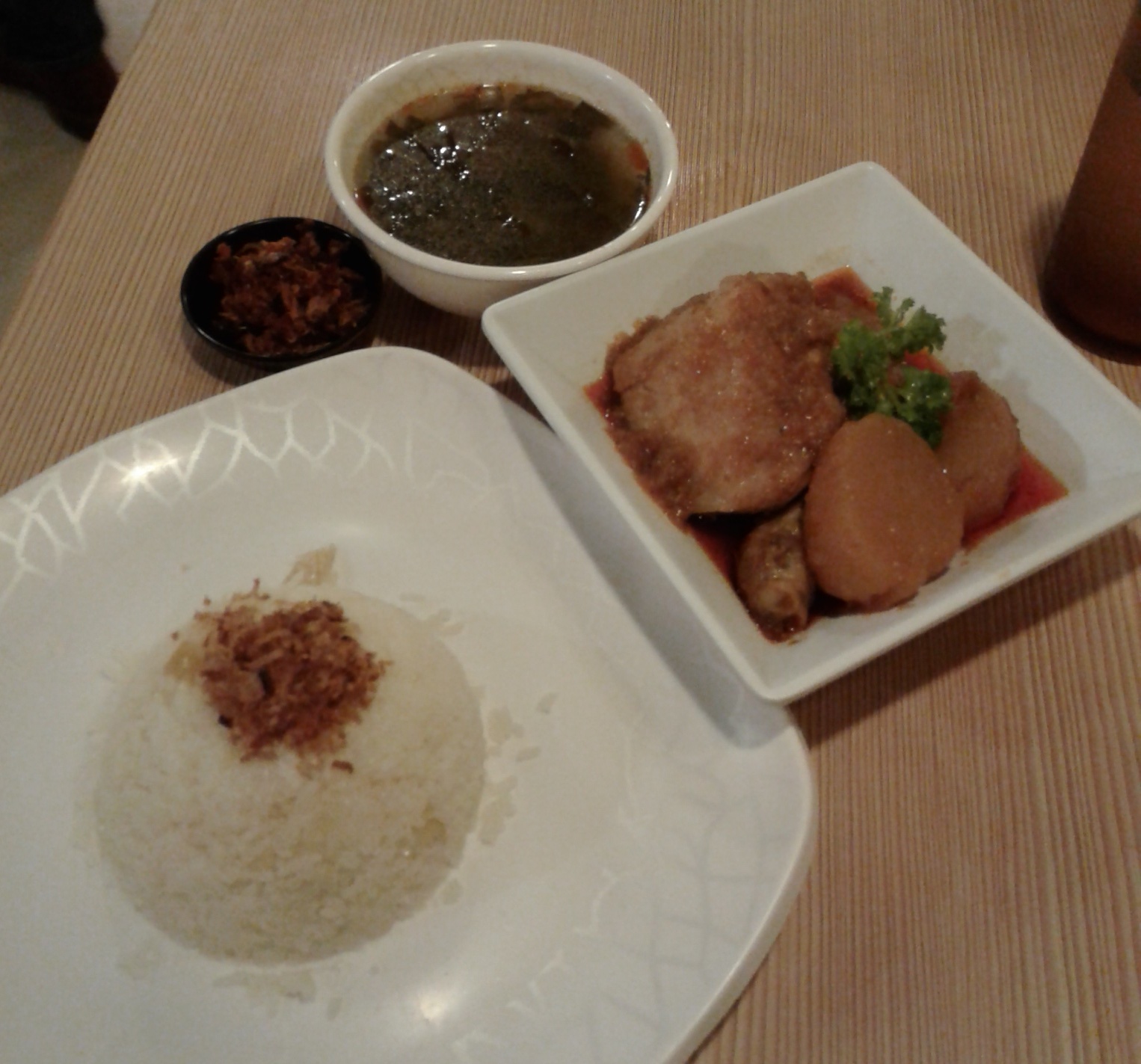
Black Bean Pork
Tender pork stewed with black bean sauce. I don't know what's in the recipe (apart from, one would guess, black beans!) but the gravy was rich, nutty, black-beanish with a touch of 'sour' to it ...I might even say 'lemonish' but apparently there's no citrus in there. It came with rice and a watery sour/spicy soup. 


Tea Leaf Salad
This is more a 'mix', not a Western-style leafy salad. Ours was served pre-mixing, so that we could try the components individually. But it was good as a mixture too. The ingredients included: stewed tea leaves, dried shrimp, garlic cloves (require peeling!), a potpourri of various (roasted?) nuts, raw tomato and green chillis. A tasty, crunchy combo, though I avoided the chillis!


Chicken Curry with Butter Rice
Tender chicken in a sort of fragrant, flavoursome curry sauce. It was not a creamy, heavy curry, but quite a light one, with mild chilli spice, and includes potatoes - yum. And maybe that slight hint of (not) citrus again?? (Is it tamarind?) Rice was indeed buttery, and the meal came with a sour/chilli side soup with greens again, which was quite a good flavour complement. 


Shwe Yin Aye (a rampant rainbow-coloured cendol dessert!)
Cendol (chendol) is actually a green noodley thing used in a lot of SE Asian desserts (a fave of mine being the Malay pudding called... erm, Cendol!) The Burmese version is a different recipe, and offers a selection of cendol, jellies, coconut jelly, sticky rice, sago, white bread, beans and nuts, all in a creamy coconut soup. It wasn't bad, not too sweet, the rice and sago were particularly nice. The bread was a bit strange to me, but perfectly edible in the mix!  


Where?
We went to: Inle Restaurant in Peninsula Plaza, Singapore. http://www.inlemyanmar.com.sg/

If you're feeling braver re 'guessing the menu' the next door, more casual, YaNant Thit was also recommended for curry. (I think some of the menu is in Burmese, hence the 'guessing' aspect!) https://foursquare.com/v/yanant-thit-burmese-food/4bf510176a31d13ae667962e

Happy eating!