Most recently, I've been staying near Willesden Green in London. And given this sunny August weekend, I took a walk to investigate the nearest green space - Gladstone Park.
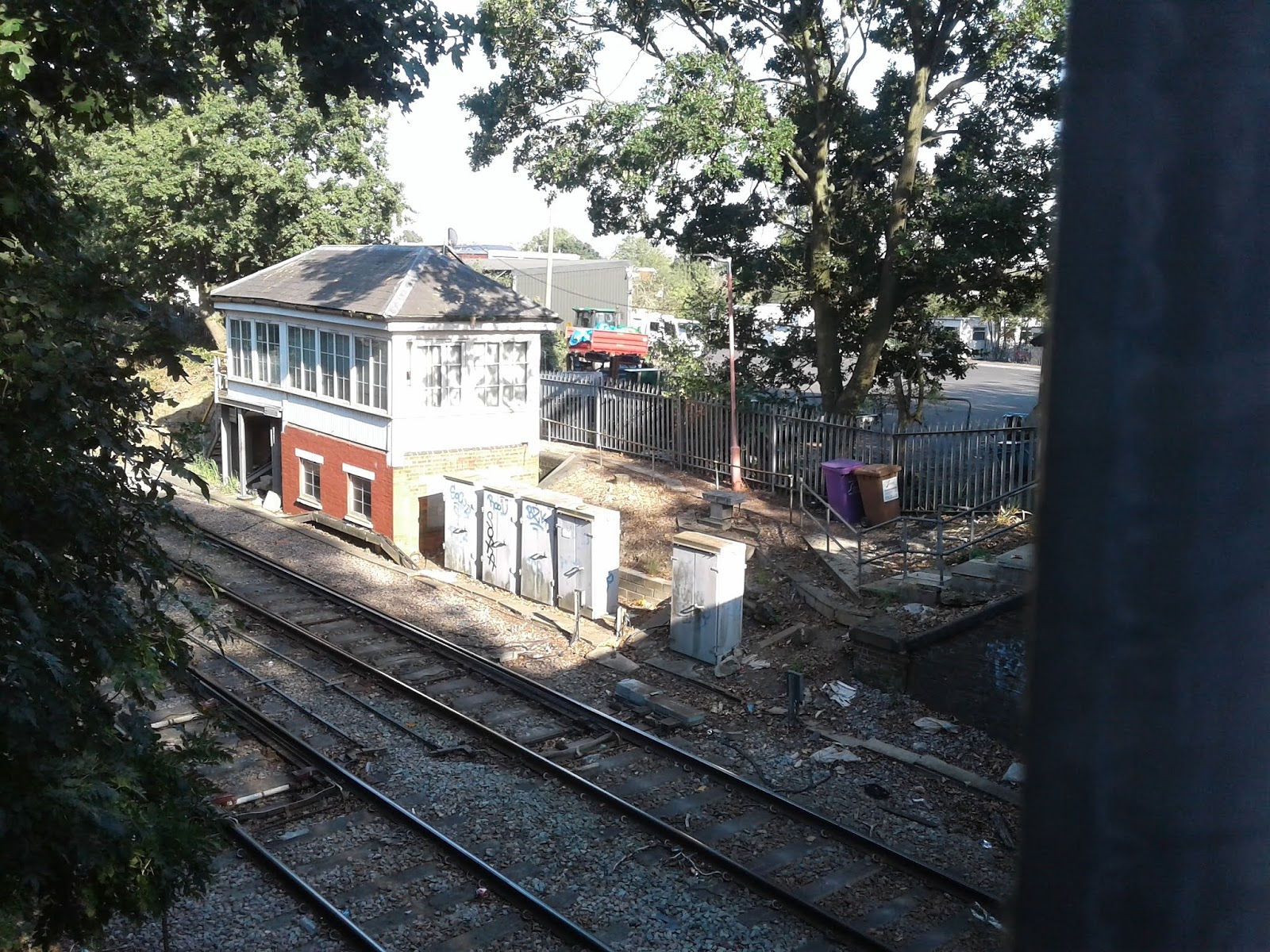
The park is OK - more of a heath or fields than one of the excellent Royal Parks in this city. But one thing which seemed interesting there was this small, old station - closed to the public, and labelled Dudding Hill Junction.
Turns out this is part of a little railway that time forgot!
The station is part of the old Dudding Hill line, which was opened with much excitement in 1868. The line itself is only about 4 miles long, serving areas of North West / West London. In the late 1800s, the Willesden area (I think in part because of swanky new rail services) was morphing from an outskirts village, into a middle-class London suburb. [Which is kinda reflected in a lot of the architecture here - though today it's Zone 2, and fairly central in the ever-expanding city!]
The Dudding Hill line was closed for general use just after 1900. It seems passenger services were soon picked up by the arrival of the even swankier Metropolitan and other lines which still function as part of today's London Underground.
But amazingly, the old line STILL operates a sparse service, using a speed limit of 40mph, and semaphore signalling - just as it would have a century ago! The service is/was apparently mainly for freight, but with very occasional chartered passenger services (which in 2019 must be like a step back in time!)
Tbh this line can't be generating much revenue, and I'm surprised that it has not been demolished to re-use the space/lines. In fact there have been numerous recent proposals to re-work it, but I'm not sure if any are going ahead. In a way this is quite nice, though. It is unusual to find inadvertent reminders of the past, especially in a big city like London!
Here's the photo I took of Dudding Hill Junction yesterday, and then one stolen from Wikipedia, which shows a glamorous Victorian passenger crowd descending the steps. :)
Monday, 26 August 2019
Wednesday, 17 April 2019
Around London today - Palladium House
London is an old city. In the centre you will find all the standard, global chain stores and restaurants as you walk around. But if you look up...
I passed by this place again today. It's Palladium House (originally Ideal House) built in 1929 and a really nice example of the Art Deco style which was fashionable then.
Ideal House was the UK headquarters for the American Radiator Company, and designed as a little sister to their black and gold skyscraper HQ in Manhattan. (Which is actually a bit bonkers and rather impressive!)
Radiators - especially for Britain - were pretty hi-tech in the 1920s, and I guess the London building would have been equivalent to a flagship Tesla showroom today.
Palladium House now is a chain family restaurant at street level, and offices upstairs. It's also Grade II listed (meaning it's protected and only certain modifications can be made). And it's worth looking up for if you're near Oxford Circus!
Palladium House, 1-4 Argyll Street, London W1F 7TA
Also on this blog:
I passed by this place again today. It's Palladium House (originally Ideal House) built in 1929 and a really nice example of the Art Deco style which was fashionable then.
Ideal House was the UK headquarters for the American Radiator Company, and designed as a little sister to their black and gold skyscraper HQ in Manhattan. (Which is actually a bit bonkers and rather impressive!)
Radiators - especially for Britain - were pretty hi-tech in the 1920s, and I guess the London building would have been equivalent to a flagship Tesla showroom today.
Palladium House now is a chain family restaurant at street level, and offices upstairs. It's also Grade II listed (meaning it's protected and only certain modifications can be made). And it's worth looking up for if you're near Oxford Circus!
Palladium House, 1-4 Argyll Street, London W1F 7TA
Also on this blog:
Friday, 29 March 2019
Not Matcha of the Day: fungal weirdness in Pret a Manger, London
Quite the most disgusting drink I've had in a while. x2. Oh my!
"Pret" is one of London's ubiquitous eatery chains. It sells coffees, sandwiches, salads, pastries, to take-away or eat-in quickly. The food is fresh, decent quality. And not cheap.
So when matcha latte was introduced during my stay, I was quite excited. In general, the UK does not do Japanese foody things well, and has a tendency to completely misunderstand them. Which is how the strange output of places like Wagamama still get accepted as Japanese food!
But accessible matcha in a fairly classy place like Pret seemed worth a try. And in the absence of an Asian Tsujiri or Nana's on my way to work, this could prove a boon.
But no.
Fashionably rancid
OK, on my first try, and despite the fact nearly all matcha latte in Asia is made with regular milk, I didn't specify regular milk. And so was automatically (inexplicably) given a Western-healthy, vegan, matcha made with a bizarre trend here: coconut-rice milk. Good grief! Revolting is not the word! A truly rancid concoction. And, despite its high price (around £2.50/S$4.50/$3.40 for a small cup) this green tea approximation had to go in the bin!
Unperturbed, I went back the next day and requested another one with normal cow's milk. And though 100% better than the awful coconut one, it was still revolting. Bitter, yes. But nothing creamy or dreamy going on at all. It was grim; tasting as if very old, fungal-infected green tea powder had been used instead of fresh stuff.
No wonder so many British pals had been suspicious of my matcha obsession! If this weirdness is what's served up in the UK, they have every right to be turned-off!
So, definitely save your pounds and avoid. Pret does good coffee and Western things. But it's up there with Itsu and Wagamama for the 'Japanese' stuff!
For more matcha reviews, click the Matcha Addiction label :)
Also on this blog:
"Pret" is one of London's ubiquitous eatery chains. It sells coffees, sandwiches, salads, pastries, to take-away or eat-in quickly. The food is fresh, decent quality. And not cheap.
So when matcha latte was introduced during my stay, I was quite excited. In general, the UK does not do Japanese foody things well, and has a tendency to completely misunderstand them. Which is how the strange output of places like Wagamama still get accepted as Japanese food!
But accessible matcha in a fairly classy place like Pret seemed worth a try. And in the absence of an Asian Tsujiri or Nana's on my way to work, this could prove a boon.
But no.
Fashionably rancid
OK, on my first try, and despite the fact nearly all matcha latte in Asia is made with regular milk, I didn't specify regular milk. And so was automatically (inexplicably) given a Western-healthy, vegan, matcha made with a bizarre trend here: coconut-rice milk. Good grief! Revolting is not the word! A truly rancid concoction. And, despite its high price (around £2.50/S$4.50/$3.40 for a small cup) this green tea approximation had to go in the bin!
Unperturbed, I went back the next day and requested another one with normal cow's milk. And though 100% better than the awful coconut one, it was still revolting. Bitter, yes. But nothing creamy or dreamy going on at all. It was grim; tasting as if very old, fungal-infected green tea powder had been used instead of fresh stuff.
No wonder so many British pals had been suspicious of my matcha obsession! If this weirdness is what's served up in the UK, they have every right to be turned-off!
So, definitely save your pounds and avoid. Pret does good coffee and Western things. But it's up there with Itsu and Wagamama for the 'Japanese' stuff!
| Advertised with pride! OMG :/ |
For more matcha reviews, click the Matcha Addiction label :)
Also on this blog:
Thursday, 21 March 2019
After Asia: a dearth of smartphones in public!
There are hardly any smartphones on show in public in London! Compared with SE Asia, that is.
Travel on any public transport in Singapore, Kuala Lumpur, or Bangkok, and almost everyone will be on their phone, often with loud games or Malay/Hokkien/Thai dramas playing openly.
Not so in London. Ride the Tube here, and there will be a few people quietly on their phones, a lot reading the free newspapers (Evening Standard, Metro) given out at stations, or listening to music on headphones. Almost zero noise apart from talking, and the vehicle itself.
Some of this is because there is high crime in London. Waving an expensive device is not wise, and some friends using their phones in public have literally had the gadgets snatched by fast-running thieves! Having said this, places like Kuala Lumpur are hardly famous for their low-crime. And yet it's smartphones a-gogo over there!
Also, there is currently no signal on the London Underground (aka Tube) - you can register to access a poor one in stations only, but most people don't. A comprehensive 4G network is set to launch this year. But, apart from occasional teens, people here rarely make phone noise where there is a signal either.
It seems there are differences in culturally-acceptable sounds. In the UK, for example, loud - sometimes disturbing - racket around public drunkenness, sports events, or house-parties - is tolerated. Or at least people do it, and others are powerless to change it. These kinds of noise pollution simply don't occur in somewhere like Singapore. Anyone holding a loud house-party there would be very unpopular - the general sympathy lying with any neighbours having to endure it. And people would push to have it shut down.
But while this kind of racket happens a lot in London, talking in the cinema, for example, or a blaring device in a restaurant (both common in SE Asia!) are absolutely unacceptable. And people rarely do either.
Anyway, my stop comes up soon. I'm writing this on an old, undesirable device, while quietly listening to my iPod on the way across London :)
Wednesday, 27 February 2019
After Asia, and the Algerian Coffee Stores
During this past year in APAC, I travelled a fair amount between Kuala Lumpur and Singapore. And each time I returned to Singapore (after perhaps only a couple of months' break) there would be some fairly key changes. Malls would have completed and launched; shiny new stations on the MRT lines opened; condominiums gone up; large new stores would have taken a foothold.
I've come back to London after seven years, and not much has changed. There has been some change - which Londoners seem to perceive as quite radical! But compared with the pace of the places I lived in in Asia, it's kinda slow.
There are reasons for this of course: London has been 'developed' for many centuries, the infrastructure in London's centre is antique, often architecturally protected, and difficult to change. So it's not following a new masterplan like Singapore can. But there are also cultural differences, I think, in which UK people value things which are old. Perhaps over convenience or practicality. And there is a little suspicion of the new, which doesn't exist in APAC.
For tourists, I suppose this also gives the UK some of its appeal: it's historical with its own unique thing going on.
For me, it has cut both ways. I have both struggled with the non-modernity of many systems here (tech, transport etc etc) and rather enjoyed the interesting old places with character. And here is one of them: the Algerian Coffee Stores shop, on Old Compton Street.
This is not a tourist attraction, but just an old place offering decent service for people interested in coffee and making it. I went in to find a replacement washer for a friend's coffee percolator. And the chap there spent a good 20 minutes searching and trying items to best fit the pot. The cost of the washer: £1.10! (About SGD2/USD1.50) It wasn't about the money, but getting it right, so that good coffee could be made! And this is a kind of old-fashioned, quality, service which I like.
Also, when you go in, you are greeted with an excellent whiff of coffee / tea / chocolate. And treated to the visuals of shelves packed with all kinds of exotic coffee beans, confections and apparatus.
I guess what, in modern business terms, might be lost in time (while people take care to look after customers) is perhaps compensated for by brand and uniqueness. And, I'd guess, repeat custom throughout generations? This shop has been handling coffee in London for over 130 years. I think you can buy an affordable espresso or latte in there now, too.
Anyway, if you ARE a tourist in London, you could do worse than popping in to this place to purchase an interesting roast, or some good chocolate. :)
Link: Algerian Coffee Stores
Also on this blog:
I've come back to London after seven years, and not much has changed. There has been some change - which Londoners seem to perceive as quite radical! But compared with the pace of the places I lived in in Asia, it's kinda slow.
There are reasons for this of course: London has been 'developed' for many centuries, the infrastructure in London's centre is antique, often architecturally protected, and difficult to change. So it's not following a new masterplan like Singapore can. But there are also cultural differences, I think, in which UK people value things which are old. Perhaps over convenience or practicality. And there is a little suspicion of the new, which doesn't exist in APAC.
For tourists, I suppose this also gives the UK some of its appeal: it's historical with its own unique thing going on.
For me, it has cut both ways. I have both struggled with the non-modernity of many systems here (tech, transport etc etc) and rather enjoyed the interesting old places with character. And here is one of them: the Algerian Coffee Stores shop, on Old Compton Street.
This is not a tourist attraction, but just an old place offering decent service for people interested in coffee and making it. I went in to find a replacement washer for a friend's coffee percolator. And the chap there spent a good 20 minutes searching and trying items to best fit the pot. The cost of the washer: £1.10! (About SGD2/USD1.50) It wasn't about the money, but getting it right, so that good coffee could be made! And this is a kind of old-fashioned, quality, service which I like.
Also, when you go in, you are greeted with an excellent whiff of coffee / tea / chocolate. And treated to the visuals of shelves packed with all kinds of exotic coffee beans, confections and apparatus.
I guess what, in modern business terms, might be lost in time (while people take care to look after customers) is perhaps compensated for by brand and uniqueness. And, I'd guess, repeat custom throughout generations? This shop has been handling coffee in London for over 130 years. I think you can buy an affordable espresso or latte in there now, too.
Anyway, if you ARE a tourist in London, you could do worse than popping in to this place to purchase an interesting roast, or some good chocolate. :)
Link: Algerian Coffee Stores
Also on this blog:
Sunday, 18 November 2018
After Asia: some unexpected viewpoints on the UK. Intro...
One thing about being an ('integrated'*) expat, is that you get to see your own country from a new angle. I'm not sure if this can be done without a fairly decent chunk of years overseas - and perhaps living in a very contrasting culture helps, too.
When I moved from the UK to Singapore in 2012, I found a lot of things new and peculiar. And yes, also difficult. OK, Singapore partly lives up to its reputation as 'Asia 101' for Westerners. Because most systems are in English, and many things work in a Western-logical way. But if you bother to scratch beneath this convenient surface, it's Asia. This shouldn't be a surprise, right? It looks Western / international, but the value systems underlying the place are not Western. They're Chinese (or I guess Chinese diaspora). With a few other influences - including Malay, Indian - thrown in. And a few aspects which are - as other Chinese diaspora generations in the region will testify to - just uniquely Singaporean.
Also, working a regional job has allowed me to interact a bit with others around APAC, and view their takes on people, business, politics too.
Attitudes and assumptions - socially perhaps more than in business for me, anyway - are different from what I was used to in the UK. Some of these differences are actually very fundamental (even for a half-Asian person!) but you don't necessarily register this until a bit of time in the new place. I think this is partly because SE and E Asian cultures are relatively a little reserved about expressing opinion; so you need to take the time to stop and quietly observe and take in what others are doing / prefer doing. And also because it is very easy to just make an assumption - a fundamental understanding, even - that one's own 'right and wrong' is correct. This is not entirely a Western-arrogance thing. It exists, I suspect, for most people on this planet! We think and feel that our values are right, because we've known them all our lives, and because a majority of people around us - in our own countries, societies, cultures - think similarly.
But living overseas has highlighted this for me: our value systems might be right for us. Or they might be partially right / pretty good. But there are actually a whole bunch of really quite radically different value systems out there! And not everything in our own setups IS necessarily the right or best way.
So my viewpoints have changed over six+ years in SE Asia. There are European values which I still think are enduringly sound. But others which I really do question now - because it's such a drastically different (while also functional) story in Asia.
I guess on one level this could be viewed as a bit of a mindf***. Having one's lifelong foundations rocked about like this. And living overseas has most certainly had its alienating challenges at times! But actually I feel very grateful for this new group of perspectives.
So, I'm now back in London for a few months. And it feels rather strange! I've been enjoying it. But (or perhaps because) I feel like a tourist visiting my own city. A lot is familiar and comfortable - because I've lived in London for most of my adult life. But I'm currently still outside, looking-in, with some interest and/or bemusement!
Coming up in this series are some things - from the small and ridiculous, to the larger and more serious - which I have noted as stand-out and different during this stay.
*An expat who doesn't remain ghetto-ised with other expats from their own nation (there are a lot of these!) but tries to make local friends, understand the operations, language and culture of the new place.
When I moved from the UK to Singapore in 2012, I found a lot of things new and peculiar. And yes, also difficult. OK, Singapore partly lives up to its reputation as 'Asia 101' for Westerners. Because most systems are in English, and many things work in a Western-logical way. But if you bother to scratch beneath this convenient surface, it's Asia. This shouldn't be a surprise, right? It looks Western / international, but the value systems underlying the place are not Western. They're Chinese (or I guess Chinese diaspora). With a few other influences - including Malay, Indian - thrown in. And a few aspects which are - as other Chinese diaspora generations in the region will testify to - just uniquely Singaporean.
Also, working a regional job has allowed me to interact a bit with others around APAC, and view their takes on people, business, politics too.
Attitudes and assumptions - socially perhaps more than in business for me, anyway - are different from what I was used to in the UK. Some of these differences are actually very fundamental (even for a half-Asian person!) but you don't necessarily register this until a bit of time in the new place. I think this is partly because SE and E Asian cultures are relatively a little reserved about expressing opinion; so you need to take the time to stop and quietly observe and take in what others are doing / prefer doing. And also because it is very easy to just make an assumption - a fundamental understanding, even - that one's own 'right and wrong' is correct. This is not entirely a Western-arrogance thing. It exists, I suspect, for most people on this planet! We think and feel that our values are right, because we've known them all our lives, and because a majority of people around us - in our own countries, societies, cultures - think similarly.
But living overseas has highlighted this for me: our value systems might be right for us. Or they might be partially right / pretty good. But there are actually a whole bunch of really quite radically different value systems out there! And not everything in our own setups IS necessarily the right or best way.
So my viewpoints have changed over six+ years in SE Asia. There are European values which I still think are enduringly sound. But others which I really do question now - because it's such a drastically different (while also functional) story in Asia.
I guess on one level this could be viewed as a bit of a mindf***. Having one's lifelong foundations rocked about like this. And living overseas has most certainly had its alienating challenges at times! But actually I feel very grateful for this new group of perspectives.
So, I'm now back in London for a few months. And it feels rather strange! I've been enjoying it. But (or perhaps because) I feel like a tourist visiting my own city. A lot is familiar and comfortable - because I've lived in London for most of my adult life. But I'm currently still outside, looking-in, with some interest and/or bemusement!
Coming up in this series are some things - from the small and ridiculous, to the larger and more serious - which I have noted as stand-out and different during this stay.
| The New Yorker cartoon |
*An expat who doesn't remain ghetto-ised with other expats from their own nation (there are a lot of these!) but tries to make local friends, understand the operations, language and culture of the new place.
Sunday, 28 October 2018
The Apam Balik Kakigori
South East Asia is nothing if not diverse. Historically (and partly because places like Singapore and Malaysia were along key maritime trade routes) there has been a huge mishmash of interesting things - and people - melding local influences. Today, Japan and S Korea are fashionable throughout the region, and so you'll find these East Asian colours reflected in South East Asia's clothing, make-up, food, tech, music, brands, design and more.
And here's a typical hybrid: the Apam Balik Kakigori. Which I was treated to on my birthday this year, in Kuala Lumpur, Malaysia.
Apam Balik is a traditional Malaysian crepe - with Indian origins. It's a folded coconut/rice pancake, containing crushed peanuts, sweetcorn, and sugar. Variations might include fragrant pandan and other ingredients. Apam (appam or aappam) is the name of this pancake in Malayalam or Tamil - as it comes from Southern India. Balik literally means 'to go or come home' in Malay; in this case referring to the folded, turnover aspect of the pancake.
Kakigori (yes even more kakigori!) is a Japanese shaved-ice dessert, with modern versions quite trendy in hipster cafes region-wide.
So this was a hipster version of a Japanese dessert, nodding to a traditional Malay sweet, which was already nodding to India. And (even though I am currently quite obsessed with all kakigori) it was also delicious!
The sweet cream / topping was flavoured with pandan (with lime meringue pieces, actually!) Then there was corn-custard, and surprise sweetcorn and crushed nuts inside the fluffy ice construction.
| An apam balik hawker stall in Malaysia |
Photo of apam balik stall: HungryGoWhere
Subscribe to:
Posts (Atom)


