Sunday, 7 May 2023

Foraging in the UK (& wild garlic pesto)

Foraging has a trendy edge to it in the UK, where I am currently. It is the act of picking leaves, fruits and fungi from the wild to eat. These are often also ingredients you wouldn't normally find in supermarkets.

Tbh I have a friend in Hokkaido, Japan, who forages while hiking and cooks her finds. And during my rural UK childhood, it was very normal to collect things like wild blackberries from local hedgerows to make jam or a pie at home. It's an old practice worldwide.

In fact there is legislation around UK foraging, and you need permission from the landlowner to do it. Some of this is to do with tresspassing laws, plus there is a long list of wild plants and fungi which have been protected by law since 1981. So get an OK from the farmer, wildlife trust, or whoever else owns the land before you start! (This also applies to digging up wild plants to use in a garden etc.) Most sites do not allow commercial foraging, for obvious reasons of scale and unfair profit.

In the past couple of decades (one of which I was overseas for) organic and natural foods have become much more desirable to Brits. This is due to concerns over pesticides harming both humans and our ecosystems, and the environmental impacts of large-scale agriculture in general. I've mentioned before the complex class systems of the UK. And the popularity of organic foods is seen as a fairly middle-class thing. Not least because they are so much more expensive to buy.

What could (in theory) be more organic than foraged things growing wild? AND (in theory) they're also free! UK celebrity chefs like Hugh Fearnley Whittingstall have also popularised unusual, local, responsibly foraged ingredients at home. So you can see how the trend has grown from just something country people did occasionally to make pie. 

The number of foraging Brits also spiked further over the pandemic - as people spent more time outdoors, and in their kitchens.

There are of course, other concerns for foraging besides the law - not least that you need to be a real expert on plants and fungi! Many items look very similar to the untrained eye - but some can be highly  poisonous to eat. There are also some ingredients which must be prepared properly for safe eating (even our common potato is incredibly toxic, unless cooked and used in the right way - not that potatoes grow wild here!) 

Wild garlic growing

The Pesto

ANYWAY. I got gifted a bunch of wild garlic from our local woodland. They have strict rules on foraging, which is allowed to a certain weight per home individual after permission. There's a £5000 fine if you forage without a permit! One experienced forager had overpicked, and so handed the surplus back to the park. And since I volunteer there sometimes, I was offered some. 

I had never clapped eyes on wild garlic before, tbch, but was advised that pesto was an easy and tasty recipe for it. (I had not made pesto before, either).

Foraged

I improvised, due to affordable ingredients I could find in our local supermarket, and looked up a few pesto recipes to get a vague idea of what to do - the rest was a 'taste as you go' experiment!  Here is what I did:

Very carefully washed each garlic leaf separately! I might have been being paranoid here, but was thinking dogs and foxes, and the fact garlic grows on the ground! Laid the leaves out to dry (I have reused the paper towels, of course). 

I separated out the buds with stalks for salads.

Ingredients: wild garlic leaves/stalks, crushed walnuts, grated parmesan, olive oil, lemon juice. 

Wanged amounts in a blender until I got the texture and taste I wanted. (FYI the leaves break down to a much smaller volume).

The flavour: a cross between garlic and watercress, I think. The pesto is quite subtle, but with a garlic undertone. And ideally would be best married with homemade or fresh pasta to showcase this. Freezes well in individual portions, though try to defrost overnight in the fridge (microwaving will totally wilt the leaf content). 

The raw buds in salad are really delicious - slightly creamy flavoured even, but with a mild garlic kick. 

Here's the final dish made with cheapo pasta - will try to source a more upmarket carb for the next portion!


Wednesday, 4 May 2022

Matcha Addict - Jenki, London

Oh my! 

Jenki is a hipster 'matcha bar' in London's touristy Spitalfields Market. But it's one of maybe three (?) matcha outlets in the entire city, so I felt I had to give it a go. 

I excitedly ordered an iced matcha latte, which cost me £4. (S$8 / US$5)

Sadly the go-to (again!) for this was soy or oat milk (which are trendy in the UK) and I had to specify cow's milk. But OK.

The Verdict: It tastes just like iced milk! I could not detect any matcha at all in this drink and had to add sugar just to get some flavour from it. I mean it looks great. Nice colour green (usually a sign of quality) and gradient. Plus it sounded great on the website. But I have no idea why people would purchase this stuff, when you can have a very nice cup of milk and ice at home! 

Tbh a spectacular case of style over substance (plus what I find a depressing acceptance by Europeans for inauthentic Japanese things as the 'real deal'!) Am not surprised this place was full (not of Asians!) given its design and location. But really, avoid and take your cash elsewhere!


Jenki: https://www.jenki.co.uk/

Matcha Addict - DIY Matcha Latte in London!

In an endless quest to get my fix of the excellent Green, I purchased this affordable matcha powder in an Asian food store in London. 

Two things to note here: 

1) There are different grades of matcha powder, ranging from high-end (usually bright green) delicious, to low-end (often a sludgier brown) which might be more suited for cooking. Yes matcha biscuits, pastries, puddings, cakes and all sorts exist too! Generally you get what you pay for.

2) A lot of 'Japanese' and 'Korean' things sold in the UK are actually Chinese. This applies to almost everything, including restaurants. And most times UK people don't know the difference. This especially applies if the Asian product is affordable or on the high street. 

You can buy reasonably authentic matcha powder in London. But it will cost you! Usually you're looking at around £8-10 for 100g. Which I haven't been able to justify budget-wise yet, especially as I'm not very expert at making the tea myself. So when I saw this on sale for £1.98 it seemed stupid not to try it. 

It's Chinese. And I was not expecting great quality for the price! 

The powder is a sludgy olive green. Low grade! (And does resemble green paint pigment, which I hope it's not.) And the flavour is very bitter, without creaminess. It took me several tries to get the balance of milk, powder, sugar, water optimised for a latte. And I don't have a fancy frother or whisk. But then it was perfectly drinkable in small doses! I say small doses because more than 1 cup gave me headaches, as coffee would. (High quality matcha does not.) Or could it be the paint powder aspect kicking in...?

The verdict: really not bad. Probably meant for cooking, not drinking. But a reasonable 1 cup/day fix if you're desperate - for a very good price. And tbh I suspect this is what many London cafes use when they serve matcha. 

Not sure I'd buy it again because of the headache factor, but it gave me a good chance to experiment with DIY matcha lattes. I might lash out on a better quality, Japanese, powder now I know how. It would still be considerably cheaper than the whopping prices London cafes charge for matcha drinks!


Looks a little more minty here than irl!


Matcha Addict - Japan House, London

Well, I've been generally uninspired living in London (over a pandemic) so not been blogging about cultural things much. 

As things vaguely reopen here, I have managed to pop out and try occasional matcha drinks, though. So here to follow is a possible slew of drink reviews! 

First up is first-drunk. The hot matcha latte from London's (overrated) Japan House. I visited for the first time, to see an exhibition, and maybe get some authentic Japanese inspo in Europe. The space is basically an expensively-priced, sparse, retail outlet of Japanese things for tourists, and some un-cosy seating. Even London's Japan Centre is exciting by comparison! (And it's not exciting.) Plus the JH exhibition was meh. But they DO have a drinks bar serving matcha and occasional Japanese sweets.

This mid-sized latte came in at around £4 (S$8 / US$5) No pretentious 'coconut rice milk' etc mucking around, just regular cow's milk = good (I guess you can ask for alternatives if you're vegan, lactose intolerant blah blah). 

The verdict: Drinkable. Tastes like decent matcha as-made-in-the-UK (not creamy bitter like the Asian offerings, but a passable tea). I wouldn't go back to pay this price for it. 


Japan House, London: https://www.japanhouselondon.uk/


Sunday, 21 November 2021

A Proper Job - local dialect

Here's a quickie - prompted by the consumption of this very nice beer in the UK (if you can find it, try it!) 

The phrase 'proper job' comes from the West Country (the SW region of England). It means 'very good' or 'job well done'. And it's not used like this more nationally. 

Examples: 

You "I got an A in my exam!". Local: "Proper job!"

Local finishes a pint of good lager, smacks their lips and says "Proper job!". 

Bye.


Sunday, 18 July 2021

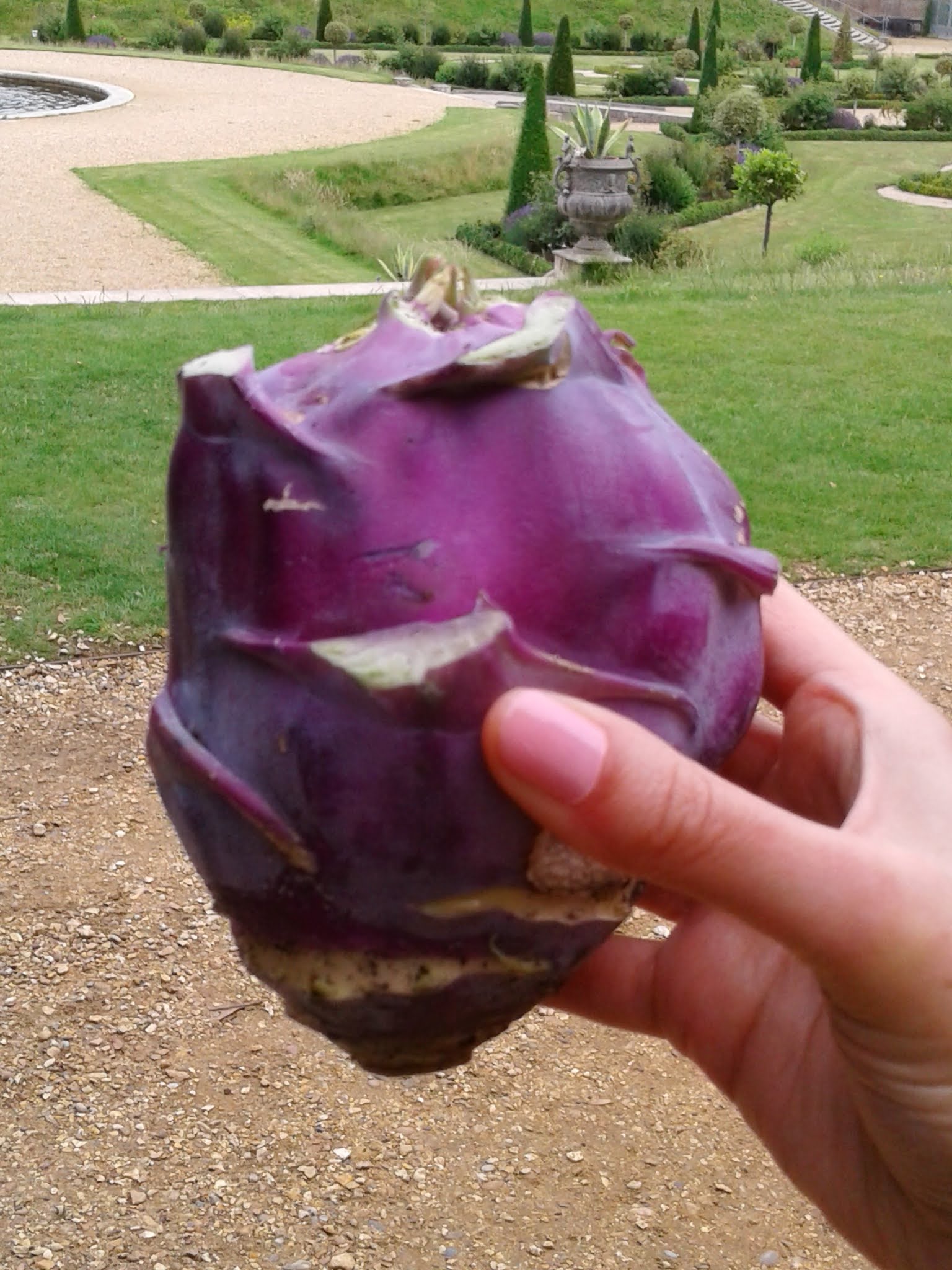
Kolhrabi!

So, we went to Hampton Court Palace recently (a revisit for me - but after a long time!) And they have carts in the grounds where you can purchase fruit, veg and plants from the gardens. There is no charge, and no attendant - you just donate what you can, if you want to. It's a bit like the concept of a hotel Honesty Bar. But with produce. 

And amongst the vegetables was this weird thing: a kohlrabi. OK, I've been outside Europe for a while, but I'd never seen it before. So I bought one to experiment with. 

This guy is a brassica - related to cabbages and cauliflowers. The bit I got - the 'bulb' - actually grows above ground as a fat stem, as this is not a root vegetable. The leaves can also be eaten, apparently. The bulbs come in white or purple varieties, and the name is German meaning 'cabbage turnip' - which I guess describes its looks! (It does also somewhat resemble a dragon fruit imho... )

I roasted the first half (it requires peeling and chopping, plus steaming first, to soften it up) and the outcome and general review was 'so so'. It's not sweet or flavoursome like a parsnip when roasted, or crispy like a potato. Fairly bland tbch!

Then a Greek friend suggested trying slices raw, dipped in lemon juice. And this was absolutely delicious! Raw, this vegetable is sort of like a cross between a radish and a carrot in texture - crunchy, mild and very refreshing. It would definiately work nicely in salads I think. And I will try it again if I can find one! 


Thursday, 22 April 2021

Britain: the National Dunk

Oh look, I have been absent from Blogger for a while, and all the formatting has broken! ANYWAY, until I have time to fix it, this: 

Unlike East and Southeast Asians*, Brits traditionally drink tea with milk (and sometimes sugar). I don't think milky tea is popular in other European countries. Italy, France, Spain are definitely more into coffee as their national beverages. 

In the UK we also have a habit of dunking sweet biscuits into the tea, and then nibbling on the soaked biscuit. In the modern day, this has an effect of part-melting and warming chocolate biscuits, and softening others. (The duration of your dunk is important for this - too long and whole confection just collapses into your drink..)

Dunking also happens in other Western cultures, but perhaps with coffee and/or more specific biscuit types (biscotti in Italy, for example, or stroopwafels in the Netherlands).

History

Apparently the ancient Romans used to dunk hard, crunchy bread into wine. And more recently in Europe, 16th century sailors would dip their rock-hard biscuit rations into hot drinks, simply to make them edible. When British Victorians invented the formal 'afternoon tea' and Queen Victoria herself was seen to dunk her biscuits, the trend caught on, and was thereafter exported to countries such as the US and Australia. 


In Britain, most cookie types can be dipped, and we just do it with tea. Click here for the Wheel of Dunkability and find out which UK biscuit you are! (The chocolate digestive is apparenty the national favourite.) 


* The exception might be modern 'dessert-style' teas such as Taiwanese bubble tea, or matcha and houjicha drinks from Japan. 

** English learners: sweet, crunchy confections are known as 'biscuits' in the UK, and 'cookies' in America. Though we do also understand the term 'cookie' in the UK. 


 Also on this blog:

Biscuits and some issues with US & UK English


Wednesday, 4 March 2020

The Humble Hot Water Bottle (East and West)

The hot water bottle (or hot-water bottle) is a British invention. It is used to warm your bed during cold winter months.

The basic is a rubber (or now PVC) flat bottle, which you fill with very hot water, stopper securely and then keep in bed. More recent ones also have furry covers, which makes them quite cuddlesome (and retain heat for longer)! You can put the hot water bottle into your bed maybe 15 minutes before sleep. So covers are nice and warm when you get inside :)

I am a big fan of the (particularly modern) hot water bottle! I have never been crazy about electric blankets (fear of electrocution?) and also the bottle is more economical/eco-friendly. Girls also use hot water bottles for tummy cramps, and I've used one to alleviate back pain after an injury.

My family used these warmers when I was a child. Back then the rubber bottles didn't have covers and I think some were slightly corroded, leading to the most unpleasant experience of one bursting in bed - fortunately without burns, but half a litre of water in bed during winter was NOT welcome! (You can reduce this risk by avoiding boiling water to fill- which helps preserve the materials. Modern PVC is also less likely to corrode.) 

As with many cultures, people in the chilly UK have used bed-warming items for centuries. Like metal pans filled with coals, even early hot water bottles made from metals or clay. The rubber bottle idea was first introduced in the 19th century - as rubber became a more common material in the West. And then patented by a Croatian engineer in the early 1900s. 

In Japan, there is a similar, soft-covered item known as a 'yutanpo' (()ぽ) - made from rubber, metal or ceramic. The idea is traditional, though, similarly, there are modern versions, including electronic ones, apparently! I am not sure how widely used yutanpo are. Most of the places I've visited in Japan used electric blankets to heat beds. Though a friend on a ski trip in icy Hokkaido recently said that they used yutanpo overnight. (If you use yutanpo in your home in Japan, please do add a comment!)

I've also read a few expat blogs with concerned Brits unable to find nice, covered, hot water bottles in the US - though I guess they can now be ordered online if necessary!

Below is my trusty, British hot water bottle. Happy snoozing.


Japanese yutanpo with cover.
Yutanpo photo credit - eBay 


Also on this blog:
Chillblains
Ovens. And kitchens (where I rightly belong)


Friday, 14 February 2020

Valentine's Day (East & West)

I'm currently in London, and February 14th looms. In the West, this is Valentine's Day. Tbh I'm not keen on pressurised commercial festivals (as they are now). Some can be upsetting for certain groups (which is only just becoming recognised now) and today, generally, they're just a gimmick for retailers to make cash. Over £1 billion (USD 1.3 billion, SGD 1.8 billion) is spent annually in the UK for Valentine's Day. So one can see the commercial savvy in pushing celebrations! But sometimes, even if you don't like the hype, these festivals can be interesting culturally, or historically. 

So here goes!

In the UK today (if we celebrate it!)
February 14th is supposedly a festival of romance. And it's symbolised by hearts, cupids, pink things, doves, chocolates, roses, and perhaps poetry. As children, it was traditional to send an anonymous card to the person (or people) we had a crush on, signing it "?" or "Your Valentine". Supposedly leaving the recipient flattered and wondering who liked them. The card might be sent in the post, or (more usual) left inside your crush's desk or locker! Of course, this also left the people who did NOT receive any cards feeling left out or slightly ridiculed. So some friends would agree to send cards to each other, just so that we had at least one, and looked like we were part of the day.

For adults, very occasionally, anonymous cards or sometimes flowers will be sent (usually from men) to a love interest on Valentine's Day. Retail pressure also suggests that existing couples should go out for overpriced meals, and buy each other expensive and unimaginative gifts! (Red roses, chocolates and things shaped like hearts...) Or just gifts, generally. Prices in restaurants, and for themed gifts rise especially. Traditionally, for heterosexual couples, it was the man's responsibility to arrange Valentine's activities and presents. Today it is increasingly either party. Or none!

How it started
Valentine's Day's origins are Christian, but the romance part is not. 

February 14th is officially the Feast of St Valentine in the church calendar*. It actually could  celebrate more than one Saint Valentine (apparently there are several Christian saints with this name!) For the UK, it usually relates to Valentine of Rome and Valentine of Terni - who were both early Christian priests, martyred in the 3rd century AD. Probably. (They might have actually been the same guy - such is the haziness of history!)

A bit is known about Valentine of Rome. It seems he was imprisoned for - among other things - presiding over marriages to prevent men going to war (at the time forbidden under Roman law - as young single men were required for fighting). It is also said that he restored the sight of a young blind girl, sending her a letter before his execution, signed 'your Valentine'. Fair enough. But not super romantic.

The lovey-dovey concept was introduced to the public over a millennium later. With the cultural / social fashion of "courtly love"**, promoted by Chaucer (famous English poet) and other artsy types in the 14th century. Although it seems there were no existing traditions, the church feast day suddenly became associated with giving flowers, cards signed 'your Valentine', and professing romantic love. These sentiments were reiterated in later art and literature. And have endured to this day. 

Some sources state that February 14th was adopted from the early (pre-Christian) Roman fertility festival of Lupercalia. This idea has some logic, and tbh, a lot of popular pagan festivals were rebranded by the early Christian church, in a kind of smart change-management exercise. But this theory for Valentine's Day has apparently now been thrown out by experts. 

In Japan today
As with several Western concepts, Japan has adopted Valentine's Day but tweaked it to its own style. The idea was first imported by a confectioner in the 1930s. And today there are two Valentine's Days in Japan - one for women, and one for men. I have never been in Japan during these festivals. But this is what I've gathered from friends and research!

February 14th is specifically for women to gift chocolates or sweets to men. And they do not all have to be romantic interests. Two types of chocolate exist for the occasion: "giri-choko" [義理チョコobligation chocolates] which are bog-standard chocolate gifts for male friends or family; and "honmei-choko" [本命チョコ real, or love chocolates] which are special or homemade, and gifted to actual partners or crushes. Also, the recipient of honmei-choko can reject the gift if he's not interested in the giver (harsh! Though it's apparently rare). In some cases, Valentine's can become very expensive for women, especially if they feel they should buy giri-choko for their whole office.

White Day, then takes place on March 14th. This was introduced in 1978 by the National Confectionery Industry Association to redress the expenses of Valentine's Day for women - and also to make more money for the industry, natch! This is when men give gifts to women. Usually returning the favour of giri-choko, or upping the honmei-choko to a bigger or better gift (I guess if the romantic feelings are reciprocated!) 

Openly gay singles and couples can apparently choose which day they wish to gift any honmei-choko, though it seems being openly gay in Japan is less common than it is in the West.

Although it is modern and entirely industry-invented, there is a little more sense to the Japanese system! Depending on the situation, there is a chance that an open honmei-choko gift could lead to actual chances of romance a month later, or on the day. The anonymous British card-giving is sort of useless. Because while it protects the secret sender from embarrassment or rejection, nothing practical can really come of it!

As in the West, not everybody in Japan thinks Valentine's and/or White Day is a great idea, and not everybody celebrates them. But it is still a big, national deal, which hugely boosts the revenues of retailers and confectioners!


* Some, but not all, Christian churches recognise the Feast of St Valentine. As I've mentioned before, there are MANY different kinds of Christianity, and variations for their festivals and other things.

** Courtly love was not a grunge star, but a literary concept started in France, and seen in the works of Chaucer and others. It was designed to entertain the medieval nobility, and emphasised stories of (lovesick) gentlemen wooing ladies in a very chivalrous way. Ultimately, Valentine's is an equivalent of future generations taking the sentiments of the Hollywood romcom seriously, and carrying them out as an annual tradition, attached bogusly to a religious feast!

Photos: part of this year's Valentine's display in London's famous Fortnum & Mason; gifts for him, for her, for anyone! :) 

Also on this blog:
Stuff Valentine's. Here's a much better Western festival to celebrate this month
Christianity (slightly) Defined...


Wednesday, 29 January 2020

Brass Monkeys!

I'm in London at the end of January. And today it is "brass monkeys". 

In fact, you might also say it could "freeze the balls* off a brass monkey". (Which is a bit more vulgar.)

In the UK and US, we use these phrases colloquially to describe exceptionally cold weather.

This usage apparently started in 19th century America. Nobody really knows the reason for the animal mention. But it seems likely that it referred to small brass monkey statuettes of the time (often from Japan). Which were solid metal, and thus fairly impervious. Only very extreme weather temperatures would affect these inanimate simians! 

Earlier phrases referred to freezing the whiskers, nose or tail off a brass monkey. The slightly less elegant 'balls' was added in the 20th century!

It seems that a popular, and convoluted, theory of the brass monkey being a tray to store a ship's cannonballs has been debunked by experts as well, balls. 

Anyway, brass monkeys is one of English's many strange colloquialisms. And if you hear it when visiting the UK or US, at least you now know what it means ;) 


* Balls is UK/US slang for testicles! 


Also on this blog:
What is "Going For A Cheeky Nando's"? 
More British English Slang
More informal British English
Biscuits and some issues with US & UK English


Monday, 30 December 2019

After Asia: Very Poor Quality Housing and an Inconsiderate Culture

Any Brit living in APAC (unless, perhaps, they are a millionaire) will say that the living conditions in the UK/London are terrible by comparison to those in many local countries. It is one of those things which I never really clocked, until I lived abroad. I was utterly miserable in most of my British accommodation, but - like a lot of Brits here today - flatly refused to believe it was anything other than 'normal'. Well, poor living conditions are normal for regular-earners in the UK. But they're not, necessarily, elsewhere in the world. And, even more bizarrely, UK rent and accommodation outstrips almost every other city in the world for high cost (and cost relative to salary). 

Here are the main issues: 

Old Buildings
Most accommodation in the UK is in old buildings. And not designed for modern, high-density living. Today's scenario sees the 'high-density' houses built in, say, the 1930s, now subdivided into many poorly converted, even smaller (and hyper-expensive!) apartments. Old buildings handle temperatures poorly (a lot of drafts and heat-leakage in winter; lack of ventilation in summer). And because they were never intended to be apartments, you'll find tiny kitchens, lack of bathrooms, and - due to the poor quality, old, conversions: no privacy or soundproofing whatsoever.

I've lived in plenty of shares where you would have four professionals queuing desperately each morning for use of the ONE bathroom (which will inconveniently also contain the only toilet) before work. Woe betide anyone who gets sick and might need it more frequently! 

A 'fully modernised' London conversion will mean the interiors, kitchen fittings etc will be upgraded. But the structure, and lack of soundproofing, will remain the same. In most period conversions it is common to hear your neighbours': 
- Conversations
- Arguments 
- Chopping / cooking sounds
- Television
- Music
- Washing machine
- Entertaining   
- Doors and drawers being closed
- Snoring 
- Walking around (especially if you are below them or somebody has wood floors)
- Sexual exploits in bed.

This constant noise pollution has been the single most stressful aspect for me and many of my friends. It can badly impact your mental and physical health. Working and commuting in London is exceptionally high-stress. You really do need to be able to relax and wind-down when you are at home. But the neighbour noise will often prevent this. Any one converted apartment can adjoin six or more others which you can hear. You would have to be very lucky to have considerate, quiet, people in all of them! (And even if you do, the high turnover of tenants in places like London means that that could change at any time!) 
 

The Inconsiderate Culture
Western and Eastern cultures have many differences! Modern British culture, for example, is very thoughtful regarding diversity, people's human rights, support for those struggling/in need and many other good things. But this traditionally does not extend into living at home. Again, I've only really noticed this after having eight years elsewhere for comparison! It's not to say that individual people are not considerate in our homes. In previous shares I've been in, we tried to operate a 9-9 rule. This means that we don't put on music, washing machine, do repairs or make other anti-social noise before 9am or after 9pm. Just because we knew neighbours would hear all of it! But many people are either simply not aware, or believe it is their right to do as they please within their own homes. Including playing loud music or TV, and having loud parties. This, in the UK's non-soundproofed, poor quality housing - is highly problematic! Bass and sub-woofer (both very popular in the UK, and obviously not even in existence when these old properties were built!) can carry down an entire row of subdivided, old houses. As a musician friend of mine pointed out, residential housing is simply not equipped to deal with bass. And if it is old, flimsy residential housing too....

There are no operational authorities in places like London to deal with neighbour noise. The under-resourced police are trying to handle shootings and stabbings; and a couple of decades ago, they handed neighbour disturbance responsibility to the equally under-resourced local councils (who in reality can do nothing - as many of us have discovered). People in the UK generally do not abide by laws in the way people might in some Asian countries - not least because authorities are so ill-equipped to enforce them! Modern condos with their own security or block-management are almost non-existent in London. The only option is to try to confront the neighbours yourself. And even if done very tactfully, this often gets an aggressive or rebellious reaction with volume being turned UP, just to spite you. Because Westerners generally don't like being told what to do.


Alcohol can also play a key role here (and recreational drugs, which are also common). If people are drunk, it is less likely they'll be aware of the noise they're making. In some cases it is dangerous to approach noisy neighbours. So a vast percentage of noise just persists. If you rent, the trick is to never sign a long-term lease, and always have a get-out clause. Just in case the noise is unbearable after you move in!

In two of my homes in APAC, I did suffer noise disturbance, but it was not the norm. (I lived in a whole host of quiet homes during my eight years!) The instances in Asia were 1) a location where it turned out boy-racers would speed their Ferraris at night (not neighbours, per se) and 2) an actual powerful, gang-related resident, who the block management were unable to control (though they did try). Aside from having block management, or also security in some cases, most housing in SE Asian cities is also modern, and purpose-built / insulated. And often with rooms or outdoor space away from the apartments, for people to practice musical instruments, or have parties etc if they want to. Parties are closed down at 10pm, to allow other residents to sleep. And if you want to celebrate late, or have loud music, people will go out to a bar or club to do it. But aside from all this 'design', the cultures I lived amongst simply were not into playing sub-woofer, getting drunk, or having loud parties at home. It's just not the deal. And anyone who tried to do the above would immediately be shut down by complaining neighbours - as the general vibe was that it's obstructing others' rights to peace and quiet if you do it! (Some friends and I were shut down from even having a quiet BBQ-side chat one night - because it was disturbing some of our neighbours from their sleep. Our reaction: An apology and immediately quieting down. Not pump up the volume to spite them!)

The combo of culture and poor quality housing in the UK is a high stress one. And something I pitied my London friends having to endure, as soon as I moved overseas! In the UK, period homes have gained a reputation (perhaps developed cleverly by real estate agents?) of being 'characterful' and therefore more desirable.. . But however beautiful your apartment might look, if you can't use the toilet, get peace, sleep or relax when you need to, it isn't even really a 'home'. AND on top of rent, your costs for heating will rocket as so much is lost through old structures. There is no longer any appeal for me! If I have to stay longer in London, I hope to rent an apartment in one of the city's very rare, modern condominiums. It's unfashionable, but you can't put a price on having peace and privacy at home! 

A typical London terrace. These old houses will now have been subdivided into many small flats!

Also on this blog: 
After Asia: a dearth of smartphones in public!


Tuesday, 10 December 2019

Chillblains

Here's something you don't get in the tropics! But you do get them frequently in colder climates, such as the UK winter. 

Chillblains, aka Chill Burns, are itchy, sore areas which normally develop on your toes or fingers (and even ears, nose and other cold-exposed areas, apparently). They were a frequent occurrence when I was a child - especially as we spent a lot of time playing outdoors in the cold; and before Heattech and thermal socks were a thing! Usually toes become red and swollen - though there is no obvious skin damage. The damage is the effect of cold (and damp) on toe tissue - and is worsened by the human instinct to put very cold feet immediately by a hot fire or radiator! Chillblains are usually harmless, but they're uncomfortable and can last for a couple of weeks. 

So in case any of you tropical types intend to visit a cold climate this Christmas: wear good thermal socks and gloves, keep your digits dry. And if they feel like they're frozen, don't heat them quickly with something very hot! Instead try warming some socks or gloves and put those on, to gently revive your tootsies! Or just relax and let your fingers and toes thaw at room temperature :)

Happy (healthy) holidays! 


Image: old ad found on Pinterest

Also on this blog:
Short Days, Long Nights
Snow!


Thursday, 28 November 2019

After Asia: Sniffing (East and West)

I sniff a lot. I trained myself to do it while living in SE Asia. I don't mean sniffing to smell things, but sniffing with a cold nose. And it's problematic while I'm in the UK! Here's why:

In the UK (for some reason) it is considered extremely uncouth / unpleasant to make noises with your nose in public. Most of the UK year is cold, and people are likely to have runny noses - because of the low temperatures, allergies, or actual mild illnesses. But the custom is that you handle these symptoms by dabbing, or blowing into a tissue (or in the old days, a fabric handkerchief). If there's any kind of noise required, it is considered polite to make it in the bathroom with a tissue (and wash your hands afterwards). But for a 'cold nose' from outdoors, for example, you'd dab with a paper tissue, even in public. 

British toddlers are taught "Don't sniff, blow," as parents countrywide reach for tissues to help them. Medically, in fact, there doesn't seem to be much to back nose-blowing (and a few things which suggest it's harmful). The UK preference for a blow over a sniff seems to be mainly just one of tradition, and I guess the gross-out factor of the audio?

In Singapore (and I believe Japan, and some other East Asian countries) the opposite is true. Tissues and handkerchiefs are considered disgusting - because they potentially spread germs. And thus it is much more polite to sniff, rather than blow or dab. In Singapore, this can be taken to the extreme, with full-on nasal-honking and other loud noises from men and women in public. I still find these  outbursts tough to take - because I was brought up in Western culture! 

But after finding out about it, I agree with the lighter aspects of sniffing. Tissues (and worse, non-disposable handkerchiefs) really ARE quite revolting, especially if hands are not washed after use. And while I was living in Singapore, I caught on with the light sniffing trend. (People in the tropics do still get colds, and snuffles from overzealous aircon and other changes in temp!)

SO, a few winter months in the UK, and it looks like I'll need to re-train myself all over again. And invest in banks of paper tissues. A few people have given me odd looks when sniffing (odd looks = a passive British way of expressing 'eeiiw'!) just as I thought 'eeiiw!' when I first moved to Singapore! And it's endless runny-nose-weather in London, so I'd best get with the programme! But I still struggle with the snotty tissue/hanky concept - and prefer to at least chuck after one use. I mean, Asian or not, shouldn't we all be doing that anyway, to limit the spread of winter germs?

:)


English learners: "get with the programme" is a colloquial phrase which means to keep up and follow what others are doing.

Also on this blog:
On or Off? The Shoe Thing 


Photo credit: livingwell.borges.com

Wednesday, 20 November 2019

The Twelve Days of Christmas - a revelation!

Christmas, like Chinese New Year, Divali and other big festivals officially lasts for some days. Twelve of them, for Church of England (Protestant) Christianity*. Who knew?

From around the 6th century, 'Christmas' has traditionally started on 25th December and lasted until 6th January - a day known as Epiphany. This period is known as the Christmas Season, or sometimes Christmastide. And it includes a whole raft of Christian festivals I had never heard of, including St Stephen's Day on December 26th, the Feast of the Circumcision of Christ (!) and a feast for Mary (Jesus's mother) on New Year's Day. Feasting, worship, Christmas cake, carol-singing and other things are supposed to take place over this Christmas Season. And giving gifts (often one for each of the twelve days) was a custom to reflect the Christian story of the wise men bringing gifts for the infant Jesus. There is actually a traditional festive song which we still sing across Europe, which describes (a bit theatrically!) gifts given over the Twelve Days of Christmas. But I wonder how many children know what, or when, the twelve days really are? (I certainly didn't!)

In Christianity, Epiphany is the day when the wise men (or 'Magi') made their visit to the newborn Jesus. And for the Church of England, it marks the end of the traditional Christmas Season. The night before is known as Twelfth Night, which was also a time for extra partying (and is the title of a famous Shakespearean play).

But all this gets confusing, because today's rituals are quite different. In modern day, fairly secular, Britain, for example, the three main festival days are probably Christmas Eve (24th December), Christmas Day (25th) and Boxing Day (26th) - the latter two being public holidays. We don't really recognise Twelfth Night or Epiphany any more, except perhaps as a vague indicator that we should remove Christmas decos before 6th January. (And I think that idea is also corrupted from another Christian festival!)

In 2019, the "Christmas Season" is more likely to reflect Advent - the period leading up to Christmas Day and Boxing Day. I suspect not least because Christmas is mostly about modern retail sales, as people rush out to prepare for the public holidays. But we also have carol-singing and other less commercial activities during Advent as well now. And children's advent calendars do often (misleadingly!) include images from the Twelve Days of Christmas song - although it is rather early. 

Some modern UK businesses close down from Christmas Day to 2nd January. But this is also a commercial decision because so many staff will take the period between Christmas and New Year public holidays for annual leave. It tends to be a 'dead time' for a lot of European business!

Anyway, here is a video of the Twelve Days of Christmas song. This was originally a French rhyme from the 18th century, and set to music in 1909. The first present, a partridge, would have been gifted on Christmas day :) 


Plus: Lyrics to the Twelve Days of Christmas


* FYI there are many different branches of Christianity, Western and Eastern, and even just within the UK. And many of them celebrate Christmas slightly differently. I've used the most common one in the UK, and the one I know best (though my family is not particularly religious!)


Also on this blog:
Christmassy Things: Christmas! 
Gold, Frankincense and Myrrh
メリ~クリスマス: and The Big Shutdown!
London at Christmas: The Advent Calendar
Christianity (slightly) Defined...

Tuesday, 1 October 2019

Beans

In UK colloquial food-speak, if someone says 'beans' it only really means one thing: canned baked beans in sweet tomato sauce. Basically the world-famous Heinz style offering (and various British own-brand store versions).

Canned baked beans have become so much a part of UK culture, that they require no further information! And I realised this recently while talking to a friend from France (where it seems 'beans' rightly means, well, any kind of bean-ish legume!)

British people do actually eat (and grow) many other kinds of bean (green beans, runner beans, broad beans to name a few). But they will usually be described in a way that distinguishes them from 'beans'.

In fact the origin of today's baked bean is native American (where maple syrup was used in the sauce). And, like so many other recipes worldwide, it was admired, and adapted by others. In this case American colonists - eventually finding its way to the UK in the late 19th century via Heinz's canned exports. In fact, like today's humble orange, canned baked beans were a super-luxury item back then, sold through London's exclusive Fortnum & Mason! Today's popular UK version is less sweet. And much more accessible ;)

Brits tend to eat baked beans (always heated!) on buttered toast, as a side to other traditional dishes, or as part of a cooked breakfast. They became an integral part of traditional British breakfasts - the Full English and Scottish, and also Irish*, apparently - from the early 1900s. That's over 100 years to build their 'iconic' status in the UK!

Photo: BBC Good Food
* Yes, all these regional variations on a cooked breakfast exist!


Also on this blog:
Ipoh and Creme Caramel - the Global Dessert 
British Christmas Nosh


Tuesday, 24 September 2019

Ipoh and Creme Caramel - the Global Dessert

This Christmas I joined some friends on a trip to Ipoh, a Malaysian town situated somewhere between Kuala Lumpur and Penang.

The town itself is interesting. Quite Chinese-influenced (Malaysia's ethnic populations are Malay, Chinese and Indian) Ipoh today is a blend of authentic old stuff, alongside some quite smart and thoughtfully conceived hipster places.  So you'll find interesting, locally-executed, modern  cafes and boutique b+b's, alongside fab old peranakan architecture and Chinese hawker stalls. I guess what makes Ipoh currently different from some other towns in this region, is that it has yet to become properly touristy (ie a plasticated and homogenised 'Asia' for foreign audiences) or too gentrified like the now very beautifully restored (and expensively desirable!) heritage areas of Singapore. A lot of Ipoh still has unique charm. Be it the old stuff - which is still reminiscent of the 60s and 70s in this region - or the new, which has definite Malaysian roots.

One detail which slightly surprised me in the old Chinese hawker places, however, were ubiquitous period posters for what looked suspiciously like my mother's homemade English creme caramel dessert. It's the first time I'd seen such ads in this region. And yep, it was the same dessert!

Creme caramel is an old European recipe. The name is French, but the pudding's exact origins might be French or Spanish. In the 20th century it became especially popular across Europe, including being on-trend in 1970s and 80s Britain (when my mother used to make it!)

But the Brits didn't introduce it to old colonial Malaya. Seems this tasty pudd was imported way before that, by the Portuguese in the 1500s, and it began to gain Southeast Asian popularity from there! Although I'd never encountered it before, turns out creme caramel - known in Malaysia as caramel custard - is a fairly traditional and popular recipe with all the ethnic communities there.

In fact, this dessert was introduced variously by the Spanish, French and Portuguese to all sorts of historical colonies and trading partners worldwide. And you will still find variants on these old recipes in Latin America, India, The Philippines, Japan, Vietnam and elsewhere! Who knew?

A truly universal pudding :)

Caramel custard image in Ipoh

This post was first drafted in 2018.


Wednesday, 18 September 2019

British Birdsong

As some of you know, I love birdsong, and have all my life! There is something very evocative about it - of country, of temperature, setting - for me. 

And the UK - possibly because most of my childhood was spent there - has some of the most evocative. These aren't the big, projected chirrups of tropical birds, but when you get used to them, they're very distinct. Most of these birds have many different calls (for mating, alarm, general chat!) but I've picked the ones I know best for these four faves.

You will hear less bird-life in London than in rural parts of Britain. A spring or summer woodland in the UK can be a cacophony of really quite lovely singing, and worth visiting!

Chaffinch
This is such a springtime + sunshine (morning) song for me! Though as this video shows, these guys sing at all times of year :)


Blackbird
One of the most common and unremarkable-seeming of British birds. But they have a very clear and pretty song. This video also features their agitated alarm calls (which we did hear when the cats were outside!) Blackbird calls are very reminiscent of long English summer evenings to me!


Woodpigeon
Another song very evocative of long, warm, relaxed summer evenings in rural areas. These plushie guys are different from London's famous, scrawnier, city pigeons (which are descended from lost racing pigeons). I have seen Woodpigeons in the city's leafier parks, but not heard them - perhaps due to urban noise pollution?


European Robin
These guys' clear little tones can be heard year-round in the UK. And they always makes me smile. Robins are much-loved in Britain. Partly because they're quite social with humans (they will often sit near gardeners for example - I expect hoping to get worms and bugs exposed by the work!) They also have a place in old Christian folklore, and their winter presence and cheerful plumage has made them emblematic of Christmas :) 


Also on this blog:
Favourite bird calls of Singapore


Wednesday, 11 September 2019

Martial Art of the Month: Lethwei

Lethwei, aka Burmese boxing, or Burmese bare-knuckle boxing, popped up on my radar while watching some Asian MMA fights. Seems this particular promotion is breaking the Myanmar market, and so is hyping its Burmese fighters - many of whom have Lethwei in their arsenal. I had not heard of the art before. And it's brutal!

From what I can make out, Lethwei shares many aspects with neighbouring striking arts such as Muay Thai and Khmer boxing. The big differences are, however:
  1. Rather than being a foul, head-butting is an integral part of the art
  2. No gloves or mitts are worn - only gauze wraps. (This should also make for some pretty lethal/painful strikes) 
  3. In local and traditional bouts, at least, there are no points, only knockouts. And you could knock your opponent out more than once before the game is ended.
Lethwei is an old art. I can't find dates which agree online, but it seems there are carvings depicting it in Burma's ancient Pyu cities. (Which apparently date from 200 BC to around 1100 AD - which is fairly broad!) But perhaps uniquely, when fights were held for entertainment, it seems that anyone from a king to a farmer could get into the sandpit-ring and call for an opponent.

How it works: While muay thai is known as an art of eight limbs (strikes using punches, kicks, elbows, knees) the use of the head makes Lethwei nine limbed. Just as there are multiple techniques to learn for say kicking, or elbows, there are also multiple kinds of head-butt in Lethwei, which can be used in different ways. More clinching is allowed in Lethwei, as well as some familiar throws and sweeps.

Traditionally - and in modern local matches - the only way to win is to knock out or  incapacitate your opponent. If both fighters are standing, the bout is declared a draw. Even more unusually, if one participant is knocked out, his or her corner has two minutes to revive their fighter, and send them BACK to continue in the ring! This is not an art for the faint-hearted. 

A bout will usually consist of five, three-minute rounds. With a two minutes between each round. This is double the usual rest-time for sports like Western boxing or MMA - and perhaps it's needed?? In the modern day, groin and gum shields are compulsory.

Lethwei has also enjoyed some popularity worldwide. In the mid-20th century, a process of modernising the rules was undertaken, with the aim of making the sport more transferable overseas. In international fights, a points-system is used, rather than only KO or incapacitation options. The art has had some success in Japan. And this year the World Lethwei Championships were even screened to a global audience via UFC Fight Pass. 

Here's a vid showing a basic head-butt training technique. The reel features Lethwei star Phoe Thaw, and well-known international Lethwei fighter, Dave Leduc. The 'arm slapping' action at the beginning and end is called lekkha moun. It is the way of challenging a Lethwei opponent to fight. 


And some clips from contemporary Lethwei training + bouts in Myanmar. I watch a lot of fights, but these do seem pretty brutal even to me! Balls of steel required for this art, and I guess is shows a little how lethal traditional martial arts would have been in the field centuries ago - a matter of life and death after all. (You have been warned.) 


Also on this blog:
Martial Art of the Month: Cambodia - Pradal Serey (Khmer Boxing)
Burmese Nosh: First Contact 


Tuesday, 10 September 2019

After Asia: The UK Does Not Do Tech

It's true! 

When I first moved to Singapore eight years ago, I remember being slightly horrified that so many things were online and automated. Because to me, anything using technology would be at best unreliable for use. THAT is because I'd been living in the UK! I was delighted to find that in Singapore (and nearby countries) technology works 99% of the time. And it actually does what people had trumpeted it should: make our daily lives simpler, more efficient and less stressful! 

That last statement certainly did not apply to the UK in 2011. But shockingly, I find it still doesn't now! I had coffee with a Japanese friend quite soon after I returned and was having problems with internet service. And she basically laughed, and coined the title of this post: "The UK does not do tech!"

OK, of course technology exists in the UK, but in a vast majority of cases for regular humans, it just doesn't work. I know Brits will be hopping up and down going 'But it does work!' - but compared to even some developing countries in APAC, it really doesn't! Here are four examples from my recent time in London: 

1. Supermarket checkouts have been automated. There could be maybe 20 self-service machines in a larger store now. And regardless of whether you agree with automation or not, at the very least, that should mean no queuing for the customer. But it's almost guaranteed that 50-60% of machines will be Closed or Out of Service. Or in service, but break down while you're using them. So tellers no longer get paid, and customers still wait in long queues.

2. A large number of MRT stations (especially outside central Zone 1) are no longer manned. Again, a controversial move driven by cost, and there have been concerns over passenger safety etc. But it means that at some stations we rely solely on the machines for any queries or transactions. And again, 50% of the machines don't work! Or they will work for just one of the several services they're supposed to provide. But it might not be the one you need! I mean, a basic would be to allow people to buy tickets/travelcards, no? But I've been stranded at stations several times with groups of frustrated passengers - at a bank of machines all rejecting our cards and spitting out our cash.

3. Home internet breaks down! This is something I had completely forgotten could happen! In SE Asia, it's a given that your net is provided 24/7 - 365. Just like water, or electricity. And a company which couldn't do that would probably fold quite fast! And in fact, while living in Kuala Lumpur, we'd actually have power and water outages, but the net provider was solid throughout! (Well, apart from during the power failures obviously!) In the UK, net can fail completely, for weeks in some cases (as experienced with a terrible provider here called VirginMedia) and with ridiculously difficult processes to contact customer services, who are also not interested in helping! I am actually amazed that this company hadn't folded. But I guess the bar is set very low for service and tech, so people still go back to them? (Home internet is also very expensive in the UK!)

4. Online services do not work. Some do, and occasionally commercial outfits - such as my bank - have actually improved in the past eight years. But try to (again) buy a train ticket, order medication, or do other important things online, and there's a high chance that it won't work. AND it will probably require hours of your time and stress discovering this! AND old-fashioned systems have often been removed in favour of the non-functional tech - so you're left with no way forward! The centralised (non-MRT) train ticket systems are so atrocious that my flatmate (who needs to travel regularly for business) will actually make the trip across London to visit the station offices and buy in person. It takes a few hours of his day, but he says still saves time over attempting to do anything online! None of this seems very first-world.

Like I've said before, compared to the APAC region, the pace of change in the UK is very slow. But it has been EIGHT YEARS since I left, not eight months. And I find the continued inability to make tech work wholly perplexing! There are many, many very smart people here, who know how to do the various facets of tech. Famously, the internet was even invented by a Brit! So why, in 2019, does tech infrastructure still work so poorly? Sure, it's a bigger country than Singapore. And there's existing infrastructure to overcome (?) to put in the new. But making a basic website transaction work? Or getting reliable internet access for a home in central London? What's going on there? The failures happen across both government and commercial systems. Is there just terrible management managing the people who know about tech? A dearth of talent for one, vital facet of tech? One can't argue with the fact that technology is our present and future - so it seems unlikely that poor investment is the problem, especially at commercial level. Or - like the VirginMedia example - has the bar of performance for consumers just been set so low in the UK, that organisations just don't really care or try? 

It's not good news for our economy, though! Safety and ethics aside, wasting hours of working people's time, leaving them stranded at stations, or without medications, because of bad systems does not put us in a good position! Especially when other parts of the world have harnessed technology and are racing ahead with it. 

Hopefully I will at least be able to publish this post successfully! 


Photo credit: Twitter

Tuesday, 27 August 2019

Matcha of the Day: Tombo Cafe, London

Proper Japanese matcha places are hard to find in London. Though tbh so far I have either been working contracts (no time to sneeze, let alone search for matcha houses) or between them, and thus saving pennies in this (matcha) expensive city! 

But I'd had Tombo on my radar as an apparently Japanese place serving proper, Asian-style green tea drinks and desserts. So when I found myself near South Kensington recently, and with a little cash to throw around, I went in!

What I had: 
An iced matcha latte.

The price: GBP3.85 / S$6.53 
The size: average

The verdict: 
Passable. And probably better than many matcha lattes I've tried here (the UK standard in general is very poor!) This was a proper matcha latte - using cow's milk and normal matcha. And I made sure to ask for it to be sweet, and check the milk etc in advance, to avoid any horror shows like the Pret a Manger disaster.

But the milk was still regular stuff poured from a supermarket carton. (Whereas good, and cheaper, matcha houses in Asia test and source different milks to get the best possible experience for customers.) It took about 60 seconds to make - which was good as I didn't need to wait, but somehow felt a bit disappointing for the near £4 fee! Just the right amount of ice added. And the flavour was creamy, and with a little bit of strength. (I'm used to more strength, but hey!) Overall, it was recognisable as matcha, and I might go back if absolutely craving a green tea latte. But there was way too little bang for my bucks for it to be a regular - even if a Tombo was nearby.

Service was also pleasant. But in Singapore, for example, this drink would be considered mediocre and beyond over-priced. Perhaps that is as good as it gets in the UK?


Tombo: https://www.tombocafe.com/