OK, words of the day..
Language: Malay
Meaning: literally 'three quarters'. In use: (referring to a person) 'a bit crazy or simple', 'not quite all there'. In other words, there's a quarter missing somewhere. it can be used jokingly, or more directly.
Pronunciation: teegah sookuh
Compare English phrases 'a pepperoni short of a pizza'; 'not playing with a full deck'. These phrases are slightly affectionate / joking.
^_^
Tuesday, 14 April 2015

Sunday, 12 April 2015
Cheryl Cole in sizzling choc knock shock!
(FYI this post is completely unrelated to Cheryl Cole)
Chocolate in South East Asia is pants. Oh yes. Instead of that cocoa-y, creamy stuff I grew up with in Europe, the same brands here in Singapore are an unsatisfyingly waxy, flavourless affair. (Oh no!)
There are probably some crucial reasons for this: recipes do vary worldwide - for reasons of market preference amongst other things; many regions have their own, more economical, supply chains with local production facilities; and SEA is generally a rotisserie - so transporting and vending British-style chocolate over here would be a sticky mess (remember the London uber-summer of 2003, what did KitKats look like then?) And if a recipe accommodates not-melting in transport, it's probably not-melting in your mouth too.
Here's an example bought excitedly on an Asian trip last weekend: so-called Maltesers. Yes, Maltesers, those light, crisp, meltilicious little baubles of joy! And a different market from Singapore. How hopeful was I! And the messaging still says 'the lighter way to enjoy chocolate'. But no. These were made in Australia for Asia: cue waxy, unmelty, thick-crunchy little cannon balls. *sigh*

I've bought more upmarket brands in Singapore and it still doesn't seem to be that good (with the possible exception of some Japanese brands like Royce, which are also prohibitively expensive to keep as a habit!) The upshot of all this is that while I'd happily look forward to wolfing down a bar a day in London, I've gone off chocolate during the past three years living in Asia. Fruits here are good, and I'll happily have those instead. It's much healthier. And even when I returned to Europe recently, I no longer felt any particular desire for choc. I guess I should really thank APAC manufacturers for this!
So, if by chance happen to find yourself minted, and gagging for chocolate in Singapore - go here - https://www.royce.com/contents/english_singapore/
Chocolate in South East Asia is pants. Oh yes. Instead of that cocoa-y, creamy stuff I grew up with in Europe, the same brands here in Singapore are an unsatisfyingly waxy, flavourless affair. (Oh no!)
There are probably some crucial reasons for this: recipes do vary worldwide - for reasons of market preference amongst other things; many regions have their own, more economical, supply chains with local production facilities; and SEA is generally a rotisserie - so transporting and vending British-style chocolate over here would be a sticky mess (remember the London uber-summer of 2003, what did KitKats look like then?) And if a recipe accommodates not-melting in transport, it's probably not-melting in your mouth too.
Here's an example bought excitedly on an Asian trip last weekend: so-called Maltesers. Yes, Maltesers, those light, crisp, meltilicious little baubles of joy! And a different market from Singapore. How hopeful was I! And the messaging still says 'the lighter way to enjoy chocolate'. But no. These were made in Australia for Asia: cue waxy, unmelty, thick-crunchy little cannon balls. *sigh*
I've bought more upmarket brands in Singapore and it still doesn't seem to be that good (with the possible exception of some Japanese brands like Royce, which are also prohibitively expensive to keep as a habit!) The upshot of all this is that while I'd happily look forward to wolfing down a bar a day in London, I've gone off chocolate during the past three years living in Asia. Fruits here are good, and I'll happily have those instead. It's much healthier. And even when I returned to Europe recently, I no longer felt any particular desire for choc. I guess I should really thank APAC manufacturers for this!
So, if by chance happen to find yourself minted, and gagging for chocolate in Singapore - go here - https://www.royce.com/contents/english_singapore/
Monday, 6 April 2015
Bonkers British Festivals no1: The Ottery Tar Barrels
('Bonkers' = crazy, incredible)
OK, this is not very timely, but it's from my home town in England, and it does qualify as bonkers.
What happens:
Every November 5th (aka Guy Fawkes Night) certain people of Ottery St Mary pad up in sack-cloth and run through the streets carrying giant, flaming, tar-soaked barrels on their shoulders. There are 17 barrels altogether, which are lit outside the town's pubs (where rollers spend a fair amount of time before and after their run). Barrel rolling is not a race, but a demonstration of local custom.
Ottery (as Ottery St Mary is known locally) families might compete down the generations, and traditionally it was just the men and young men who rolled. Nowadays women can do it too, and it's a very impressive, if crazy, event, attracting tens of thousands to the town for the night. (The town is tiny, btw, so this is a huge crowd!)
The barrels are soaked in tar for up to 12 months prior to the event, and filled with straw and paper before lighting. The larger ones for the men's event might weigh up to 30kg, and they become increasingly unstable as they burn. It's not necessarily a safe event for rollers or onlookers, and there have been cases of burns and serious injuries to both. As a result, I think there are 'health & safety' restrictions being applied to the festival now (not to mention high insurance costs).
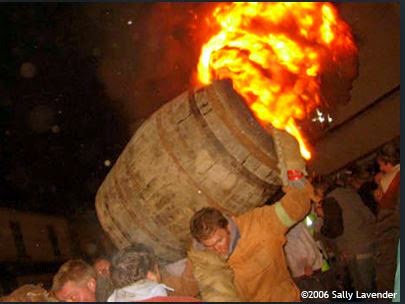
Why:
Nobody is quite sure. I tried to write a piece about the tar barrels as a journalist some years ago and hit a distinctly muddy wall with its history! The event dates from the 17th century, and has been pegged to Guy Fawkes Night - the commemoration of the date when, in 1605, Guy Fawkes was thwarted in blowing up the British House of Lords (part of Parliament) with gunpowder. (On the same night, British towns today burn an effigies of 'The Guy' on a bonfire - how's that for lasting propaganda!)
There is also a theory that the spectacle might have had roots in an old pagan custom of burning things to ward off bad spirits around Halloween, 31 October.(Halloween was a festival in its own right, long before Christianity appeared and re-appropriated it.) And even today, Halloween and November 5th tend to merge together in the UK festival calendar.
Another theory is that the event is a throw-down from using fires to warn locals of the approaching Spanish Armada (which was earlier, in 1588). Take your pick.
For Ottery today, the tar barrel event is accompanied by a large bonfire (to burn The Guy) and a fairground. As a child / teen, I used to go with my friends and family every year - mostly to have fun at the fair. And even then it became increasingly difficult to gain entry to the town, or move through the streets, competing with the number of tourists who arrived. I can only imagine it is a lot more hectic than that now. But if you're up for a bit of a crush, and a slightly crazy night, this might be worth a visit!
OK, this is not very timely, but it's from my home town in England, and it does qualify as bonkers.
What happens:
Every November 5th (aka Guy Fawkes Night) certain people of Ottery St Mary pad up in sack-cloth and run through the streets carrying giant, flaming, tar-soaked barrels on their shoulders. There are 17 barrels altogether, which are lit outside the town's pubs (where rollers spend a fair amount of time before and after their run). Barrel rolling is not a race, but a demonstration of local custom.
Ottery (as Ottery St Mary is known locally) families might compete down the generations, and traditionally it was just the men and young men who rolled. Nowadays women can do it too, and it's a very impressive, if crazy, event, attracting tens of thousands to the town for the night. (The town is tiny, btw, so this is a huge crowd!)
The barrels are soaked in tar for up to 12 months prior to the event, and filled with straw and paper before lighting. The larger ones for the men's event might weigh up to 30kg, and they become increasingly unstable as they burn. It's not necessarily a safe event for rollers or onlookers, and there have been cases of burns and serious injuries to both. As a result, I think there are 'health & safety' restrictions being applied to the festival now (not to mention high insurance costs).
Why:
Nobody is quite sure. I tried to write a piece about the tar barrels as a journalist some years ago and hit a distinctly muddy wall with its history! The event dates from the 17th century, and has been pegged to Guy Fawkes Night - the commemoration of the date when, in 1605, Guy Fawkes was thwarted in blowing up the British House of Lords (part of Parliament) with gunpowder. (On the same night, British towns today burn an effigies of 'The Guy' on a bonfire - how's that for lasting propaganda!)
There is also a theory that the spectacle might have had roots in an old pagan custom of burning things to ward off bad spirits around Halloween, 31 October.(Halloween was a festival in its own right, long before Christianity appeared and re-appropriated it.) And even today, Halloween and November 5th tend to merge together in the UK festival calendar.
Another theory is that the event is a throw-down from using fires to warn locals of the approaching Spanish Armada (which was earlier, in 1588). Take your pick.
 |
| A friend's daughter competing in the women's event. Tx to Becki for the photo! |
For Ottery today, the tar barrel event is accompanied by a large bonfire (to burn The Guy) and a fairground. As a child / teen, I used to go with my friends and family every year - mostly to have fun at the fair. And even then it became increasingly difficult to gain entry to the town, or move through the streets, competing with the number of tourists who arrived. I can only imagine it is a lot more hectic than that now. But if you're up for a bit of a crush, and a slightly crazy night, this might be worth a visit!
Monday, 23 March 2015
Sri Lanka: Does my fridge look big in this?

On one hand: it makes sense to save duty on expensive, big things. In fact, more sense than saving tax on small items like cosmetics and alcohol. On the other hand: you can't put a refrigerator in your hand-luggage. And even if you're buying it on return to Sri Lanka as a local (which is what I guess people do?) you presumably have to have a van waiting to help take it home?
Interesting. If the logistics are easy for the latter, I am now wondering why other airports don't have duty free shops selling such things - or even for larger items, duty-free cars, for example? I can imagine these cash savings would make pretty good business, but I am guessing there must be legalities which make it not worthwhile in places like Singapore or London.
Anyway, if you're visiting friends in Sri Lanka and want to take them a washing machine as a gift, here are some of the shops!
http://www.airport.lk/passenger-guide/shopping-dining.php
Sunday, 22 March 2015
Making Sri Lankan roti & coconut sambol
Yep, I have just been to Sri Lanka! (Surprisingly close to Singapore, and from my brief experience there - a really wonderful country.) Anyway, we did many fab things there, and among them was a rural village visit, with a local cooking lesson from a friendly Grandma. In fact she was both friendly, and extremely strong - as a lot of the daily cooking chores appeared to require quite high amounts of muscle-power!
 So, we were shown some basic domestic techniques such as how remove the husks and make rice flour, make rope from coconut husks.. Followed by how to make a local roti (flatbread) and coconut sambol (a kind of dipping chutney).
The Roti
Was made with millet (fluffy, three-pronged 'flowers' which required work in a heavy-duty mill to create flour). Added to the flour was water, seasoning, and coconut milk (made from a fresh coconut, and again requiring some efficient break-in work to access the nut using a scary-looking metal prong!) The dough is quite sloppy, but kneaded, spread flat between two banana leaves (which are soaked in water in advance, so that they don't combust during cooking) and put over a small toasting fire for about 5 minutes.
The Sambol
Fresh grated coconut, chilli, salt and pepper, a small reddish onion (I think that's all?) were then ground under a large rolling-pin style pestle and mortar, and served in dipping bowls to be consumed with the freshly baked roti.
The meal was delicious, actually! The cooked roti is a sort of dense pancake with a strong creamy-coconut flavour to it, which went really nicely with the spicy chutney.
Monday, 2 March 2015
Micro packed Oyako don
Another of my Christmas packet gifts from Japan - and it's taken a little guesswork as my kanji reading is not great (to decipher what it is, or how to make it!) But it seems to be a case of add-boiling-water-then put over rice. It might not look it, but it was pretty tasty! And incredibly easy (especially as I also have a rice-cooker).
'Don' 丼 is short for Donburi, and seems to mean basically 'anything over rice, in a bowl'! 親子 refers to a mix of egg, chicken and a few other ingredients. So it's a kind of flavoured scrambled egg rice topping.


'Don' 丼 is short for Donburi, and seems to mean basically 'anything over rice, in a bowl'! 親子 refers to a mix of egg, chicken and a few other ingredients. So it's a kind of flavoured scrambled egg rice topping.
Sunday, 22 February 2015
Business, Martial Arts & the Game of Thrones
As a fashionable early twenty-something I remember being perplexed when employers showed interest in people's sporting achievements. Why would somebody's hockey medal or tennis cup be of any support for a professional role? It shows people do something besides just work or study, but surely travel or an interest in the arts also fulfill this criterion? Now, nearly a decade into competitive martial arts (and with many more years in business) I can see why they were interested.
Taken seriously, sports foster some very positive mindsets. And while I think nearly all offer the below valuable lessons, to me it seems fighting (and perhaps 'adrenalin' sports) do so with more intensity. You might lose points, hopes, reputation if you suck in a badminton championship. In a combat sport, you might also lose teeth, consciousness or operational limbs. There is more at stake in a fight.
So if people fight competitively, I think it can demonstrate some desirable qualities in a potential manager / leader. For one thing, it shows that you (men and women) have balls. As in many business situations, you are never 100% prepared for a fight. You can be pretty well-trained, but you will never know what your opponent will bring, or how things will be on that particular day. So every time you step into the ring, you're knowingly taking a calculated leap of faith. I've noted that calculated leaps of faith are quite handy in business. And I think many competitive martial artists are already fairly comfortable with the concept.
Personally, I have also found that being physically fit provides me with more energy, and physical and mental resilience. These are useful life tools in or out of work.

For committed athletes, there's also commonly the desire for continual improvement and personal best. (Slightly different from 'competitive' in the old-fashioned sense of 'squashing others for the sake of it, or for personal glory'; I know these people exist in all worlds - but who could really trust a young squasher on their business team?) But if you want to become a biz leader, the drive for personal, and organisational, improvement is good. Also, of course, sports foster teamwork, and even in martial arts where fights are mostly one-on-one, you do get to train and travel with your squad and coaches, and build a feeling of family, support, trust, working together, and pleasure in your team's success as well as your own. And then there's discipline.
But one key thing that I think serious sports and business share is strategic operation.
Contrary to popular belief, fighting (in tournaments, championships) is not about 'beating the crap out of someone'. It's a game of strategy. You try to pick your fights. You study your opponent, you find their strengths and weaknesses, the things they have a tendency to fall for. And you set them up. You fake, you lure, you pace it, work with your own strengths and weaknesses. You create a situation where they are open: and then you go in for the kill. It sounds odd to suggest that this is not about 'squashing an opponent'. But it's not. It's an honest situation, and they are trying their own set of tactics on you, too. The fights where you're expressing anything personal or nasty will probably be the ones you lose. It's not a brawl, it is an intelligent game. And sometimes it doesn't matter so much if your opponent wins, as long as you have learned something, been able to execute a new move, or fulfilled whatever your goals were (hopefully also with intact dentistry). And because it is a game, it is also quite likely that you will genuinely have the utmost respect for, and maybe even be good friends with, your opponents.
Over years in business, I have noticed many of the same things apply. Those jostling for senior positions don't always do so by 'being good at their jobs', they rise by playing this game of strategy. (Or, preferably, both.) And while it can seem ruthless and unpleasant, a huge element of it is actually a game. Others vying for the same things, will probably know the unspoken rules and be fully aware of all the tactics being used on them. And they play accordingly. This is politics. And some people thoroughly enjoy this Game of Thrones in its own right.

But there are some crucial differences between a fight and the corporate Game of Thrones:
1. Not everybody in a business environment is actually aware of The Rules, or sometimes that there is even a Game of Thrones happening; so it's not always an honest or fair fight
2.OK, I've never been a CEO, but in some cases one can get on pretty well without playing this game (though I think it's always useful to be aware of it)
3. In the workplace it sometimes is personal
4. Peripheral people who don't want to play, can get caught up in it and hurt
5. If you're known as a 'player' you have to play very well; as there's a chance many will not trust you
6. And crucially: it's too exhausting! For any game of intensity there is one key rule: you cannot take your eye off it. The minute you lose focus in the ring, you get hit. There are similar risks attached to the office Game of Thrones. But in a fight tournament, you have three, 2-5 minute rounds. After which, whether you've won or lost, you can step out and get on with your life. The corporate game is a 24/7, 365 day scenario of continual focus and 'watching your back'. My view: surely life is too short?
So, for now, I am sticking to the honest game of kicking and punching people!
Photos:
1. The brilliant Ann Osman (MY, top) takes on Saber of Egypt in MMA
2. WTF taekwondo's Servet Tazegul (Tur)( in blue) v Martin Stamper (GB)
I do not hold rights to these photos, and could not find the photographers' credits online. (Thank you, whoever you are!)
Taken seriously, sports foster some very positive mindsets. And while I think nearly all offer the below valuable lessons, to me it seems fighting (and perhaps 'adrenalin' sports) do so with more intensity. You might lose points, hopes, reputation if you suck in a badminton championship. In a combat sport, you might also lose teeth, consciousness or operational limbs. There is more at stake in a fight.
So if people fight competitively, I think it can demonstrate some desirable qualities in a potential manager / leader. For one thing, it shows that you (men and women) have balls. As in many business situations, you are never 100% prepared for a fight. You can be pretty well-trained, but you will never know what your opponent will bring, or how things will be on that particular day. So every time you step into the ring, you're knowingly taking a calculated leap of faith. I've noted that calculated leaps of faith are quite handy in business. And I think many competitive martial artists are already fairly comfortable with the concept.
Personally, I have also found that being physically fit provides me with more energy, and physical and mental resilience. These are useful life tools in or out of work.
For committed athletes, there's also commonly the desire for continual improvement and personal best. (Slightly different from 'competitive' in the old-fashioned sense of 'squashing others for the sake of it, or for personal glory'; I know these people exist in all worlds - but who could really trust a young squasher on their business team?) But if you want to become a biz leader, the drive for personal, and organisational, improvement is good. Also, of course, sports foster teamwork, and even in martial arts where fights are mostly one-on-one, you do get to train and travel with your squad and coaches, and build a feeling of family, support, trust, working together, and pleasure in your team's success as well as your own. And then there's discipline.
But one key thing that I think serious sports and business share is strategic operation.
Contrary to popular belief, fighting (in tournaments, championships) is not about 'beating the crap out of someone'. It's a game of strategy. You try to pick your fights. You study your opponent, you find their strengths and weaknesses, the things they have a tendency to fall for. And you set them up. You fake, you lure, you pace it, work with your own strengths and weaknesses. You create a situation where they are open: and then you go in for the kill. It sounds odd to suggest that this is not about 'squashing an opponent'. But it's not. It's an honest situation, and they are trying their own set of tactics on you, too. The fights where you're expressing anything personal or nasty will probably be the ones you lose. It's not a brawl, it is an intelligent game. And sometimes it doesn't matter so much if your opponent wins, as long as you have learned something, been able to execute a new move, or fulfilled whatever your goals were (hopefully also with intact dentistry). And because it is a game, it is also quite likely that you will genuinely have the utmost respect for, and maybe even be good friends with, your opponents.
Over years in business, I have noticed many of the same things apply. Those jostling for senior positions don't always do so by 'being good at their jobs', they rise by playing this game of strategy. (Or, preferably, both.) And while it can seem ruthless and unpleasant, a huge element of it is actually a game. Others vying for the same things, will probably know the unspoken rules and be fully aware of all the tactics being used on them. And they play accordingly. This is politics. And some people thoroughly enjoy this Game of Thrones in its own right.
But there are some crucial differences between a fight and the corporate Game of Thrones:
1. Not everybody in a business environment is actually aware of The Rules, or sometimes that there is even a Game of Thrones happening; so it's not always an honest or fair fight
2.OK, I've never been a CEO, but in some cases one can get on pretty well without playing this game (though I think it's always useful to be aware of it)
3. In the workplace it sometimes is personal
4. Peripheral people who don't want to play, can get caught up in it and hurt
5. If you're known as a 'player' you have to play very well; as there's a chance many will not trust you
6. And crucially: it's too exhausting! For any game of intensity there is one key rule: you cannot take your eye off it. The minute you lose focus in the ring, you get hit. There are similar risks attached to the office Game of Thrones. But in a fight tournament, you have three, 2-5 minute rounds. After which, whether you've won or lost, you can step out and get on with your life. The corporate game is a 24/7, 365 day scenario of continual focus and 'watching your back'. My view: surely life is too short?
So, for now, I am sticking to the honest game of kicking and punching people!
Photos:
1. The brilliant Ann Osman (MY, top) takes on Saber of Egypt in MMA
2. WTF taekwondo's Servet Tazegul (Tur)( in blue) v Martin Stamper (GB)
I do not hold rights to these photos, and could not find the photographers' credits online. (Thank you, whoever you are!)
Subscribe to:
Posts (Atom)