Tuesday, 2 June 2015

Pseudo-ku : the curse of the 'intellectual'

I was interested to note in a recent Harvard Biz Review article, that it’s been proven that those with very high IQ, are strongly disposed to lack EQ (emotional intelligence – ie ability to be socially and emotionally aware) - and thus need different management techniques. Basically, it was telling us how to lead nerds. And to be brutally honest, there does seem to be a very high frequency of nerds in Asia. I am not sure why this is (OK I suspect it has a lot to do with developing economies, cultures with strong parental controls etc). But that strange, small species of (usually) males who we thought were peculiar, dull and one-dimensional as we cavorted and experimented aged 18 at Uni in the UK, are just ‘regular guys’ in Asia. And there’s a strong chance that the ones at Uni might have actually been from Asia too..  Low EQ is not very popular at University, or with girls – though a very high IQ might be valued in some industries later on, regardless of social skills. Hence the management advice.  

What does seem to be thankfully lacking in Asia however, (or at least in Singapore and Malaysia, where I have lived so far) is the pseudo-intellectual. People over here in Asia more commonly train in ‘useful’, traditional science subjects like engineering. And the popularity of things like art history or philosophy are just not the thing. Yet. And while science-y subjects can attract/breed nerdy, not-great-socially types, the pseudo-intellectual (or simply ‘pseud’) is another kind of social ineptitude which goes with beard-scratching* arts and humanities subjects. (I know this; I went to art school and architecture school, then spent 10 years working in contemporary art!)  

The pseud is the person – usually under 24 years old – who will ambush you at a party and bore you senseless as they launch into a diatribe about Heidegger, Kerouac, the ‘meaning behind their work’ (if they’re an artist) or try to compete with you about conceptual thought or analysis in film/philosophy/literature etc etc. Even if you’re in the middle of enjoying a shandy, and have not expressed the slightest interest in their views on Heidegger or any of the aforementioned.  The subtext from the pseud is often that they're slightly intellectually superior to you (and thus impressive and more cool) if you don’t spar, are not interested in sparring or don’t know who Heidegger is. The real subtext is that they’re immature and lacking in EQ. What might have a place in a crit** or seminar discussion in class, is not necessarily appropriate at a BBQ, or to chat up a date. And that insensitivity stands, regardless of whether you’re boring someone with physics or philosophy. (The difference with the pseud is that unlike the nerd, he/she might not also have a high IQ.) 

Artist pseuds - and this happened A LOT among the amateurs at art school - might go a stage further and actually commit ‘shocking and attention seeking acts’ in order to showcase their intellectual superiority. That ancient adage that notoriety will bring you real fame or respect. I think this is vaguely catching on with some artists in Asia now, actually! *sigh* (Incidentally, the really successful living artists are generally shrewd marketers and business people, not simple attention-seekers, although they might brand themselves that way.) 

Anyway, thankfully, once you're out of college years in the West, pseud numbers start to dwindle rapidly. And given the choice today between a nerd and a pseud, I might well opt for the nerd... or hurling myself into the BBQ pit. In the interim am very happy that the pseudo-intellectual is not yet omnipresent in Asia.


*Beard-scratching, or beard-stroking, is a mocking term referring to the actual act of scratching a (usually goatee) beard, by a pseud, while in ‘deep and meaningful’ thought. 

**A crit is part of art and architecture school training – where you stand up, present and justify your work to a panel of tutors.

Wednesday, 6 May 2015

Two Alleys

In London, and most towns in the UK, you would never walk down an alley. Day or night, really. Unless you know it very well and are possibly armed with a bazooka. Alleys are generally home to perverts, drug users, weirdos... It's not where you want to be! Singapore, however, is a bit different. And one day recently I explored two new alleys.

Alley 1
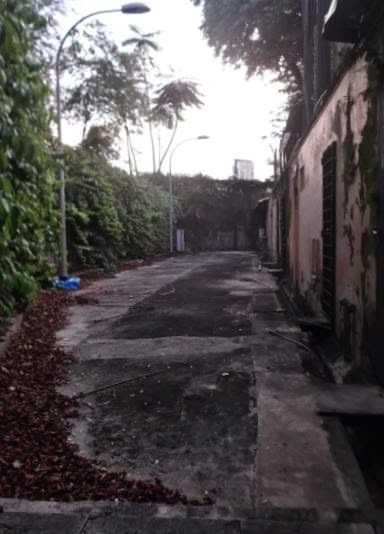
What and where: A Murakami-esque mysterious lane near my house. I pass it every day, had always wondered what was up there - or where it would lead. 
What was there: Some plants, back doors, storage spaces. It leads nowhere (ending in a small concrete yard). You couldn't fit a car up there, it's just a regular blind alley. But I find it oddly charismatic in its own way! (Click to enlarge pix)


Alley 2

What and where: some place in Kampong Glam in Singapore at about 11.30pm. Just a regular alley, no reason to have been down there before (we hadn't!) 
What was there: This. I love this! Actually it was part of a whole series of art installations in the area that night; but this one was by far my favourite. (What, I hear you cry! - a light / video installation without feedback, or 'difficult' rumblings and scrapings as soundtrack?! Yep.)


Monday, 27 April 2015

Unsatisfactory beer candies

I found these at a Japanese pub in Singapore and bought them as a fun Christmas present for a friend in the UK. I've never seen Japanese beer candies before. In the end they were too heavy to post, so I ended up eating them myself. ^^

The label says 'Sapporo' but it's not the Sapporo Beer logo - I think it just means they are beer candies from Sapporo (which is a city in Northern Japan, and has this pictured clock tower in it). 

The verdict: They taste nothing much like beer! Maybe a slight beer aftertaste? They're definitely boiled sweets, and quite pleasant. But they could be any kind of boiled sweet; it's just the label which suggests beer. 

Oh well! It was good to satisfy my curiosity with these 'biiru doroppusu' (that's what it says on the can, btw) and slightly glad I didn't spend $10 posting them to Europe! 


Thursday, 23 April 2015

And in your mall tonight..

Neat, grey-robed, Buddhist nuns en masse in The Body Shop stocking up on toiletries at Novena, Singapore. 

You don't see that often in London.

Grey robes usually mean nuns from Vietnam, China, Japan or Korea, apparently. (Other countries tend to favour reds, ochre and orange).

Tuesday, 14 April 2015

Word of the Day: tiga suku

OK, words of the day..

Language: Malay
Meaning: literally 'three quarters'. In use: (referring to a person) 'a bit crazy or simple', 'not quite all there'. In other words, there's a quarter missing somewhere. it can be used jokingly, or more directly. 

Pronunciation: teegah sookuh

Compare English phrases 'a pepperoni short of a pizza'; 'not playing with a full deck'. These phrases are slightly affectionate / joking.

^_^


Sunday, 12 April 2015

Cheryl Cole in sizzling choc knock shock!

(FYI this post is completely unrelated to Cheryl Cole) 

Chocolate in South East Asia is pants. Oh yes. Instead of that cocoa-y, creamy stuff I grew up with in Europe, the same brands here in Singapore are an unsatisfyingly waxy, flavourless affair. (Oh no!) 

There are probably some crucial reasons for this: recipes do vary worldwide - for reasons of market preference amongst other things; many regions have their own, more economical, supply chains with local production facilities; and SEA is generally a rotisserie - so transporting and vending British-style chocolate over here would be a sticky mess (remember the London uber-summer of 2003, what did KitKats look like then?) And if a recipe accommodates not-melting in transport, it's probably not-melting in your mouth too. 

Here's an example bought excitedly on an Asian trip last weekend: so-called Maltesers. Yes, Maltesers, those light, crisp, meltilicious little baubles of joy! And a different market from Singapore. How hopeful was I! And the messaging still says 'the lighter way to enjoy chocolate'. But no. These were made in Australia for Asia: cue waxy, unmelty, thick-crunchy little cannon balls. *sigh*


I've bought more upmarket brands in Singapore and it still doesn't seem to be that good (with the possible exception of some Japanese brands like Royce, which are also prohibitively expensive to keep as a habit!) The upshot of all this is that while I'd happily look forward to wolfing down a bar a day in London, I've gone off chocolate during the past three years living in Asia. Fruits here are good, and I'll happily have those instead. It's much healthier. And even when I returned to Europe recently, I no longer felt any particular desire for choc. I guess I should really thank APAC manufacturers for this!

So, if by chance happen to find yourself minted, and gagging for chocolate in Singapore - go here - https://www.royce.com/contents/english_singapore/

Monday, 6 April 2015

Bonkers British Festivals no1: The Ottery Tar Barrels

('Bonkers' = crazy, incredible)

OK, this is not very timely, but it's from my home town in England, and it does qualify as bonkers.

What happens:
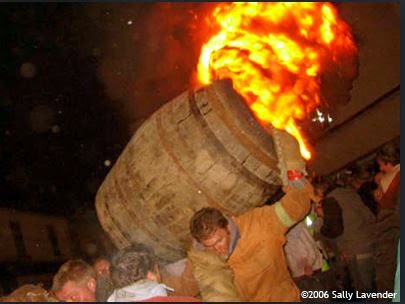
Every November 5th (aka Guy Fawkes Night) certain people of Ottery St Mary pad up in sack-cloth and run through the streets carrying giant, flaming, tar-soaked barrels on their shoulders. There are 17 barrels altogether, which are lit outside the town's pubs (where rollers spend a fair amount of time before and after their run). Barrel rolling is not a race, but a demonstration of local custom. 

Ottery (as Ottery St Mary is known locally) families might compete down the generations, and traditionally it was just the men and young men who rolled. Nowadays women can do it too, and it's a very impressive, if crazy, event, attracting tens of thousands to the town for the night. (The town is tiny, btw, so this is a huge crowd!)

The barrels are soaked in tar for up to 12 months prior to the event, and filled with straw and paper before lighting. The larger ones for the men's event might weigh up to 30kg, and they become increasingly unstable as they burn. It's not necessarily a safe event for rollers or onlookers, and there have been cases of burns and serious injuries to both. As a result, I think there are 'health & safety' restrictions being applied to the festival now (not to mention high insurance costs). 

 
Why: 
Nobody is quite sure. I tried to write a piece about the tar barrels as a journalist some years ago and hit a distinctly muddy wall with its history! The event dates from the 17th century, and has been pegged to Guy Fawkes Night - the commemoration of the date when, in 1605, Guy Fawkes was thwarted in blowing up the British House of Lords (part of Parliament) with gunpowder. (On the same night, British towns today burn an effigies of 'The Guy' on a bonfire - how's that for lasting propaganda!)

There is also a theory that the spectacle might have had roots in an old pagan custom of burning things to ward off bad spirits around Halloween, 31 October.(Halloween was a festival in its own right, long before Christianity appeared and re-appropriated it.) And even today, Halloween and November 5th tend to merge together in the UK festival calendar.

Another theory is that the event is a throw-down from using fires to warn locals of the approaching Spanish Armada (which was earlier, in 1588). Take your pick.


A friend's daughter competing in the women's event. Tx to Becki for the photo!

For Ottery today, the tar barrel event is accompanied by a large bonfire (to burn The Guy) and a fairground. As a child / teen, I used to go with my friends and family every year - mostly to have fun at the fair. And even then it became increasingly difficult to gain entry to the town, or move through the streets, competing with the number of tourists who arrived. I can only imagine it is a lot more hectic than that now. But if you're up for a bit of a crush, and a slightly crazy night, this might be worth a visit!