Sunday, 18 November 2018

After Asia: some unexpected viewpoints on the UK. Intro...

One thing about being an ('integrated'*) expat, is that you get to see your own country from a new angle. I'm not sure if this can be done without a fairly decent chunk of years overseas - and perhaps living in a very contrasting culture helps, too.

When I moved from the UK to Singapore in 2012, I found a lot of things new and peculiar. And yes, also difficult. OK, Singapore partly lives up to its reputation as 'Asia 101' for Westerners. Because most systems are in English, and many things work in a Western-logical way. But if you bother to scratch beneath this convenient surface, it's Asia. This shouldn't be a surprise, right? It looks Western / international, but the value systems underlying the place are not Western. They're Chinese (or I guess Chinese diaspora). With a few other influences - including Malay, Indian - thrown in. And a few aspects which are - as other Chinese diaspora generations in the region will testify to - just uniquely Singaporean. 

Also, working a regional job has allowed me to interact a bit with others around APAC, and view their takes on people, business, politics too.

Attitudes and assumptions - socially perhaps more than in business for me, anyway - are different from what I was used to in the UK. Some of these differences are actually very fundamental (even for a half-Asian person!) but you don't necessarily register this until a bit of time in the new place. I think this is partly because SE and E Asian cultures are relatively a little reserved about expressing opinion; so you need to take the time to stop and quietly observe and take in what others are doing / prefer doing. And also because it is very easy to just make an assumption - a fundamental understanding, even - that one's own 'right and wrong' is correct. This is not entirely a Western-arrogance thing. It exists, I suspect, for most people on this planet! We think and feel that our values are right, because we've known them all our lives, and because a majority of people around us - in our own countries, societies, cultures - think similarly.

But living overseas has highlighted this for me: our value systems might be right for us. Or they might be partially right / pretty good. But there are actually a whole bunch of really quite radically different value systems out there! And not everything in our own setups IS necessarily the right or best way.

So my viewpoints have changed over six+ years in SE Asia. There are European values which I still think are enduringly sound. But others which I really do question now - because it's such a drastically different (while also functional) story in Asia.

I guess on one level this could be viewed as a bit of a mindf***. Having one's lifelong foundations rocked about like this. And living overseas has most certainly had its alienating challenges at times! But actually I feel very grateful for this new group of perspectives.

So, I'm now back in London for a few months. And it feels rather strange! I've been enjoying it. But (or perhaps because) I feel like a tourist visiting my own city. A lot is familiar and comfortable - because I've lived in London for most of my adult life. But I'm currently still outside, looking-in, with some interest and/or bemusement! 

Coming up in this series are some things - from the small and ridiculous, to the larger and more serious - which I have noted as stand-out and different during this stay. 


The New Yorker cartoon

*An expat who doesn't remain ghetto-ised with other expats from their own nation (there are a lot of these!) but tries to make local friends, understand the operations, language and culture of the new place.


Sunday, 28 October 2018

The Apam Balik Kakigori


South East Asia is nothing if not diverse. Historically (and partly because places like Singapore and Malaysia were along key maritime trade routes) there has been a huge mishmash of interesting things - and people - melding local influences. Today, Japan and S Korea are fashionable throughout the region, and so you'll find these East Asian colours reflected in South East Asia's  clothing, make-up, food, tech, music, brands, design and more. 


And here's a typical hybrid: the Apam Balik Kakigori. Which I was treated to on my birthday this year, in Kuala Lumpur, Malaysia. 

Apam Balik is a traditional Malaysian crepe - with Indian origins. It's a folded coconut/rice pancake, containing crushed peanuts, sweetcorn, and sugar. Variations might include fragrant pandan and other ingredients. Apam (appam or aappam) is the name of this pancake in Malayalam or Tamil - as it comes from Southern India. Balik literally means 'to go or come home' in Malay; in this case referring to the folded, turnover aspect of the pancake. 

Kakigori (yes even more kakigori!) is a Japanese shaved-ice dessert, with modern versions quite trendy in hipster cafes region-wide. 

So this was a hipster version of a Japanese dessert, nodding to a traditional Malay sweet, which was already nodding to India. And (even though I am currently quite obsessed with all kakigori) it was also delicious! 


The sweet cream / topping was flavoured with pandan (with lime meringue pieces, actually!) Then there was corn-custard, and surprise sweetcorn and crushed nuts inside the fluffy ice construction.


An apam balik hawker stall in Malaysia
* Pandan is a leaf which gives flavour, fragrance and a vibrant green colour to many South East Asian dishes.


Photo of apam balik stall: HungryGoWhere

Friday, 19 October 2018

Don Don Donki

This opened recently in Singapore, and it seems caused quite a stir. Partly because it was handy, cheap and from (fashionable) Japan. And partly because there were sex-toys openly on sale. According to the media. I don't think they are on sale now.

Don Don Donki is a price-friendly Japanese supermarket. Selling mostly Japanese things (it seems from quite a wide range of products!) And, I think, like its contemporary (the wonderful, relatively sex-free) Daiso, probably set to be hugely popular across SE Asia.

As for the toy debacle, I didn't see them personally (and was overseas when the news controversy broke!) so I can't say how indiscreet they were. But apparently they were portable and for men. And tbf to Singapore, subtle Durex toys are on sale across the nation state's 7-Elevens and pharmacies; it's not hyper-prudish. So was the indecorous story deliberate PR for the Don Don Donki Singapore launch? This seems less likely in conservative Asia. But the store has been a major hit with Singaporeans either way.

I finally got to visit this month. And it was quite nice. Packed to the rafters with decent quality, affordable Japanese things (groceries, pharma etc in this branch). Of course most packaging is in Japanese, so there's an air of mystery for non-readers. But we purchased some ice-cream items which turned out to be ridiculously yummy - hoorah!

In fact this chain - named Don Kihōte (ドン・キホーテ) though apparently known as 'Donki' there - is Japan's largest grocer. It was rebranded Don Don Donki for Singapore, the phrase taken from the store's own theme song "Miracle Shopping" which was even released as a single in Japan. There are some other Donki brands under the (it seems huge) Japanese umbrella owner, the Don Quijote Group. The original chain (initially called Just Co) has been around in Japan since 1980.

Anyway, here's a video I took in the Singapore store - which we first rummaged around quite late at night, as this supermarket is open 24 hours.


Something 'mikan' (tangerine) melty, mild orange-choc segments filled with ice-cream. Lux.
Matcha (green tea) Mini Milks. Bloomin' yum.


Also on this blog:
Donkey surprise! And the UK case of the bogus burger..
And in your mall this afternoon...


Friday, 31 August 2018

Martial Art of the Month: Japan - Kenjutsu

Kenjutsu practice in Singapore
Kenjutsu means sworsdmanship. It is, needless to say, the sister of the better-known Kendo (most 'jutsu' having a 'do'*). But today they differ quite a lot.

Tbf, this one's kind of amorphous, because there are a gazillion different schools (ryu) and ways of practicing what can be termed Japanese 'swordsmanship'. Kendo and Iaido are both (modernised) members of the family. And Kenjutsu can often be attached specifically to other Japanese martial arts (many Asian martial arts will include weapons training for senior belts). So you might not see 'Kenjutsu' advertised per se. But it does exist as an art which is different from both Kendo and Iaido, if you can find it!

I actually trained with an Aikido club, which had the senior belts weapons policy. I have done no Aikido in my life! But I do have a senior belt in another martial art, and was keen on an equivalent sword art in that (not available anywhere in Singapore at the time). So they let me join. But as I progressed, it did become obvious that knowledge of Aikido practice, movements and concepts would have helped for this one!

What it is
Practice of various moves and strategies linked to martial combat with swords. This includes strikes, footwork, grip, defense, how to use energy to your advantage / against opponent. We didn't 'spar' but we did two-person techniques as well as kata and the usual martial arts training for muscle memory, accuracy and strength. We don't use real swords (katana) for Kenjutsu! Well, the most advanced practitioners might, but only for display and kata. At my school, we used 'bokken' (sometimes called 'bokuto') - a solid wooden weapon of similar shape and weight to a katana. (Quite heavy btw!) But you still need to be extremely disciplined / controlled in training. You can  badly hurt someone with a bokken, and frankly this isn't an art for meatheads. And I guess it's why senior belts are often required before you start.

Why it's fun 
I practiced Kenjutsu for a couple of years in Asia, and Kendo briefly in the UK. And for me, Kenjutsu is by far the more fascinating and applicable. Today's Kendo, like many martial arts, is a modernised, stylised sport; it might look cool with all that kit, and you do eventually spar - but there are a limited number of stylised moves you can actually perform. Kenjutsu, however, is more realistic. So moves might include regular shots to slice the head, neck, wrists, or spear the stomach. But also nifty moves probably more related to original martial practice. For example, slicing off the thumbs (warriors will have trouble holding a weapon without thumbs!), arms, having a go at the knees etc. So there's a lot more variation and combination think about.

Kenjutsu (as I've practiced it at least) is not the dynamic fun of, say, a Karate sparring bout. But the enjoyment comes from the discipline, and the sheer smartness of it. Moves are designed for maximum efficiency and can perform several functions at once. It's seriously clever! To be fair, one might develop an art with some care if one's life depended on it in ancient Japan. Today, there's simply a great satisfaction in training one's body and mind to do it.

What you need
Good control, an understanding of martial arts, plus bokken. We trained outdoors in tropical Singapore (you need a dojo with high ceilings to practice weapons!) But indoor classes would require proper martial arts clothing (gi, hakama etc, it's usually a respect thing!) I believe schools which spar understandably also require a whole bunch of protective gear, similar to that used for Kendo.

Here are some Kenjutsu practitioners demonstrating moves:


* Jutsu = skill/method/technique  Do = way/'way of being'. Ken = sword.


Tuesday, 28 August 2018

Cyberjaya

This is Malaysia's purpose-built, hi-tech town and science park. At around 30km², tech-enabled Cyberjaya is situated in Sepang, on the outskirts of Kuala Lumpur, anchoring the country's so-called Multimedia Super Corridor.  The town was launched in 1997 with the aim of establishing Malaysia as a go-to/vibrant hub for, well, technology, science, and R&D in ASEAN - and, later on, globally.  (Cyberjaya was created alongside Putrajaya* - a new hub for government.)

Tbh, this seems pretty smart to me. As time has told, tech has become a humdinger in this region (I think moreso than in the West). The agility and speed of nations in SE and E Asia is quite staggering at times; and as they develop and grow, new ideas (tech) are adopted and rolled out quickly. There isn't the cynicism of the West, nor existing alternatives or old ways. Because a lot of these countries are 'new'. So in my view, Malaysia's government (plus McKinsey) was pretty shrewd with the Cyberjaya plan.

But I remember there were lots of jokes locally in the late 90s - heard via my brother who was in KL at the time - about how Cyberjaya would never work. How it was all talk without functionality (and, it certainly seems, local buy-in). Then the place launched, and I kinda heard nothing more. I read that there was a world-class, state-of-the-art 3D movie-making facility there, and a multi-media (now outdated term?) university. But no more news.

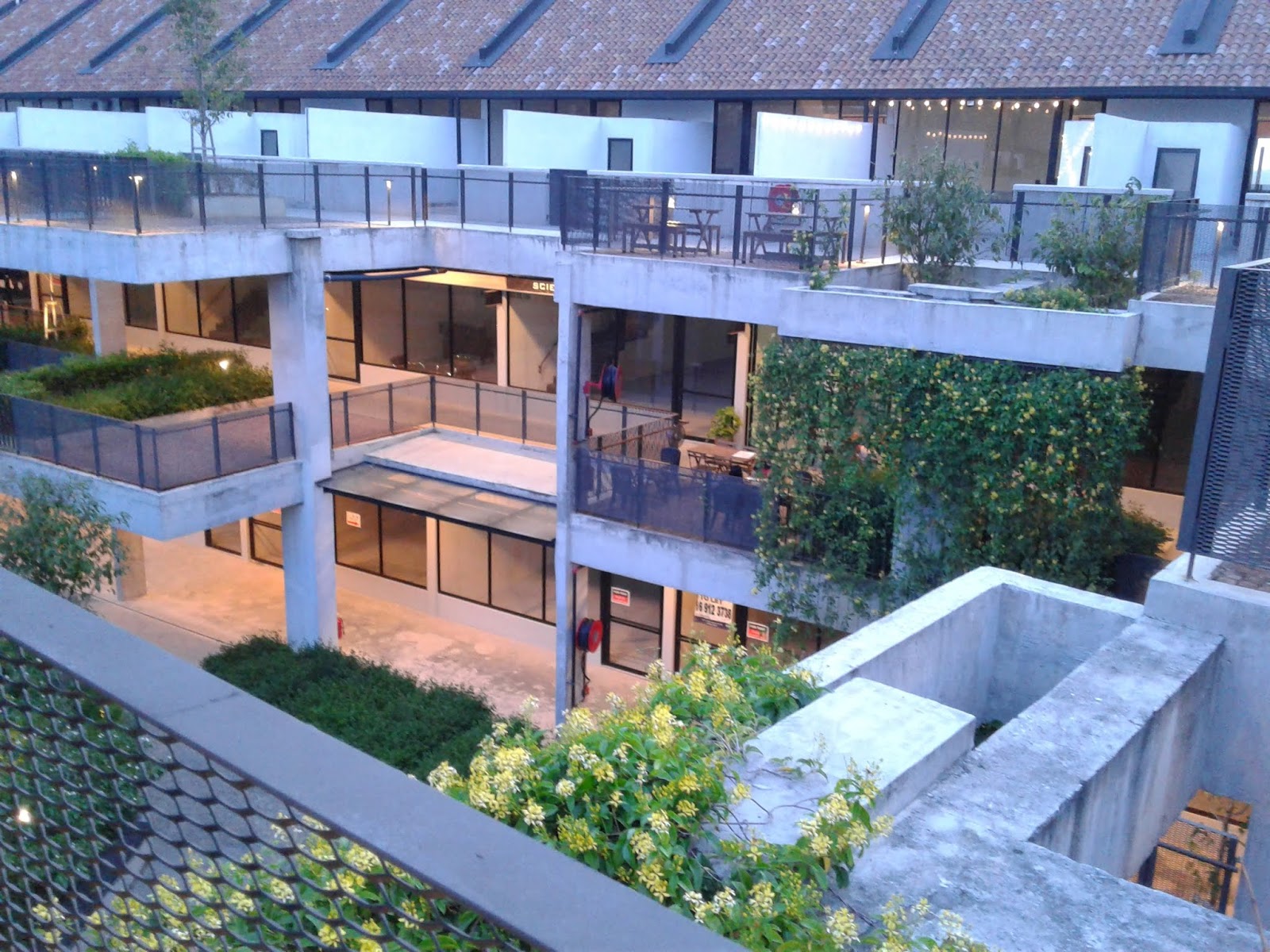
About a year ago, a business colleague from the UK had a meeting in Cyberjaya. His feedback: "A bit of a ghost town". And this week I actually joined friends (with a car) for dinner there. In fact we were visiting a new development, which my pals had worked with. And it was pretty nice! Opened only about a year ago, Tamarind Square is a complex of interestingly designed boutique office and shop spaces - I would say mainly catering for SMEs, although there's a larger retail area with a flagship (?) grocer's, 24-hour bookshop, and other stores. The entire space is bound together by gardens and walkways with creepers. There's a great new-community feel to the place, and I can imagine a smart, young crowd working and collaborating there - with hipster cafes, al fresco eateries, and yoga spaces on hand. Currently however - and OK, this place is pretty new (and not entirely complete) - it is a bit of a ghost town too.


So what happened to Cyberjaya? Well, I didn't get to explore the whole area, but from our drive to Tamarind Square, it seems a lot still is under construction. And to be fair, 1997 saw the onslaught of the Asian Financial Crisis - which was tough for many nations and saw this project being propped up by government. There are tax incentives, and almost no restrictions on foreign talent if you set up in Cyberjaya (as a foreign company?) and I've read that many big globals (IBM, Wipro, BMW etc etc) do have a presence there. And the district is apparently profitable. But it still has that ghostly air. 

Kuala Lumpur and suburbs also still suffer from inadequate public transport. And while the cleaner air of Sepang might appeal, it turns out there is currently only one train station to serve both Cyberjaya and Putrajaya. (And it's part of the KLIA Express - a non-interlinked line!) There are limited buses, too, apparently. But it took quite a drive for us to get from KL out to Cyberjaya - and from what I saw, a lot of the new district is quite sparse. Personally, even with a car, I would not be tempted to invest in a swish residential unit there, and would find it a difficult commute for work: it's too isolated, with not enough locally (yet) to make it worth a relocate. If others are thinking like me, then there is a chicken-and-egg situation going on. Retailers etc will move in when there's footfall. But people won't settle without amenities and retail.

My Malaysian friend had an additional explanation: Cyberjaya was too early. The government was smart to think about it, but the rest of the nation (public, workers, businesses) weren't switched on to tech, and didn't have today's fashionable entrepreneurial spirit back in 1997. So I guess the project lost brand momentum. And if anything needs sparky, up-to-date and forward-looking brand momentum, it's probably tech/R&D. There is also national government support for the majority ethnic group in Malaysia, which (it has been argued) discourages the survival instinct which could be applied to other visionary projects in this region - Singapore as a whole country might fall into this category! - and gets the workforce behind national growth and eventual success.

There are probably 110 other things to consider in Cyberjaya's story. But I really hope that it does become a successful R&D hub, or ASEAN Silicon Valley. Two new MRT stations are set to open in the next five years. That would be a (n overdue) great step in the right direction imo. And who knows, maybe today's creative, entrepreneurial, yoga-loving, crowd will be part of the solution, too? 


Here's some blurb: 
Cyberjaya Malaysia
Tamarind Square 


* Jaya in Malay means 'success' and is applied to countless towns, districts (even stores) across the country. I guess for good luck.


Friday, 17 August 2018

The kakigori story

Yes! At last it's kakigori time. As I've mentioned before, E/SE Asia is a fest of shaved-ice desserts. Kakigori is a refined Japanese one. Alongside options like Korean bingsu, Taiwanese snow ice,  Malaysia's (more street) ais kacang, and a myriad others in the region. This try was actually in Kuala Lumpur, so I can't 100% vouch for the pudding's authenticity. But it's probably closer to the Japanese originals than a London offer would be. 

In Japan there are all sorts of fab, swish-sounding kakigori, like fig, or camembert. I had been hoping for a chestnut one in KL. But they ran out of ingredients and offered tiramisu instead. I requested something milky, but there are fruity options too. 

What Was It Like? 
Light, fluffy shave-ice, topped with a tiramisu beret, and dusted all over with cocoa. Inside, there was more tiramisu, layers of plain ice and syrupped ice, crunchy choc bits and a few cubes of kanten (? a kind of Japanese jelly).  You do not get bored eating this dessert. Aside from the architectural challenge of avoiding collapse (of the pudding, perhaps, rather than self) there are a whole bunch of ingredients going on inside to discover! 

For anyone who hasn't tried decent bingsu etc, it's hard to describe the fluffy ice experience. I can only compare it to exceptionally refined snow, which is so light it is almost not there, and vanishes as you ingest it. There isn't a 'watery' aspect to these desserts. (Though there is with the crunchier street ice ones). 

This particular outlet's 'tiramisu' component was processed, but still pretty edible in context. Like bingsu, the final spoonfuls are sweet and milky (in this case with a berg of heavily crystallised ice, which was a bit less appealing!) 

Like most Japanese desserts, kakigori is not especially sweet. But it's deceptively filling. Looking around the cafe, it seems the way to eat this dish is to share it with a handsome young man. Though having forgotten to bring one, I scoffed this generous portion solo. And felt a bit sick afterwards. A reflection of volume/greed over dessert performance: it IS enough for two!


I visited: Kakigori at Pavilion, Bukit Bintang, Kuala Lumpur
A tiramisu shaved-ice dessert costs RM16 (USD3.90/SGD5.35)

Also on this blog:
Stupendous Chinese Desserts!
Nosh of the Day: Bingsu


Thursday, 28 June 2018

Nerd Corner: the Outrageous Sudoku Shocker

Well it seems in Japan, people rarely call or know sudoku as sudoku (数独). They know it more commonly as nanpure (nam-poo-ray) which is a portmanteau of the English 'Number Place'. Whaaat?

But yes, I was reliably informed by Japanese friends, after 'nanpure' was listed as the Japanese for sudoku in a recent textbook. 

This seemed particularly odd to me - outside Japan we all know sudoku as a Japanese puzzle, with a Japanese name. And yet that's not the case actually in Japan?? 

Pretty much. Which set me off on a bit of delving. 

There seem to be two (maybe interlinked) reasons for this mysterious reversal. 

1. The puzzle is not necessarily, entirely, Japanese. There have been a whole bunch of similar number puzzles historically, and worldwide. And in the 20th century the (relatively obscure?) American puzzle, Number Place, made its way to Japan. It was popular, got modified, named sudoku, and later on, re-exported to the West ...where it was a huge hit and generally known as 'Japanese'. But in Japan - unlike the West - the original Number Place moniker still had resonance.

2. This one is anecdotal from another Japanese friend, but makes pretty good sense: the term 'sudoku' was actually copyrighted, in Japan, by a certain Japanese publisher. As a result, other publications could use the same puzzle concept, but they had to call it something else. And nanpure seems to have been the most ready option. Overseas, however, where there was no breach of copyright, all puzzles were presented as 'sudoku'.

Anyway, hope that's provided a little Thursday interest. Time for coffee (with no puzzles) for me. 


- Sudoku itself is a Japanese portmanteau for 数字は独身に限る (suuji wa dokushin ni kagiru) roughly 'keep the digits single'. As you might have guessed, portmanteau words from many languages are popular in Japanese! 

- Nanpure ナンプレ is written in a different script, katakana - reserved for borrowed foreign words.