OK, we all know the classic British English / US English clangers: Pants UK = elasticated underwear Pants US = trousers Rubber UK = eraser you have in your pencil-case at school Rubber US = condom Pissed UK = drunk Pissed US = angry (in UK we say 'pissed off' for this) But there's more. I have a friend from Chicago and we recently went out here in Singapore. No Chinese dialects to contend with, second language grapplings that me and my Asian friends have.. and yet we had conversations like this:
She: I went to IKEA and I bought this comforter.. Me: What's a comforter? She: You know, like a padded blanket thing you have for the bed Me: Oh, you mean a duvet ! She: What's a duvet? Also (in Chicago at least) you can go tailgating as a student. In the UK this means you're possibly creeping along, illegally following someone's car. To my friend it meant taking vehicles, crates of beer and getting drunk in the car-park before watching a big football / baseball game. And I also discovered that Americans have biscuits. We all know that they call real biscuits 'cookies'. But biscuits exist too.. and they're not 'biscuits' but basically crumbly, savoury scones, which you have with gravy! I joined her and her friends at a US restaurant, and I tried one. Here it is! (Underneath the bacon)
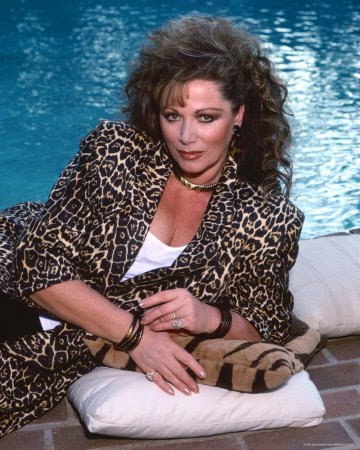
About 10 years ago I made a humorous pact with a friend that if either of us hit 55 and started wearing leopard-print clothing (along with mini skirts etc) we would be roughly admonished by the other. We're thankfully neither of us near this point yet, but the reason we made the pact is as follows: In the West, for some strange reason (and I suspect heavily rooted in 1960s or 70s fashion) some women of a certain age wear animal-print designs to look sexy. But it in fact the look has been for some decades, anything but sexy, and instead distinctly cheesy!* Animal print clothing might also be accompanied by a lot of make-up, dyed hair, a heavy fake tan, and a lot of gold jewellery. Another aspect that might chaperone this look is the fact that it won't change - it might start at a sexy 55 but continue on well into a lady's senior years. The look was very popular in the 1980s, even among Hollywood types. A major protagonist was (is) UK/US racy fiction writer Jackie Collins (pictured below left).
So I was slightly amused when I was introduced to the concept of the Japanese Osaka obachan (literally 'auntie from Osaka'). Osaka is famous for having an outgoing, humorous, 'louder' population in Japan. And the Osaka obachan is a type: an older woman who might be quite loud and is characterised by a wardrobe of animal-prints, with dyed hair, a lot of make-up and gold jewellery! I have no idea if the Osaka obachan style is derived from the Hollywood celebs of the 70s and 80s, or if she has grown up independently. Are women of a certain age - globally - naturally attracted to animal-print clothing?? A mystery that perhaps could make an entire PhD topic of investigation. Meanwhile, here is a video from Japanese theatrical concept group 'Obachan' with the Obachan Theme!
*Cheesy is non-rude British slang meaning without sophistication, cheap, dated, and perhaps slightly amusing as a result.
Today in Singapore I was given this. It shows that Coke is smartly localising its personalised cans. But also it got me wondering what 'ah' means before a noun in SG. Another one I've seen said 'ah kong'. And there is a popular local movie here called 'Ah Boys to Men'. What is 'ah'? A local friend informed me it has no real meaning, but signifies an affectionate way of referring to the person. (FYI in Singapore you will commonly find local dialects mixed together, with Malay, with English, anything goes really!) Ah kong means grandpa. And this 'ah' is mainly from the Chinese Hokkien dialect (though it seems there are Cantonese and other 'ahs' as well!) Funnily enough, in Northern England we also use 'our' to refer affectionately to family members and close friends, usually preceding actual names - our Sarah, our Gary etc. (ie 'belonging to us'.)
In Singapore, I've also heard the Hokkien terms 'ah beng' and 'ah lian' which refer to gangsterish, badly dressed young males and females respectively. I can only guess these are also seen affectionately?
Actually not Sulawesi, but the delicacy from a microscopic island just off it. I don't even know what this is called, but they were offered to us by our boat Captain, and were quite yummy! The actual sweet is mainly sliced almonds (I think) bound with a kind of molasses. Not sweet enough to be Gula Melaka* - but perhaps a relative of it? Each piece was wrapped in a leaf. No coconut in this one, which is unusual in sweets from this part of the world - but actually made quite a refreshing change!
*Gula Melaka is the Malay name for a kind of dark, sticky palm sugar used a lot in South East Asia. You buy it in rock-hard pellets, which look a bit like patties of boot polish. Then you usually grate or melt it for cooking. It has a different name in Indonesia. I think in India and Sri Lanka it is called Jaggery.
Yep, it's summer time back home. Which is the time I feel most homesick - as it's the time when England is truly joyous and beautiful. And it reminds me of childhood, when we lived in a rural country cottage, with an acre-big garden full of trees, flowers and shrubs. And hydrangeas were - and still are - one of my favourite summer plants. Hyrdrangea flowers actually change colour depending on the acidity of the soil. A strongly acid soil produces blue flowers, an alkaline one, pink. With various shades (even on one plant) of mauve in between. There are also 'lacecap' styles - frilly, flat bursts of flowers; and the traditional ones which give you large 'puffs' of blooms. The ones we had at home were in both styles and mostly blue/purple. But what I love about them the most is their cool lusciousness. Getting amongst a big, healthy, dark-leaved hydrangea shrub is like hanging with a huge, fragrant, cooling, salad-y thing. They were one of my favourite spots in the garden in hot summers! These plants require a lot of water, which is possibly why they can be so generous with their green calmness in the heat; it also explains their name. In fact (perhaps ironically) hydrangeas originate from Asia, chiefly North East Asia - but apparently with some varieties found in Indonesia (I've never seen any). But the ones I remember are the temperate shrubs over an English summer :)
Woop, woop, this blog has just passed the 10,000 views barrier!! I know this is what Vin Diesel's Facebook page gets in three minutes. But Diesel has much heavier publicity than I do. (And, in fact, is probably much heavier in general.) I've never promoted this page, purposely. So thanks all for coming to browse curiously and read! :) *Vin Diesel's FB page was recently awarded the most liked and viewed in the world.
Competing with the grey-robed nuns buying toiletries in The Body Shop, a posse of red-robed monks casing the crockery section in Daiso? Clearly, Singapore is truly a 'shopping paradise for all'! (Though good choice re Daiso in my opinion; everyone needs 'Hello Tomato' plates.)
PS We don't have Daiso in Europe. And I'm not sure what I will do without it when I go back! (Apart from lobby to have it open branches there). Daiso is basically a pound / dollar store, but from Japan, and REALLY NICE QUALITY AND DESIGN. With lots of weird (and yet useful) inventions we don't have outside Japan too. Half of my home in SG has come from Daiso and long may this be the case!